number (see section 4.7 for details on the serial number). For the calibration, Sensirion uses transfer standards, which are subject to a scheduled calibration procedure. The calibration of the reference, used for the calibration of the transfer standards, is NIST traceable through an ISO/IEC 17025
number (see section 4.7 for details on the serial number). For the calibration, Sensirion uses transfer standards, which are subject to a scheduled calibration procedure. The calibration of the reference, used for the calibration of the transfer standards, is NIST traceable through an ISO/IEC 17025
access of the operating system the card must be selected. Customized commands are issued using the transfer command. ACG Identification Technologies GmbH 14 HF Mifare Easy Module V1.0 5.6 Mifare DESFire This tag supports additional security algorithms (DES, Triple-DES, MAC) for security sensitive applications
ideal for an emerging set of use cases which call for very high bandwidth for video and other data-transfer applications, and which require a small board footprint – examples include consumer tablets, augmented/virtual reality headsets, and car infotainment systems. The high SerDes bandwidth offered
for an emerging set of use cases >which call for very high bandwidth for video and other data-transfer Die 12.5Gps klingen schon mal nicht schlecht - die Frage ist, was der kostet- Mit einem AUS geht das ja ja auch "bequem".
· Lead Free Finish, RoHS Compliant (Note 3) C D Mechanical Data · Case: DO-201 · Case Material: Transfer Molded Epoxy. UL Flammability DO-201 Classification Rating 94V-0 Dim Min Max · Moisture Sensitivity: Level 1 per J-STD-020C A 25.40 — · Terminals: Finish - Bright Tin. Leads: Axial, Solderable B 8.50
vollkommen gereicht, den hat man in der Regel ja sowieso, und ist in dem 1. Gerät mit drin. ThermoTransfer-Technik, also wenn ich sowas lese wird mir komisch, Technik aus dem letzten Jahrtausend? Laserdrucker sind aktuell unschlagbar oder schon immer, v.a. die in ws/ws. Was macht der TO eigentlich so
Current T=25 Co 100 nA j R Gint Internal Gate Resistance 0 Ω C ies Input Capacitance 3.35 nF Reverse Transfer V CE5V,f=100kHz, C res V GEV 0.08 nF Capacitance Q G Gate Charge V GE15…+15V 0.22 uC t Turn-On Delay Time 34 ns d(on) tr Rise Time 70 ns td(off) Turn-Off Delay Time 108 ns t Fall Time V CC00V,I =3CA
code] 375.2572592976723 ----------------------- 1.0s + 0.63822946917954 Continuous-time transfer function model [/code] Wie gesagt. Der dynamische Strom wäre interessant. Die Fehler in der Drehzahlmessung kann man korrigieren, besser wäre es das EMV Problem im Aufbau zu beseitigen (Schirmung
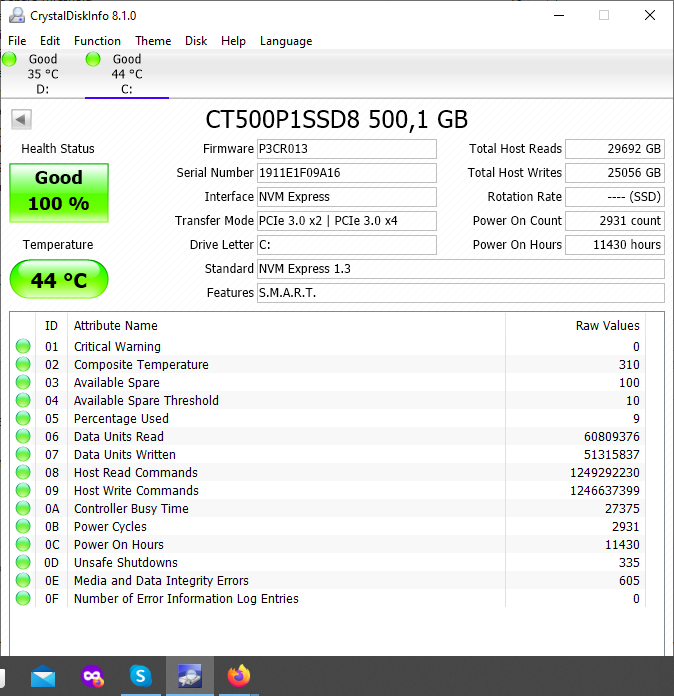
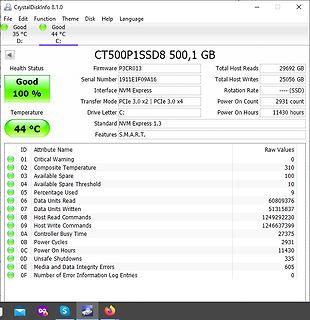
D:
Good 44 °C C:
CT500P1SSD8 500,1 GB
Health Status 100%
Firmware P3CR013
Interface NVM Express
Transfer Mode PCIe 3.0 x2 | PCIe 3.0 x4
Drive Letter C:
Standard NVM Express 1.3
Features S.M.A.R.T.
Total Host Reads 29692 GB
Total Host Writes 25056 GB
Rotation Rate ---- (SSD)
Power On Count 2931 count
. At the compressor suction connector the temperature must be approx. ambient temperature. Thus transfer of moisture to the refrigerator insulation is avoided. Systems with an expansion valve must be charged with refrigerant until there are no bubbles in the sight glass, which should be placed as close
to receive a new frame. The master can re-synchronize at any time, even in the middle of a byte transfer. Note: Any time shorter that t5 leads to an undefined frame state, because the Slave may or may not have seen /SS inactive. Piher Sensors & Controls SA Tel: +34 948 820 450 Polίgono Industrial Municipal
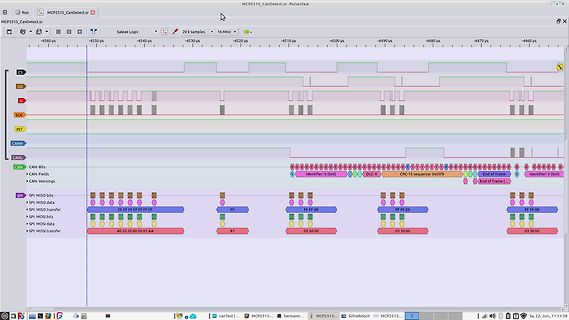
Servus allerseits! Beim STM32U575 lese ich Daten via SPI wie folgt: [c] LL_SPI_SetTransferSize(SPI3, cnt); LL_SPI_EnableIT_TXP(SPI3); LL_SPI_EnableIT_RXP(SPI3); LL_SPI_Enable(SPI3); LL_SPI_StartMasterTransfer(SPI3); this->WaitAndCheckEndOfTransfer(); LL_SPI_Disable(SPI3); [/c] Mit
Serial Data Output (SO) These pins are used as the connections for an external This pin is used to transfer data out of the MCP795XX. 32.768 kHz quartz crystal and load capacitors. X1 is During a read cycle, data are shifted out on this pin the crystal oscillator input and X2 is the output. The after the
dann die Priorität von PN von 1 auf 2 erhöht. Hat leider nichts gebracht. Habe dann PN SPI Transfer von DMA auf Normal umgestellt: Funktioniert. Irgendwelche Hinweise, was dazu führen könnte, dass der DMA sporadisch abbricht ?
the PCI-bus, peripherals operate at the native speed of the computer system, thus enabling data transfer between peripherals and the system at maximum speed. This performance is critical for bandwidth-constrained devices such as video, multimedia, mass storage and networking adapters. PCI-bus standard
Turn on time* Ton IF=5mA Maximum 5ms 4ms 2.0ms I=Max. Typical 0.1ms 0.05ms 0.08ms 0.04ms IF=5mA Transfer Turn off time* Maximum Toff 1.0ms I=Max. character- istics Typical 0.8pF f =1MHz I/O capacitance Ciso Maximum 1.5pF V B=0V Initial I/O isolation Minimum Riso 1,000MΩ 500V DC resistance Note: Recommendable
network standard for protocol reasons. In Ethernet, the medium has to be "silent" (i.e., no data transfer) for a short period of time before a node can consider the net- work idle and start to transmit. IPG is used to correct timing differences between a transmitter and receiver. During the IPG, no data
; Data byte to be written. ldi tmp3, 1 sts updiUartDataCount_ram, tmp3 ; Transfer block size. rcall updi_tx [/avrasm] Sie kennen Reinhard Meys 'Annabelle'? PS: > Dennoch bekomme ich am Ende NVMCTRL_STATUS == 0x10 Ja, genau: 'INVALIDCMD The selected command is not
the SFP transceiver. The serial data signal (SDA, Mod Def 2) is bi-directional for serial data transfer. The host uses SDA in conjunction with SCL to mark the start and end of serial protocol activation. The memories are organized as a series of 8-bit data words that can be addressed individually or
wenige minuten. Das Bottleneck ist eigentlich immer das 1gbit LAN. Bis auf den eigentlichen Transfer sehe ich keinen Unterschied zwischen lokalem und remote zugriff über Handy und von (wireguard). Bei rsync muss Datei für Datei verglichen werden. Das sehr ich als mögliche schwachstelle. Git hat
beeindruckender aus. https://www.analog.com/en/resources/journalandarticles/technical-articles/model-transfer-functions-by-applying-the-laplace-transform-in-ltspice.html
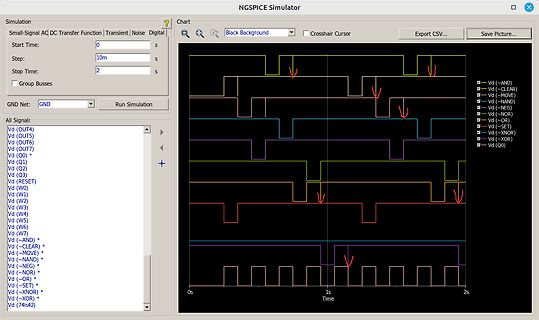
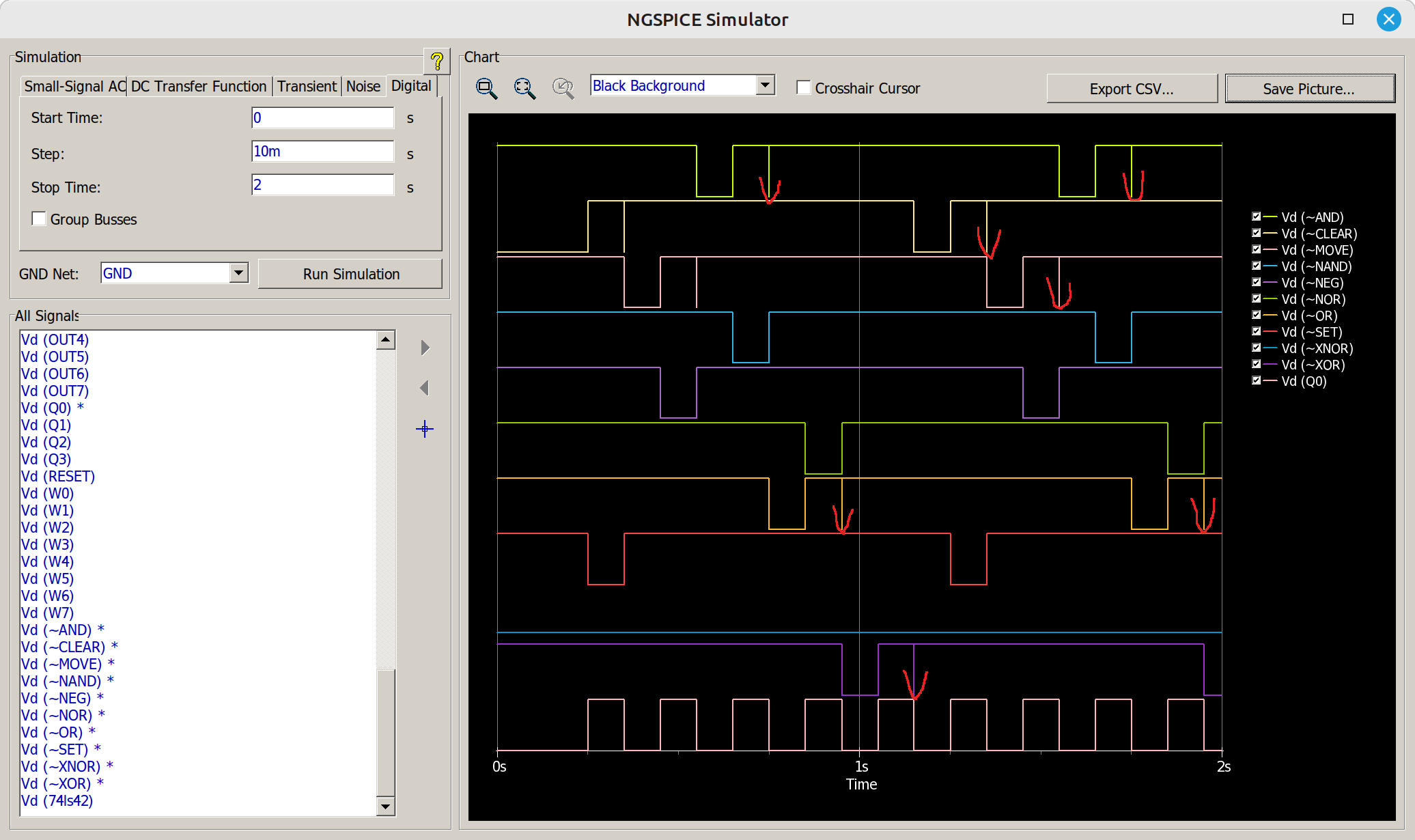
NGSPICE Simulator
Simulation
Small-Signal AC
DC Transfer Function
Transient
Noise
Digital
Start Time:
0
s
Step:
10m
s
Stop Time:
2
s
Group Busses
Run Simulation
Chart
Black Background
Crosshair Cursor
Export CSV...
Save Picture...
All Signals:
GND Net:
START, MCU should send 7-bit slave address (7’b0111000) first, and then the 8 bit denotes a read transfer when it’s high; or a write transfer when it’s low. MCU write: S 8’h70 0 8’h01 0 Byte[1] 0 Byte[2] 1 P MCU read: S 8’h70 0 8’h00 1 S 8’h71 0 Byte[0] 0 Byte[1] 0 Byte[2] 0 Byte[3] 1 P From CM6206 to
416MHz (104MHz x 4) for Quad I/O when using the Fast Read Dual/Quad I/O and QPI instructions. These transfer rates can outperform standard Asynchronous 8 and 16-bit Parallel Flash memories. The Continuous Read Mode allows for efficient memory access with as few as 8-clocks of instruction-overhead to read
Application 6), and the input impedance and resistance of the customer interface circuit, R . The transfer function of this from the FILTER pin to ground. The buffer amplifier inside of INTFC resistive divider is given by: theACS712 (located after the internal resistor and FILTER pin R connection) eliminates
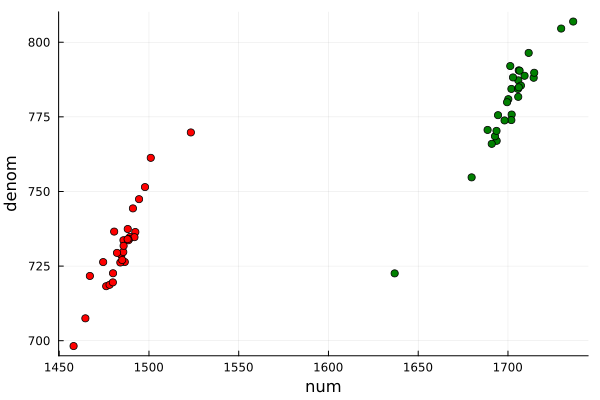
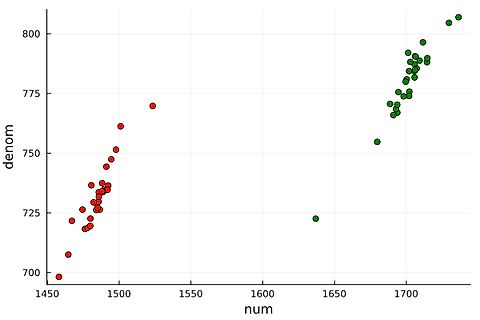
------- 1.0z - 0.9631654059920672 Sample Time: 4.8754326946516506e-5 (seconds) Discrete-time transfer function model ************* 1523.3354692237676 ------------------------ 1.0s + 769.7803072873033 Continuous-time transfer function model ************* [/code] Die Näherungen mit PT1
Übereinstimmung. Bilder=> trans29.png.zip Wirklich: Es gibt einen Unterschied +/- (rot/grün) Bild: transferFunctions29.png, Die Endwerte +/- unterscheidet sich um etwa 10% [code] ┌────┬─────────┬────────┬────────────┐ │ i │ num[1] │ den[1] │ G(s) T=inf │ ├────┼─────────┼────────┼────────────┤ │
#7670807: > ... sind die paar > Bytes schon längst unkomprimiert übertragen. Zumal man mit DMA Transfer die Prozessorlast noch verringern kann und damit der Controller während des Block-Transfers schon einen neuen Datensatz vorbereiten kann. Der englisch-sprachige Programmierer nennt diese Art der
wuerde es allerdings so sehen: die V*-Sprachen braucht man allenfalls noch zum Interfacing und Transfer nach Sim/Syn. Analog zum bare-metal 'OS', wo man nach wie vor eine crt0.s in Assembler stricken muss, aber nicht mehr der volle Befehlssatz gelernt werden muss. So sollte es auch sein, damit man
must leave the data line HIGH to enable the master to generate the STOP condition. Figure 6. Data Transfer on I C Serial Bus Depending upon the state of the R/W bit, two types of data transfer are possible: 1) Data transfer from a master transmitter to a slave receiver. The first byte transmitted by the
:666:38: warning: use of 'auto' in parameter declaration only available with -fconcepts uint8_t transferTokenToCommand (const auto &token, auto &cmd) ^~~~ C:\Arduino IDE Portable\AVRxDB\arduino-1.8.19\portable\sketchbook\AVR128DB64_5500-0086-V1_Board\Modellbahn_TestEncoderInterfacePCF8575_PCA9685_FRAM
eher das Problem, oder das Dateisystem bzw die Parametrierung dazu. HAL macht herzlich wenig beim Transfer mit DMA, das sind wenige Registerzugriffe um den DMA zu starten.
nicht auf's Netz synchronisiert. Wenn man damit leben kann, könnte er auf der Solar-Seite vom Transfer-Switch auch L1-3 brücken. Dann ist alles auf der Insel, der Strom dreht nicht mehr, und er überlastet evtl. den N-Leiter zum Herd, wenn Backofen und alle Platten gleichzeitig an sind.
one clock line (SCL). Both lines are connected to a positive supply via pull-up resistors. Data transfer is initiated only when the interface is not busy. 6.1. BIT TRANSFER One data bit is transferred during each clock pulse. The data on the SDA line remains stable during the HIGH period of the clock
18. SPI – Serial Peripheral Interface 18.1 Features • Full-duplex, three-wire synchronous data transfer • Master or Slave operation • LSB first or MSB first data transfer • Seven programmable bit rates • End of Transmission Interrupt flag • Write Collision flag protection • Wake-up from Idle mode •
dazwischen? Du hast also einen Transfer-Initiator und einen Transfer-Empfänger. Wenn Du beide Softwareinstanzen auf unterschiedlichen Hosts startest, funktioniert der Transfer. Auch wenn der Initiator in einen Docker-Container geschoben
weitere Instanz > dazwischen? Das Python-Programm ersetzt das Ziel. > Du hast also einen Transfer-Initiator und einen Transfer-Empfänger. Wenn > Du beide Softwareinstanzen auf unterschiedlichen Hosts startest, > funktioniert der Transfer. Auch wenn der Initiator in einen > Docker-Container
extended and inter of the number of inputs parallel together. mediate temperature ranges. • Square transfer voltage characteristics. HCC/HCF 40008 Series Features The principal features of the HCC/HCF 40008 series are as follows: General COS/MOS Characteristics • Operating range of HCC 3-18V; HCF 3-15V
PC as the host. That two For real-time data transfer it is possible to guarantee the step transfer involves connecting the camera to the PC availability of one or more channels to guarantee a certain data rate. This is important for video because (one
receiver can optionally be enabled to serve as the serial input. The XCK pin will be used as the transfer clock. As for the USART, a data transfer is initiated by writing to the DATA Register. This is the case for both sending and receiving data, since the transmitter controls the transfer clock. The
Changing the I bit through the I/O register results in a one-cycle Wait state on the access. Bit 6 – T Transfer Bit The bit copy instructions, Bit Load (BLD) and Bit Store (BST), use the T bit as source or destination for the operated bit. Bit 5 – H Half Carry Flag This flag is set when there is a half carry
das nützen? Ich bräuchte etwas dass mir das Ende des Ringbuffers meldet. Ein (MBTC) Memory Buffer Transfer Complete Flag.
nützen? Ich bräuchte etwas dass mir das Ende des > Ringbuffers meldet. Ein (MBTC) Memory Buffer Transfer Complete Flag. Nun ja, das HTIF bzw. TCIF lösen einen Interrupt nach Hälfte bzw. nach vollständigem Transfer aus ... Die Callbacks reagieren genau darauf. Die beiden Interrupts kann man natürlich
Ursachenforschung ist das also nur Stochern im Nebel ... Wenn die Ursache klar ist, sollte man ggf. auch an Transfer per DMA denken. Das *KANN* für etwas Entspannung sorgen (falls es um größere Datenpakete geht).

 Bild
Bild
 Bild
Bild
 Bild
Bild
 Bild
Bild