-
Datei
sketch_Jan07_TIMER2_OVF.ino
Adafruit_GFX.h> //Adafruit GFX https://github.com/adafruit/Adafruit-GFX-Library #include <Adafruit_SSD1306.h> //Adafruit SSD1306 https://github.com/adafruit/Adafruit_SSD1306 #include <EEPROM.h> // //------------User preferences---------------------------------------------------------------- #define ZF
in „USB to TTL mit CH340“ · Mikrocontroller und Digitale Elektronik ·
-
Datei
ssd1306_128x64_i2cAdafruit_Display.ino
*****************/ #include <SPI.h> #include <Wire.h> #include <Adafruit_GFX.h> #include <Adafruit_SSD1306.h> #define OLED_RESET 4 Adafruit_SSD1306 display(OLED_RESET); #define NUMFLAKES 10 #define XPOS 0 #define YPOS 1 #define DELTAY 2 #define LOGO16_GLCD_HEIGHT 16 #define LOGO16_GLCD_WIDTH 16 static
in „Arduino / OLED lässt sich nicht einbinden“ · Mikrocontroller und Digitale Elektronik ·
-
Datei
solar_light_tracker_8_.ino
communication library. #include <Adafruit_GFX.h> // Core graphics library for screen. #include <Adafruit_SSD1306.h> // SSD1306 oled driver library for monochrome 128x64 display. #define SCREEN_WIDTH 128 // 128 pixels width screen. #define SCREEN_HEIGHT 64 // 64 pixels height screen. Adafruit_SSD1306 display
in „Code Solartracker“ · Mikrocontroller und Digitale Elektronik ·
-
Datei
code_P1.ino
================*/ #include "Adafruit_SHT31.h" //temperatur and humidity sensor #include "Adafruit_SSD1306.h" //OLED /* ========================================================================================================================================== Global variable ==========================
in „Arduino selfmade Internal Clock 8MHz I2C probleme“ · Mikrocontroller und Digitale Elektronik ·
-
Datei
ESP32_WebServer_FileServer_mit-Display_-_Kopie.ino
file #include <SD.h> #include <SPI.h> #include <Wire.h> #include <Adafruit_GFX.h> #include <Adafruit_SSD1306.h> #define SCREEN_WIDTH 128 // OLED display width, in pixels #define SCREEN_HEIGHT 32 // OLED display height, in pixels #define OLED_RESET -1 // Reset pin # (or -1 if sharing Arduino reset pin)
in „Problem mit Webserver/Fileserver Projekt ESP32 - mit Ardurino“ · Mikrocontroller und Digitale Elektronik ·
-
Datei
Waschzeit_3R_LOW_OLED_10-02.ino
include <TimerOne.h> #include <SPI.h> #include <Wire.h> #include <Adafruit_GFX.h> #include <Adafruit_SSD1306.h> #define startPin 2 // #define stopPin 3 // #define taktPin 9 // #define relay1Pin 10 // #define relay2Pin 11 // #define relay3Pin 12 // #define potiPin A3 // #define DISPLAY_I2C_ADDRESS 0x3C
in „Arduino Timer für Campingwaschmaschine“ · Mikrocontroller und Digitale Elektronik ·
-
Datei
cheap_eyes.ino
via I2C using Wire include #include <Wire.h> // Only needed for Arduino 1.6.5 and earlier #include "SSD1306Wire.h" // legacy include: `#include "SSD1306.h"` #include "images.h" // Initialize the OLED display using Wire library // Change Display Pins here. SSD1306Wire display2(0x3c, D2, D1); SSD1306Wire
-
PDF
Code_Beschreibung_Solartracker.pdf
des Reset-Pins, wenn er vorhanden ist. #define SCREEN_WIDTH 128 #define SCREEN_HEIGHT 64 Adafruit_SSD1306 display(SCREEN_WIDTH, SCREEN_HEIGHT, &Wire, -1); Wir deklarieren vier Variablen, um anzugeben, welcher LDR-Widerstand mit welchem Port des Mikrocontrollers verbunden ist. Außerdem deklarieren wir
in „Code Solartracker“ · Mikrocontroller und Digitale Elektronik ·
-
Datei
u8g_com_arm_stm32.h
/** \author Wojciech Domski */ #ifndef U8G_COM_ARM_STM32_SSD_I2C_HEADER #define U8G_COM_ARM_STM32_SSD_I2C_HEADER #include "u8g.h" #include "hw_config.h" #define SSD1306_I2C_ADDRESS 0x78 uint8_t ssd1306_i2c_init(I2C_HandleTypeDef *hi2c); uint8_t u8g_com_arm_stm32_ssd_i2c_fn(u8g_t *u8g, uint8_t msg, uint8_t arg_val, void *arg_ptr); #endif
in „STM32 F103 - I2C Probleme“ · Mikrocontroller und Digitale Elektronik ·
-
Datei
sketch_jan18b.ino
#include "SSD1306Ascii.h" #include "SSD1306AsciiAvrI2c.h" template<typename DatenType> class GleitenderMittelwert // eher Tiefpassfilter { private: const double factor; double mittelwert; public: GleitenderMittelwert
in „Arduino-Programm für Tankanzeige. Tankfüllstandsmessung.“ · Mikrocontroller und Digitale Elektronik ·
-
Datei
solar_light_tracker_Armin3.ino
communication library. #include <Adafruit_GFX.h> // Core graphics library for screen. #include <Adafruit_SSD1306.h> // SSD1306 oled driver library for monochrome 128x64 display. #define SCREEN_WIDTH 128 // 128 pixels width screen. #define SCREEN_HEIGHT 64 // 64 pixels height screen. Adafruit_SSD1306 display
in „Compilation error: exit status 1“ · Mikrocontroller und Digitale Elektronik ·
-
Datei
solar_light_tracker_Armin3.ino
communication library. #include <Adafruit_GFX.h> // Core graphics library for screen. #include <Adafruit_SSD1306.h> // SSD1306 oled driver library for monochrome 128x64 display. #define SCREEN_WIDTH 128 // 128 pixels width screen. #define SCREEN_HEIGHT 64 // 64 pixels height screen. Adafruit_SSD1306 display
in „Solartracker mit Anemometer und Windalarm“ · Mikrocontroller und Digitale Elektronik ·
-
Datei
OLED_i2C_Test.ino
5V VCC GND GND */ #include <SPI.h> #include <Wire.h> #include <Adafruit_GFX.h> #include <Adafruit_SSD1306.h> #define OLED_RESET 4 // not used / nicht genutzt bei diesem Display Adafruit_SSD1306 display(OLED_RESET); void setup() { // initialize with the I2C addr 0x3C / mit I2C-Adresse 0x3c initialisieren display.begin(SSD1306_SWITCHCAPVCC, 0x3C); // random start seed / zufälligen Startwert für Random-Funtionen initialisieren randomSeed(analogRead(0)); } // #define DRAW_DELAY 118 #define DRAW_DELAY 12 #define D_NUM 47
in „OLed Farbdisplay 128x64 mit 6 Pins“ · Mikrocontroller und Digitale Elektronik ·
-
Datei
fehler.txt
library dependencies for file: C:\Users\Judith\Documents\Arduino\libraries\U8glib\src\clib\u8g_dev_ssd1306_128x32.c Using cached library dependencies for file: C:\Users\Judith\Documents\Arduino\libraries\U8glib\src\clib\u8g_dev_ssd1306_128x64.c Using cached library dependencies for file: C:\Users\Judith
in „Marlin auf anet e12“ · Mikrocontroller und Digitale Elektronik ·
-
Datei
solar_light_tracker_07_11_24.ino
communication library. #include <Adafruit_GFX.h> // Core graphics library for screen. #include <Adafruit_SSD1306.h> // SSD1306 oled driver library for monochrome 128x64 display. // #define SCREEN_WIDTH 128 // 128 pixels width screen. // #define SCREEN_HEIGHT 64 // 64 pixels height screen. // Adafruit_SSD1306
in „Code Solartracker“ · Mikrocontroller und Digitale Elektronik ·
-
Datei
config_328.h
I2C_SDA PD0 /* port pin used for SDA */ #define I2C_SCL PD1 /* port pin used for SCL */ #endif /* * SSD1306 * - 4 wire SPI interface using bit-bang SPI */ #if 0 #define LCD_SSD1306 /* display controller SSD1306 */ #define LCD_GRAPHIC /* graphic display */ #define LCD_SPI /* SPI interface */ /* control
in „ComponentTester-1.42m problem“ · Mikrocontroller und Digitale Elektronik ·
-
Datei
config_328.h
I2C_SDA PD0 /* port pin used for SDA */ #define I2C_SCL PD1 /* port pin used for SCL */ #endif /* * SSD1306 * - 4 wire SPI interface using bit-bang SPI */ #if 0 #define LCD_SSD1306 /* display controller SSD1306 */ #define LCD_GRAPHIC /* graphic display */ #define LCD_SPI /* SPI interface */ /* control
-
Datei
ATtiny85_RDA5807_Radio.c
void volume_show(void) { char i; // Schleifenzähler gotoxy(6,6); // Balkenanzeige löschen i2c_start(ssd1306_addr); i2c_write(0x40); for (i= 0; i< 60; i++) i2c_write(0x00); // 0x24 für Doppestriche i2c_stop(); gotoxy(6,6); // Balken zeichnen i2c_start(ssd1306_addr); i2c_write(0x40); for (i = 0; i < (aktvol
in „(sehr) kleines "FrameWork" für ATtiny44“ · Projekte & Code ·
-
Datei
PixelPipe_v0.5.ino
Potentiometer, 1 Button) * 5V->5V, GND->GND, VRX->A0, VRY->A1, SW->2 mit PULL-UP */ #include <Adafruit_SSD1306.h> #include <Adafruit_GFX.h> #include <SPI.h> #include <Wire.h> #define OLED_RESET 4 //Settings // actual pipe speed = PIPESPEED * REFRESH_MS #define PIPESPEED 2 #define REFRESH_MS 50 #define STATE_START
in „PixelPipe_Game Arduino UNO mit OLED Display und Joystick“ · Projekte & Code ·
-
PDF
Beispiel_Code_KI_generiert.pdf
Annahmen • Ein SSD1306 OLED-Display mit 128x64 Pixel, Ansteuerung per I2C (7-Bit-Adresse meist 0x3C). • Es existieren I2C-Routinen (Start, Write Byte, Stop). • Der AVR-Assembler ist für einen gängigen AVR wie Atmega328P. • 8-Bit-, Registerorientierter Code. Beispiel: Initialisierung der SSD1306 per I2C in AVR- Assembler 1. I2C Basisroutinen (sehr rudimentär/skizzenhaft) /* • i2c_start: • o startet I2C-Kommunikation • i2c_write_byte: • o schreibt ein Byte • i2c_stop: • o stoppt I2C-Kommunikation
in „I2C Display einfache Frage“ · Mikrocontroller und Digitale Elektronik ·
-
Datei
ArduinoPilotMicro433WindNG.ino
include <RCSwitch.h> #include <SPI.h> #include <Wire.h> #include <Adafruit_GFX.h> #include <Adafruit_SSD1306.h> //#include <HardwareSerial.h> #define SERIAL_9N1 0x86 #define SCREEN_WIDTH 128 // OLED display width, in pixels #define SCREEN_HEIGHT 64 // OLED display height, in pixels // Declaration for an SSD1306 display connected to I2C (SDA, SCL pins) #define OLED_RESET -1 // Reset pin # (or -1 if sharing Arduino reset pin) Adafruit_SSD1306 display(SCREEN_WIDTH, SCREEN_HEIGHT, &Wire, OLED_RESET); #define
in „Hilfe bei Fehlersuche Arduino Funkverbindung“ · Mikrocontroller und Digitale Elektronik ·
-
Datei
main.c
clock */ SystemClock_Config(); /* Initialize all configured peripherals */ LED_Init(); VCOM_init(); ssd1306_i2c_init(&hSSD1306_I2C); u8g_InitComFn(&u8g, &u8g_dev_ssd1306_128x64_i2c, u8g_com_arm_stm32_ssd_i2c_fn); u8g_Begin(&u8g); u8g_FirstPage(&u8g); u8g_SetFont(&u8g, u8g_font_profont15); strcpy(lcd_zeile
in „STM32 F103 - I2C Probleme“ · Mikrocontroller und Digitale Elektronik ·
-
Datei
lcd_ssd1306_gfx.c
Copyright 2016 Skie-Systems. All rights reserved. * */ /* Standard ASCII 6x8 font */ #include "lcd_ssd1306_gfx.h" #include <math.h> #include <stdlib.h> #if PSC_I2C != 1 && PSC_I2C != 4 && PSC_I2C != 16 && PSC_I2C != 64 #error "Wrong prescaler for TWI at ATMega328p!" #elif SET_TWBR < 0 || SET_TWBR > 255
in „SSD1306/1309 Library zum Darstellen von Text auf OLED Displays“ · Projekte & Code ·
-
Datei
lcd.c
| SET_TWBR > 255 #error "TWBR out of range, change PSC_I2C or F_I2C !" #endif static const uint8_t ssd1306oled_font6x8 [] PROGMEM = { 0x00, 0x00, 0x00, 0x00, 0x00, 0x00, // sp 0x00, 0x00, 0x00, 0x2f, 0x00, 0x00, // ! 0x00, 0x00, 0x07, 0x00, 0x07, 0x00, // " 0x00, 0x14, 0x7f, 0x14, 0x7f, 0x14, // # 0x00
in „SSD1306 - Adressierung einzelner Pixel im Buffer“ · Mikrocontroller und Digitale Elektronik ·
-
Datei
lcd.c
| SET_TWBR > 255 #error "TWBR out of range, change PSC_I2C or F_I2C !" #endif static const uint8_t ssd1306oled_font6x8 [] PROGMEM = { 0x00, 0x00, 0x00, 0x00, 0x00, 0x00, // sp 0x00, 0x00, 0x00, 0x2f, 0x00, 0x00, // ! 0x00, 0x00, 0x07, 0x00, 0x07, 0x00, // " 0x00, 0x14, 0x7f, 0x14, 0x7f, 0x14, // # 0x00
in „SSD1306/1309 Library zum Darstellen von Text auf OLED Displays“ · Projekte & Code ·
-
Datei
Firmware.ino
display #include <LiquidCrystal.h> #include <Wire.h> #include <Adafruit_GFX.h> #include <Adafruit_SSD1306.h> #include <SPI.h> #define OLED_CS 8 #define OLED_RESET 9 #define OLED_DC 10 #define OLED_CLK 11 #define OLED_MOSI 12 Adafruit_SSD1306 display(OLED_MOSI, OLED_CLK, OLED_DC, OLED_RESET, OLED_CS)
in „Fehlermeldung beim Kompilieren mit arduino 1.06“ · Mikrocontroller und Digitale Elektronik ·
-
Datei
error.txt
-Os -mcall-prologues -funsigned-char -funsigned-bitfields -fpack-struct -fshort-enums -MD -MP -MT SSD1306.o -MF dep/SSD1306.o.d -c SSD1306.c avr-gcc -mmcu=atmega328 -Wall -I. -Ibitmaps -DF_CPU=8000000UL -DOSC_STARTUP=16384 -gdwarf-2 -std=gnu99 -Os -mcall-prologues -funsigned-char -funsigned-bitfields
-
Datei
error.txt
-Os -mcall-prologues -funsigned-char -funsigned-bitfields -fpack-struct -fshort-enums -MD -MP -MT SSD1306.o -MF dep/SSD1306.o.d -c SSD1306.c avr-gcc -mmcu=atmega328 -Wall -I. -Ibitmaps -DF_CPU=8000000UL -DOSC_STARTUP=16384 -gdwarf-2 -std=gnu99 -Os -mcall-prologues -funsigned-char -funsigned-bitfields
-
Datei
error.txt
-Os -mcall-prologues -funsigned-char -funsigned-bitfields -fpack-struct -fshort-enums -MD -MP -MT SSD1306.o -MF dep/SSD1306.o.d -c SSD1306.c avr-gcc -mmcu=atmega328 -Wall -I. -Ibitmaps -DF_CPU=8000000UL -DOSC_STARTUP=16384 -gdwarf-2 -std=gnu99 -Os -mcall-prologues -funsigned-char -funsigned-bitfields
-
Datei
sr04_timer.c
Ultraschall- echos. MCU : ATtiny44 F_CPU : 8 MHz intern Hardware : Sensor HC-SR04 Display OLED mit SSD1306 Controller Lautsprecher Fuses : fuer 8 MHz intern lo 0xe2 hi 0xdf Fuses : fuer ext. Quarz >= 8 MHz lo 0xde hi 0xdf Pinbelegung I2C --------------- PB0 = SDA PB1 = SCL Pinbelegung HC-SR04 -------
in „(sehr) kleines "FrameWork" für ATtiny44“ · Projekte & Code ·
-
Datei
minimumSSD1306_potentiometer.ino
#include "SSD1306_minimal.h" #include <TinyWireM.h> SSD1306_Mini oled; void setup(){ oled.init(0x3c); oled.clear(); } void loop(){ // Read Potentiometer char sensorValue = analogRead(3); //Print Hello World oled.startScreen
in „Attiny85 dht22 oled ssd1306 i2C“ · Mikrocontroller und Digitale Elektronik ·
-
Datei
minimumSSD1306_potentiometer.ino
#include "SSD1306_minimal.h" #include <TinyWireM.h> SSD1306_Mini oled; char str[5]; void setup(){ oled.init(0x3c); oled.clear(); } void loop(){ // Read Potentiometer int sensorValue = analogRead(3); //Print Hello
in „Attiny85 dht22 oled ssd1306 i2C“ · Mikrocontroller und Digitale Elektronik ·
-
Datei
_P168_ThermOLED.ino
########################################################### ##################### Plugin 168: OLED SSD1306 display for Thermostat #################### ########################################################################################## This is a modification to Plugin_036 with graphics library provided from squix78 github https://github.com/squix78/esp8266-oled-ssd1306 Features : - Displays and use current temperature from specified Device/Value (can be a Dummy for example) - Displays and maintains setpoint value - on power down/up this plugin maintains and reloads
in „ESPEasy Sketch Kompilierungsfehler“ · Mikrocontroller und Digitale Elektronik ·
-
 Bild
Bild
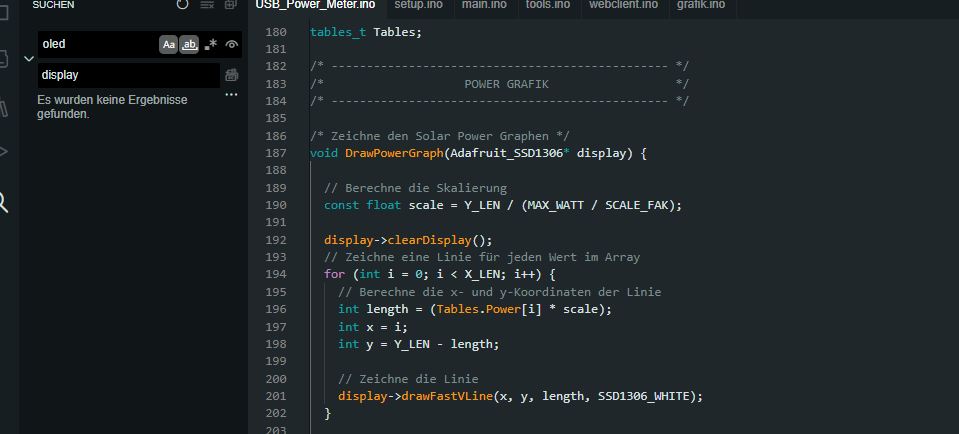
C++ Quellcode für Solar Power Grafik auf OLED Display
Tables; /* /* POWER GRAFIK /* */ /* Zeichne den Solar Power Graphen */ void DrawPowerGraph(Adafruit_SSD1306* display) { // Berechne die Skalierung const float scale = Y_LEN / (MAX_WATT / SCALE_FAK); // Zeichne eine Linie für jeden Wert im Array display->clearDisplay(); for (int i = 0; i < X_LEN; i++)
in „Adafruit SSD1306 Objekt lässt keine Zeiger zu“ · Mikrocontroller und Digitale Elektronik · · Screenshots
-
 Bild
Bild
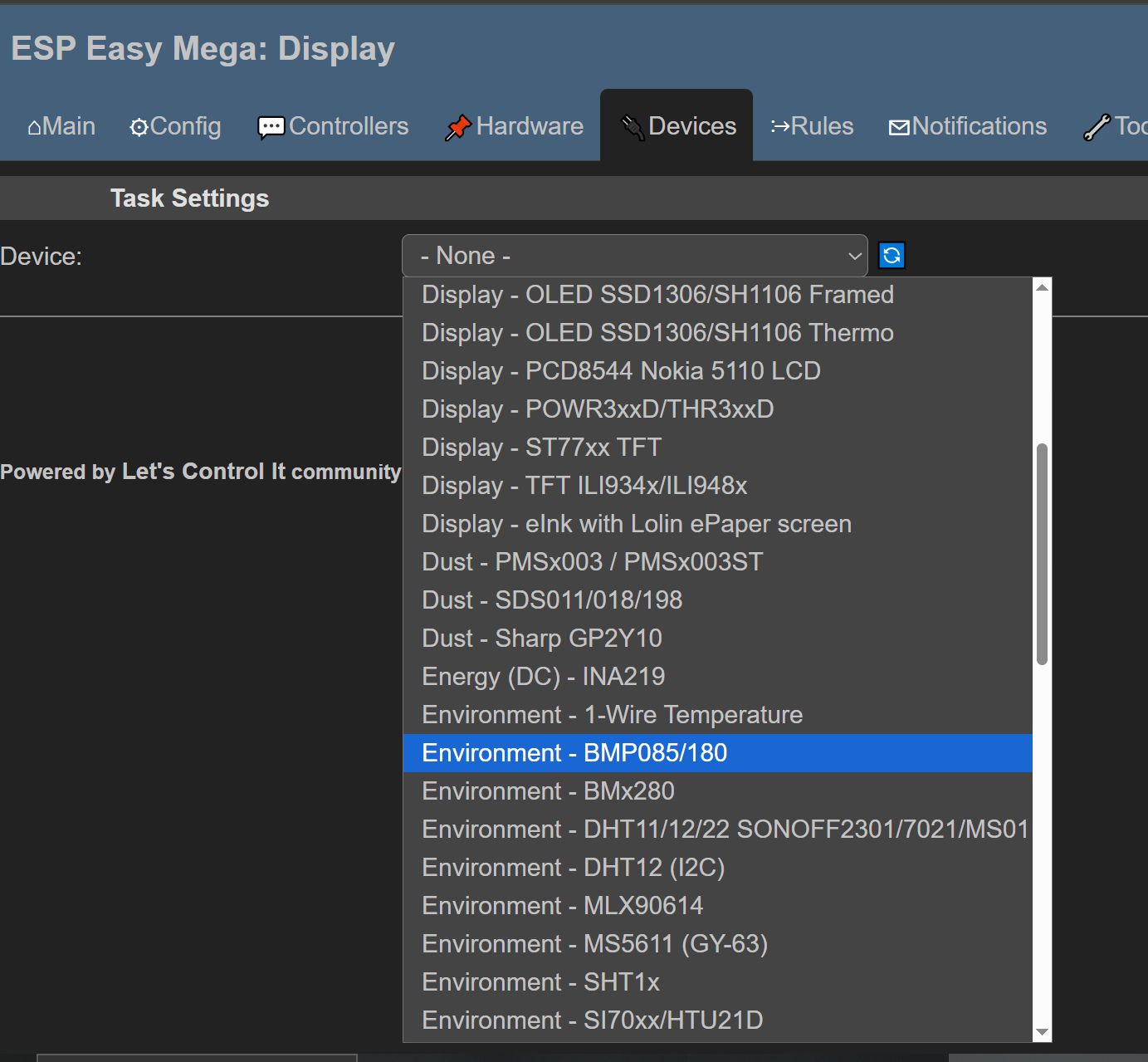
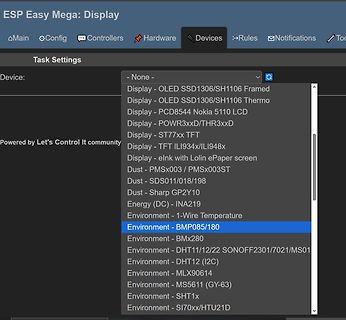
Dropdown-Menü für Geräteeinstellungen in einer Software
Config Controllers Hardware Devices Rules Notifications Task Settings Device: - None - Display - OLED SSD1306/SH1106 Framed Display - OLED SSD1306/SH1106 Thermo Display - PCD8544 Nokia 5110 LCD Display - POWR3xxD/THR3xxD Display - ST77xx TFT Display - TFT ILI934x/ILI948x Display - elnk with Lolin ePaper
in „Günstiges und einfaches Mini-Controller Board, was würdet ihr heute nehmen?“ · Mikrocontroller und Digitale Elektronik · · Screenshots
-
Datei
OLED_Analogwert.ino
#include "U8glib.h" // Konstruktor anpassen! (Beispiel für SSD1306 I2C) U8GLIB_SSD1306_128X64 u8g(U8G_I2C_OPT_NONE); void draw() { int sensorValue = analogRead(A0); // 1024.0 ist Korrektur für 0-5V Umrechnung float voltage = sensorValue * (5.0 / 1024.0); u8g.setFont
in „I2C Display einfache Frage“ · Mikrocontroller und Digitale Elektronik ·
-
Datei
OLED_Test_30032026.ino
#include "U8glib.h" // Konstruktor anpassen! (Beispiel für SSD1306 I2C) U8GLIB_SSD1306_128X64 u8g(U8G_I2C_OPT_NONE); void draw() { int sensorValue = analogRead(A0); // 1024.0 ist Korrektur für 0-5V Umrechnung float voltage = sensorValue * (5.0 / 1024.0); u8g.setFont
in „I2C Display einfache Frage“ · Mikrocontroller und Digitale Elektronik ·
-
Datei
oled_demo.c
-------------------------- oled_demo.c Minimalprogramm fuer Textausgabe auf einem OLED-Display mit SSD1306 oder SSD1315 Display Damit das Programm grundsaetzlich mit jedem Mikrocontroller laufen soll, wurde I2C mittels Bitbanging realisiert, auch wenn hier ein direktes compilieren nur fuer einen AVR-Controller
in „I2C Display einfache Frage“ · Mikrocontroller und Digitale Elektronik ·
-
Datei
oled_2313demo.c
---------------------- oled_2313demo.c Minimalprogramm fuer Textausgabe auf einem OLED-Display mit SSD1306 oder SSD1315 Display, explizit fuer einen ATtiny2313 Mikrocontroller MCU : ATtiny2313 Takt : 8 MHz Fuses : Low: 0xe4 | High: 0xdf | Ext: 0xff IDE : keine 25.02.2026 R. seelig -------------------
in „I2C Display einfache Frage“ · Mikrocontroller und Digitale Elektronik ·
-
Datei
OLED.bas
address Config Twi = 100000 'Com-speed I2C 100 KHz I2cinit 'Initialise I2C bus Waitms 5 $lib "glcdSSD1306-I2C.lib" 'Library for OLED Config Graphlcd = Custom , Cols = 128 , Rows = 32 , Lcdname = "SSD1306" I2cstart I2cwbyte &H78 I2cwbyte &H00 I2cwbyte &HDA 'Enable Normal screen I2cwbyte &H22 I2cstop
in „[Bascom] ATMega328 und Software I2C steuern“ · Mikrocontroller und Digitale Elektronik ·
-
Datei
FINAL_OLED.ino
> dht DHT; const byte DHT22_Pin = 1; //const int analogInPin = 3; //int sensorValue = 0; #include "SSD1306_minimal.h" //#include <avr/pgmspace.h> //#define DEG "\xa7" "C" SSD1306_Mini oled; // Struct for sending measured data /* struct Data { uint16_t temp; // Temperature value uint16_t hum; // Humidity
in „Attiny85 dht22 oled ssd1306 i2C“ · Mikrocontroller und Digitale Elektronik ·
-
Datei
OLED-M328.bas
address Config Twi = 100000 'Com-speed I2C 100 KHz I2cinit 'Initialise I2C bus Waitms 5 $lib "glcdSSD1306-I2C.lib" 'Library for OLED Config Graphlcd = Custom , Cols = 128 , Rows = 32 , Lcdname = "SSD1306" I2cstart I2cwbyte &H78 I2cwbyte &H00 I2cwbyte &HDA 'Enable Normal screen I2cwbyte &H22 I2cstop
in „[Bascom] ATMega328 und Software I2C steuern“ · Mikrocontroller und Digitale Elektronik ·
-
Datei
OLED-M128.bas
address Config Twi = 100000 'Com-speed I2C 100 KHz I2cinit 'Initialise I2C bus Waitms 5 $lib "glcdSSD1306-I2C.lib" 'Library for OLED Config Graphlcd = Custom , Cols = 128 , Rows = 32 , Lcdname = "SSD1306" I2cstart I2cwbyte &H78 I2cwbyte &H00 I2cwbyte &HDA 'Enable Normal screen I2cwbyte &H22 I2cstop
in „[Bascom] ATMega328 und Software I2C steuern“ · Mikrocontroller und Digitale Elektronik ·
-
Datei
klimamessung.py
#! /usr/bin/Python3 #coding=utf-8 #Bibliotheken importieren from lib_oled96 import ssd1306 from smbus import SMBus import smbus import time from PIL import ImageFont from datetime import datetime import io import HYT939 #Display einrichten i2cbus = SMBus(1) #0=RaspberryPi1, 1=RaspberryPi>1 oled=ssd1306(i2cbus) #ein paar abkürzungen um den Code zu entschlacken draw=oled.canvas #Schriften festlegen FreeSans12 = ImageFont.truetype('FreeSans.ttf', 14) FreeSans20 = ImageFont.truetype('FreeSans.ttf'
in „HYT939 geht hart auf anschlag“ · Mikrocontroller und Digitale Elektronik ·
-
 Bild
Bild
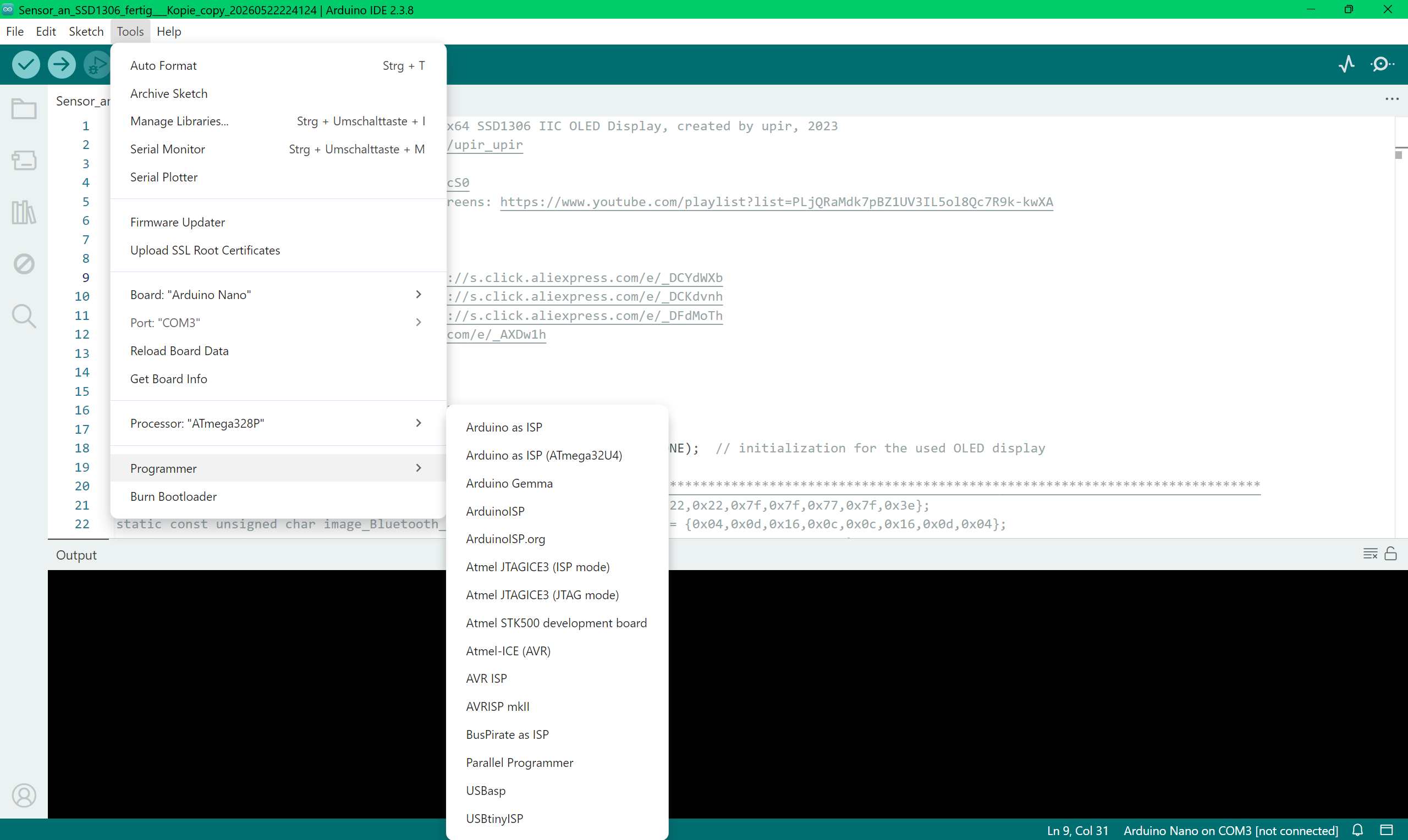
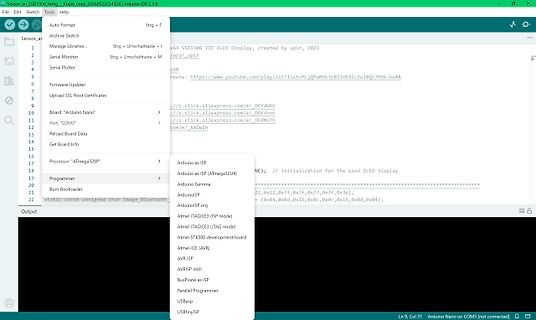
Arduino IDE Menü und Code-Editor
Sensor_asd1306_fermg.copy_2026052224124 | Arduino IDE 2.3.8 File Edit Sketch Tools Help Sensor_asd1306_fermg.copy_2026052224124 x64 SSD1306 IIC OLED Display, created by upir, 2023 upir_upir https://www.youtube.com
in „Suche Arduino kompatiblen Bootloader für ATmega8 mit 8Mhz intern“ · Mikrocontroller und Digitale Elektronik · · Screenshots
-
Datei
tollercode.c
BUTTON_ON 7 #define DT 2 #define CLK 3 #define COLD 9 #define WARM 10 #define OLED_RESET 4 //U8G2_SSD1306_128X64_NONAME_F_SW_I2C u8g2(U8G2_R0, /* clock=*/ SCL, /* data=*/ SDA, /* reset=*/ U8X8_PIN_NONE);// for u8g2lib class Button { public: Button(uint8_t pin); void begin(bool pull); bool pressed();
in „Code for grösseres, 1.3"-Display anpassen (u8glib)“ · Mikrocontroller und Digitale Elektronik ·
-
Datei
Print_test_Function_call.ino
include <SPI.h> #include <Wire.h> #include "DS3231.h" #include <Adafruit_GFX.h> #include <Adafruit_SSD1306.h> #include "thermalprinter.h" #define SCREEN_WIDTH 128 // OLED display width, in pixels #define SCREEN_HEIGHT 64 // OLED display height, in pixels #define OLED_RESET -1 // Reset pin # (or -1 if sharing Arduino reset pin) Adafruit_SSD1306 display(SCREEN_WIDTH, SCREEN_HEIGHT, &Wire, OLED_RESET); Epson TM88(&Serial1); // init the Printer with HW-Serial (Serial1) RTClib RTC; DateTime time_now; void setup() { // put your setup code here
in „Arduino: Ausgabe Zeit als Funktionsaufruf für mehreren "Devices"“ · Mikrocontroller und Digitale Elektronik ·
-
Datei
SSD1306_GFX.inc
/* * SSD1306_GFX.inc * * Created: 09.12.2020 20:17:48 * Author: Steffen Hörhold */ oled_set_pixel: ; XL -> [0..127] | YL -> [0..63] push r16 push r17 push YL push YH mov r16,YL clr YH oled_set_pixel_loopA: subi
in „[ASM] SSD1306 text library für oled displays + AVR 0- und 1-Series“ · Projekte & Code ·
-
Datei
oled.h
generated by some other hardware. */ #define NO_RESET_PIN 255 /** * Driver for OLED displays with SSD1306 or SH1106 controller. * * Supported display sizes: 96x16, 128x32 and 128x64 pixels. * This driver supports only displays with internal charge pump and I²C interface. * The I²C communication is done
in „Zeichnen eines Punktes mit LCD_Plot_Point“ · Mikrocontroller und Digitale Elektronik ·
-
Datei
oled.h
generated by some other hardware. */ #define NO_RESET_PIN 255 /** * Driver for OLED displays with SSD1306 or SH1106 controller. * * Supported display sizes: 96x16, 128x32 and 128x64 pixels. * This driver supports only displays with internal charge pump and I²C interface. * The I²C communication is done
in „Arduino Bibliothek - Methoden bzw. Funktionen en Detail erklärt - gesucht“ · Mikrocontroller und Digitale Elektronik ·