foo (char a, char b) { if (a) c = b; }[/c] compiliert mit avr-gcc -S -Os -mmcu=at90s8515 zu [code]foo: tst r24 breq .L1 sts c,r22 .L1: ret [/code] und mit avr-gcc -S -Os -mmcu=at90s8535 zu [code]foo: cpse r24,__zero_reg__ sts c,r22 .L1: ret [/code]
Es könnte Missverständnisse geben: Mein Programm läuft auf dem *AT90S8515* mit Quarz 3,6864MHz. Beim Mega8515 könnte das etwas anders sein, da der Timer1 bedeutend mehr Features hat und damit andere Bits in den Controlregistern. Du müsstest also auch den betreffenden
um den AVR etwas kennen zu lernen, probiere ich gerade am STK500 die PWM aus. Wenn der Timer1 (AT90S8515) benutzt wird, wird es wohl auch Fast PWM genannt. Jedenfalls wollte ich es mit den SW0/1 breiter oder schmaler werden lassen, allerdings kommt es irgendwo zu einem Überlauf, denn wenn ich incrementiere
AT90S8515.pdf
Erstellen
Text oder Tools suchen
Anmelden
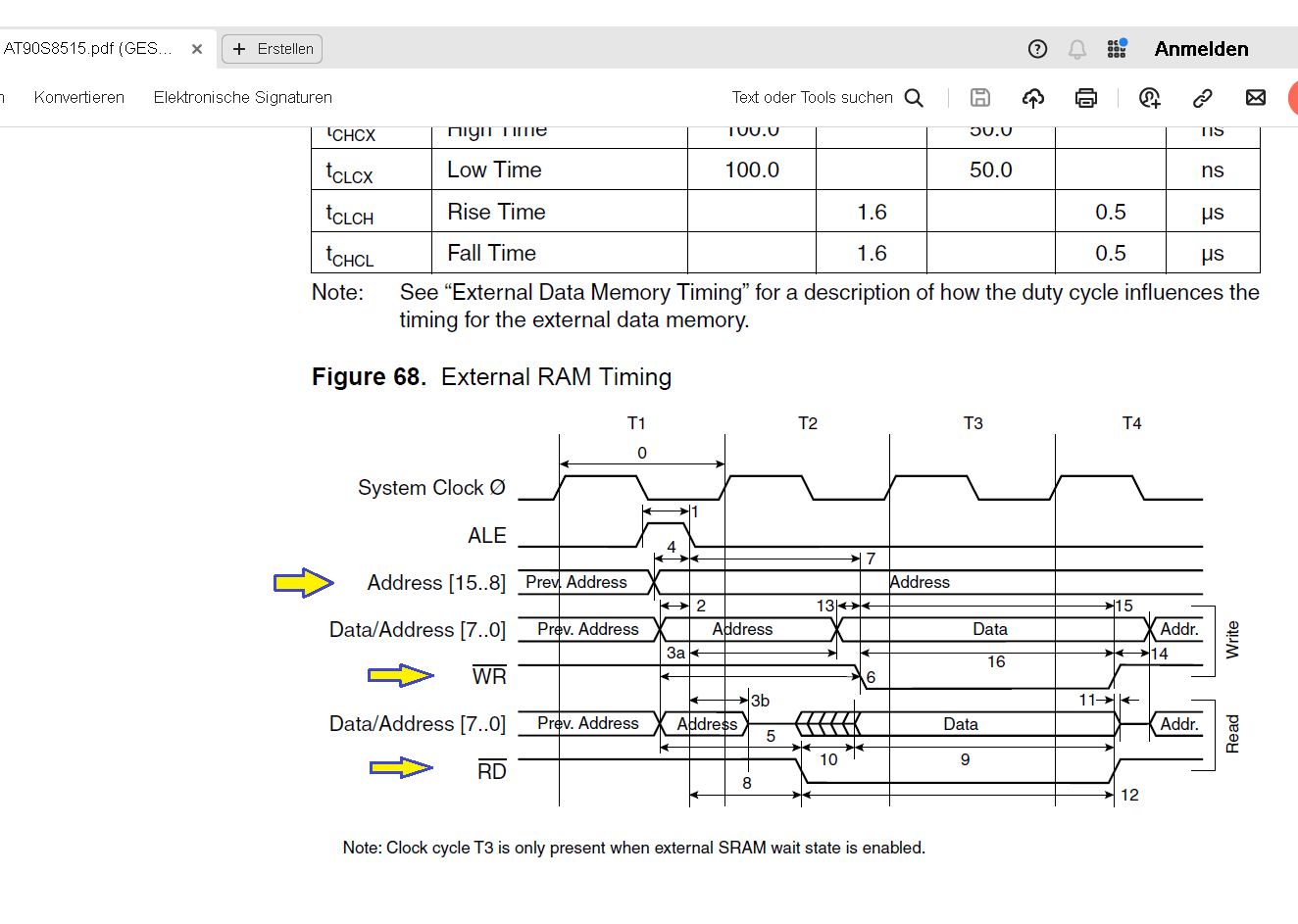
tCHCX 100.0 50.0 ns
tCLCX 100.0 50.0 ns
tCLCH Rise Time 1.6 0.5 µs
tCHCL Fall Time 1.6 0.5 µs
Note: See "External Data Memory Timing" for a description
PD2, LED an PD3 '--------------------------------------------------- $regfile = "2313def.dat" 'AT90S8515-Deklarationen $crystal = 3686400 'Quarz: 3.6864 MHz Dim Zahl As Byte Config Portb = Output Config Portd = Input Do 'Do Zahl = 8 'initialisiert die variable Portb = &B11111111 ' schaltet die leds
Christian Schifferle Oktober 2002 #Hier muss der verwendete AVR-Controller eingetragen werden #(at90s8515, at90s8535, attiny22, atmega603 etc.). MCU = at90s2313 #Hier wird die Zieldatei definiert (ohne Namenserweiterung). TRG = Prell #Hier kommen die Quelldateien hin, wobei auf bereits definierte #Symbole
Hallo, ich hab mit einem kleinen Projekt auf einem AT90S8515 angefangen. Das Programm soll mehrere Drehgeber auswerten und die aktuelle Position über den UART an den PC weiterreichen. Dazu arbeite ich mit 3 Interrupt-gesteuerten Routinen. Die erste auf Timer0
10 11:46:30 Peter Exp $ Software: AVR-GCC 3.3 Hardware: any AVR with built-in UART, tested on AT90S8515 at 4 Mhz DESCRIPTION: This example shows how to use the UART library uart.c *************************************************************************/ #include <stdlib.h> #include
nano - Emanuele Girlando - Arduino UNO - Elektor-Artikel 4.2011 - Renesas-CPU - Uni Ljubljana - AT90S8515, FT245BM - Sven Pauli - Atmega16 - Anders Gustafson - PIC - Steven Casagrande - PIC - Jan Petersen - AVR - Oliver Dahlmann - Dennis Dingeldein - usw. unterschiedlich sind die eingesetzten
devices. AVR Devices: •AT90S1200 •AT90S2313 •AT90S/LS2323 •AT90S/LS2343 •AT90S4414 •AT90S/LS4434 •AT90S8515 •AT90S/LS8535 Software upgrades for the AVR ISP software is posted to the AVR section of the Atmel website, which is located at http://www.atmel.com. STK200 Starter Kit 1-1 Introduction 1-2 STK200
AVR Devices: ■ AT90S1200 ■ AT90S2313 ■ AT90S/LS2323 ■ AT90S/LS2343 ■ AT90S4414 ■ AT90S/LS4434 ■ AT90S8515 ■ AT90S/LS8535 Software upgrades for the AVR ISP software is posted to the AVR section of the Atmel website, which is located at http://www.atmel.com. STK200 Starter Kit User Guide 1-1 Introduction
Fleury <pfleury@gmx.ch> http://jump.to/fleury Date: December 2002 Software: AVR-GCC 3.3 Hardware: AT90S8515 at 4 Mhz, STK200 compatible starter kit Description: Demonstrates use of external interrupts. Each time a push button is pressed, the external interrupt INT0 is called, which increments the global
Code ... >>>Wie stehen denn Deine Fuses? >>>Welchen Controller benutzt Du? Ich benutze den AT90S8515 der hat keine Fuses für OSC_Select >>>Du musst den evtl. Controller umstellen auf den externen Quarz. Ich habe den clock generator vom board genommen und den Jumper am STK dafür auf OSC_SEL
solannge die Pinnummern stimmen. Die Nummern stimmen doch aber oftmals nicht (einfaches Beispiel: AT90S8515 PLCC <-> TQFP, ATtiny2313 <-> MLF). Was geschieht in diesen Fällen?
Zusammenhang "[...] nen 8151 aber habe auch schon 2313ner probiert" lässt eher doch nen (ATMega | AT90S)8515 vermuten... Ich vermute mal, der OP ist grad dabei, seinen Rechner komplett neu aufzusetzen, weil er immer noch glaubt, dass es am Compiler liegt...;-)
mir z.B. das "Dim Bli As Bit" mit einem ATTiny nicht geht... Warum geht das nicht? Mit meinem AT90S8515 ist das alles kein Problem.... Was ist an den Tinys anders? Ich sende mal die BASCOM-Datei als Anhang mit! Wäre dankbar, wenn mir jemand weiter helfen könnte.... Ich will ja nicht mit Kanonen (AT90S8515 32 I/O etc.) auf Spatzen (benötigt: 5 I/O davon 1 Interrupt) schießen.... Gruß, Stephan
Fleury <pfleury@gmx.ch> http://jump.to/fleury Date: December 2002 Software: AVR-GCC 3.3 Hardware: AT90S8515 at 4 Mhz, STK200 compatible starter kit Description: This example demonstrates basic port input/output technic. If one of the switches on port D is pressed, the corresponding LED on port B is turned
BASIC interpreter BASINT (Atmega 16/32/64, russisch) Attobasic für ATmega163 (ASM), ATmega8515/AT90S8515 (ASM) oder ATtiny2313/AT90S2313 von Richard Cappels AVR BASIC Minicomputer mit BASIC-Interpreter Great Cow BASIC Compiler: Open Source Basic Compiler für AVR und PIC Controller. Verfügbar für Windows
es eine 33er Version gibt gibt es schon ein paar Unterschiede. Laß mich den 89C52 mal mit einem AT90S8515 vergleichen, das dürfte eher hinkommen als der 4433. Der 8515 erreicht bei 8MHz auch 8 MIPS, da er bei jedem Takt einen Befehl ausführen kann (bis auf ein paar Ausnahmen, die 2-4 brauchen). Der 89C52
Ansteuerung 4 Bit Mode ;* : mit Adapterplatine ;* Version : 1.0 / 29.11.2002 Start ;* Target MCU : AT90S8515 ;*********************************************************** .include "8515def.inc" ; LCD - Ports und Defs ; 4BIT-LCD (abhaengig von CPU und Adapter) ; Dieser Block befindet sich im Include-File,
Ansteuerung 4 Bit Mode ;* : mit Adapterplatine ;* Version : 1.0 / 29.11.2002 Start ;* Target MCU : AT90S8515 ;*********************************************************** .include "8515def.inc" ; LCD - Ports und Defs ; 4BIT-LCD (abhaengig von CPU und Adapter) ; Dieser Block befindet sich im Include-File,
1998-2003 HP InfoTech s.r.l. ;http://www.hpinfotech.ro ;e-mail:office@hpinfotech.ro ;Chip type : AT90S8515 ;Clock frequency : 4,000000 MHz ;Memory model : Small ;Optimize for : Size ;(s)printf features : int, width ;External SRAM size : 0 ;Data Stack size : 128 ;Promote char to int : No ;char is unsigned
peter Exp $ Software: AVR-GCC 3.4, AVRlibc 1.4 Hardware: any AVR with built-in UART, tested on AT90S8515 at 4 Mhz DESCRIPTION: This example shows how to use the UART library uart.c *************************************************************************/ #include <stdlib.h> #include
, for evaluation and non-commercial use only Company : Comments: Chip type : AT90S8515 Clock frequency : 3,686411 MHz Memory model : Small External SRAM size : 0 Data Stack size : 128 *****************************************************/ #include <90s8515.h
Purpose: access variabled stored in EEPROM with AVR-GCC Software: AVR-GCC 3.3 Hardware: Tested with AT90S8515 (4Mhz), any AVR device can be used Program description: This example explains how global variables can be initialized at compile-time and stored into the internal EEPROM. The program can now refer
AT90S1200, The SRAM content is not guaranteed to be unchanged after any reset condition. AT90S4414 and AT90S8515 The 32 general purpose registers are not guaranteed to be unchanged after any Reset condition. Both SRAM and 32 general purpose registers are guaranteed to be unchanged when waking up from any sleep
Es gibt einen AT90S8515. Der ist allerdings steinalt und abgekündigt. Der ATmega8515 ist ein Pin Kompatibler Ersatztyp, der alles kann wie sein Vorgänger und noch ein paar Dinge mehr. Zusätzlich wird noch ein zeitgemässer

 Bild
Bild