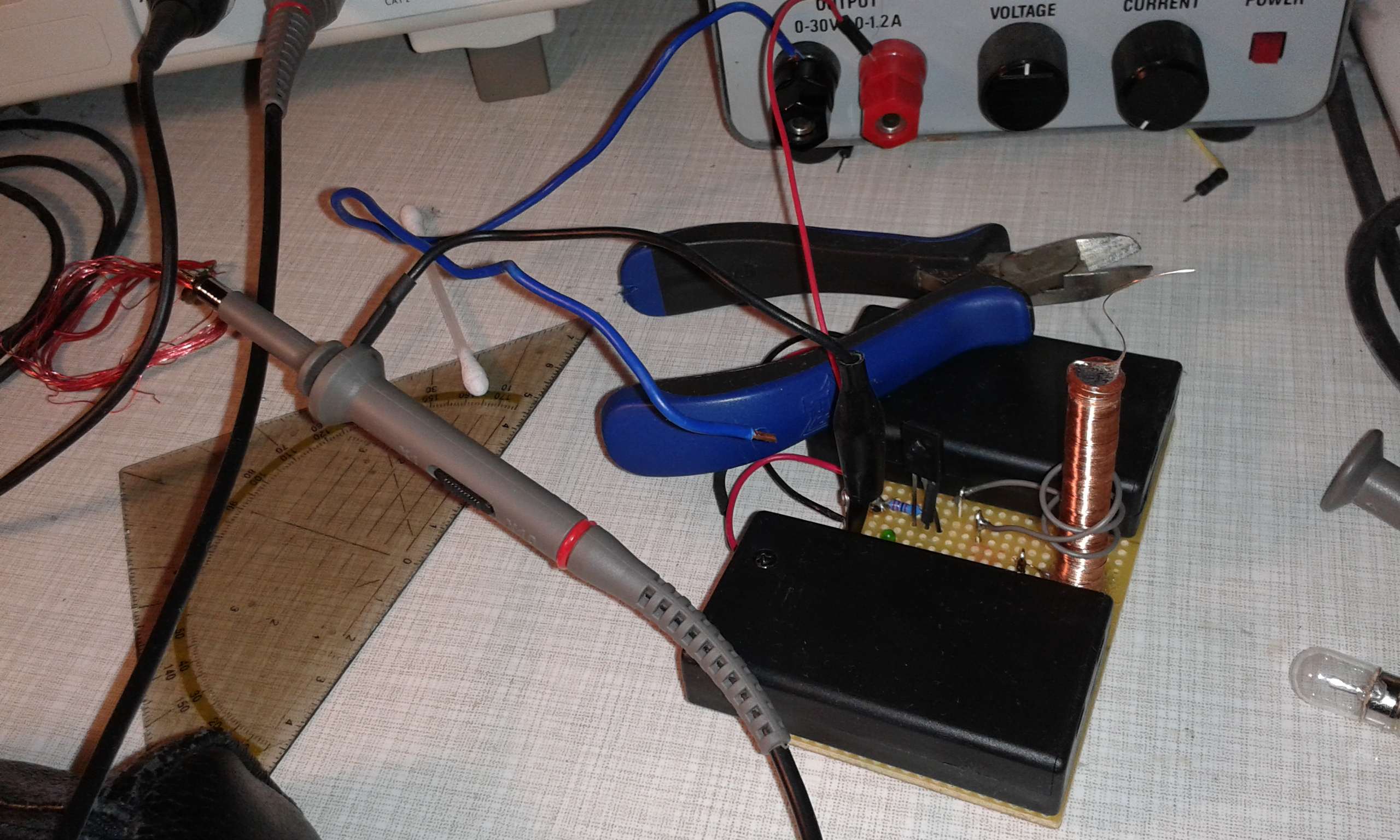
Wie original geschrieben steht:
------THEORY OF OPERATION------

-   5 to 18 volts is fed into the circuit, a resistor (R1) is placed
before the Base pin of the transistor in order to limit the amount of
current the pin receives. If too much current is allowed into the Base
pin the transistor can produce excessive heat and fail.

-   One end of the secondary (L2) is connected to the Base pin of the
transistor in order to feed it with oscillations. The two diodes (D1 and
D2) prevent the oscillations from going directly to ground. (Learn more
about oscillations and why they're important, below).

-   The transistor is made up of three pins: the Collector, the Emitter,
and the Base. If you were to think of the transistor as a garden hose
spigot (See picture 2), the Collector would be the reservoir of water.
The Emitter would be the hose and the Base would be the valve that would
allow water from the reservoir (Collector) to the hose (Emitter). The
valve (Base) is in the closed position (no water flowing) until it is
given a little nudge. When it receives a nudge, the valve opens and a
lot of water is allowed to flow from the reservoir through the hose as
long as the valve is still getting a nudge. However, as soon as the
nudge goes away the valve will close, cutting off the water from the
reservoir to the hose until the valve gets another nudge.

-   When the Base receives a little bit of current, it closes the
circuit and electricity is allowed to flow through the primary coil
(L1). However, electricity likes to take the path of least resistance so
when the electricity is allowed to flow from the collector to the
emitter (~0 ohm resistance) it will stop flowing to the base because
there is 47,000 ohms of resistance there. When the electricity stops
flowing to the base, the base will open up the circuit again until the
resistor offers less resistance than the Collector-Emitter path. This
cycle repeats itself many times a second.

-   The primary coil collapses when the electricity stops flowing
through it, when this happens, the secondary coil picks up the magnetic
field and converts it back into voltage which gets stepped up to around
a thousand volts in the process. The top load acts as a capacitor and
increases the output from the secondary causing electrons in the air to
become excited.

-   Finally, the oscillations from the secondary coil are fed back into
the transistor in order to 'tune' or achieve maximum output from the
Slayer Exciter.

 2014-12-28_20.42.50.jpg
(350 KB)
2014-12-28_20.42.50.jpg
(350 KB)