-
Thread
AVR Tutorial für Mac
kompilieren. Dazu habe ich den Code in einer Datei namens Leds.asm gesichert und dann im Terminal avr-as leds.asm eingegeben. Der avr-as hat nichtmal die include Datei. Ihr habt meine Frage missverstanden, ich möchte eigentlich nur wissen welcher Assembler die im Tutorial verwendete Syntax benutzt
gleiche Assembler (und sollte identische Ausgaben erzeugen). Im Terminal-Fenster einfach mal "avr-as --version" eingeben. Sebastian
-
Thread
VOLTCRAFT DSO-3062C 60 MHz = baugleich mit?
Beitrag #2724458: > OK, und was ist von Owon zu halten? :) https://www.google.de/search?hl=de&as_q=owon+sds7102&as_epq=&as_oq=site%3Aeevblog.com+site%3Amikrocontroller.net
jim-williams-pulse-generator/msg126447/#msg126447 ("On the PCB, I left pads to solder a coax hardline as Jim Williams describes in a later app note, so here I soldered 1m of RG402 semirigid coax to it." .. "So all in all I would say: - Add a coax hardline (15 cm should be enough) and that allows to
-
Thread
Verbindung mit Component von Grafikentwurf zum VHDL
FixedClock : IN STD_LOGIC; RefClock : IN STD_LOGIC; Set_4to1 : IN STD_LOGIC; AES_Rx_LRCk : IN STD_LOGIC_VECTOR(4 DOWNTO 1); AES_Rx_MClk : IN STD_LOGIC_VECTOR(4 DOWNTO 1); AES_Rx_SClk : IN STD_LOGIC_VECTOR(4 DOWNTO 1); IIS_MClk : OUT STD_LOGIC; IIS_SClk
IIS_SS : OUT STD_LOGIC; IIS_D3 : OUT STD_LOGIC; IIS_22M : OUT STD_LOGIC; AES_Rx_Present : OUT STD_LOGIC_VECTOR(4 DOWNTO 1); AES_Sync_Select : OUT STD_LOGIC_VECTOR(4 DOWNTO 1); WClk_Status : OUT STD_LOGIC_VECTOR(1 DOWNTO 0) ); END iis_sync; ARCHITECTURE
-
Thread
Audio over Ip
Gremien gibt ;-) Kann mich jemand mit einem kurzen Abschnitt aufklären, wo jetzt noch der Standard AES50 der von Music Corp. (Midas, Behringer) gepuscht wird einzuordnen ist?
#3361540: > Kann mich jemand mit einem kurzen Abschnitt aufklären, wo jetzt noch der > Standard AES50 der von Music Corp. (Midas, Behringer) gepuscht wird > einzuordnen ist? AES50 benutzt nur die PHY-Layer von Ethernet und ist daher inkompatibel zu gängigen aktiven Netzwerkkomponenten. Vorteil
-
Thread
SPI will auf AVR nicht laufen
Freunden ;) Hier mal ein Ausschnitt aus dem Datenblatt des Atmega328PB dazu: If SS is configured as an input, it must be held high to ensure master SPI operation. If the SS pin is driven low by peripheral circuitry when the SPI is configured as a master with the SS pin defined as an input, the SPI system interprets this as another master selecting the SPI as a slave and starting to send data to it. To avoid bus contention, the SPI system takes the following actions: Aus dem Kapitel 23.3.2 des aktuellen Datenblatts
-
 Bild
Bild
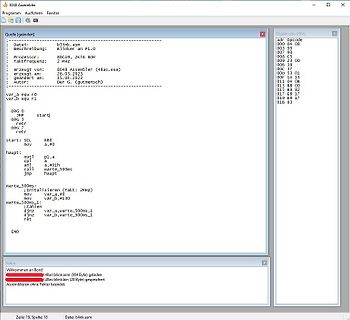
Screenshot eines 8048 Assembler Programms
: ;zahlen djnz var_a, warte_500ms_1 djnz var_b, warte_500ms_1 RET END Status Willkommen am Bord! 48as\blink.asm (904 Byte) geladen 48as\blink.bin (28 Byte) gespeichert Assemblieren ohne Fehler beendet. Zeile: 19, Spalte: 18 Datei: blink.asm
-
 Bild
Bild
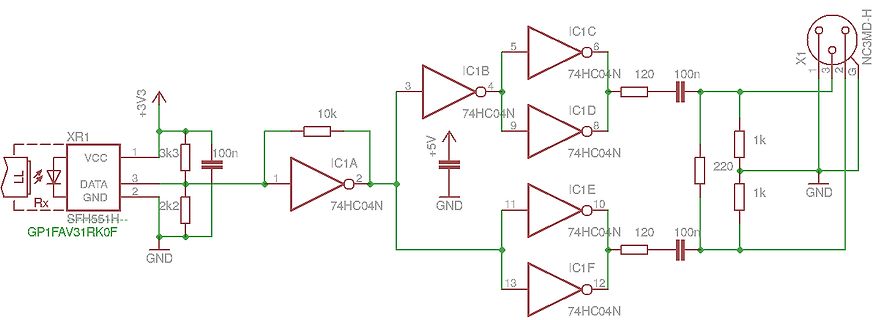
Schaltplan einer optischen Signalübertragung
XR1, VCC, 3k3, 100n, DATA, GND, 2k2, GP1FAV31RK0F, C1A, 74HC04N, 10k, +5V, C1B, 3, 4, 5, 6, C1C, 74HC04N, 120, 100n, X1, 1, 2, 6, C1D, 8, 9, 74HC04N, C1E, 11, 10, 74HC04N, 120, 100n, 1k, 220, 1k, C1F, 13, 12, 74HC04N, NC3MDH
-
 Bild
Bild
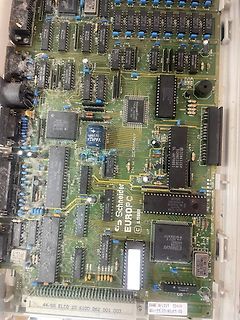
Bestückte Leiterplatte mit integrierten Schaltkreisen
VARTA, Schneider EUROPC, ELCO 20 6100 062 001 003, RAWN Nr: 219 55410, DS: KVT: B1ET: ED, 44/88, 1988
-
 Bild
Bild
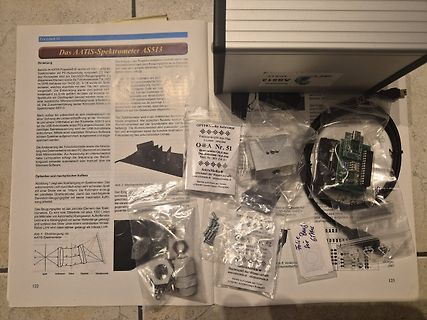
Foto einer Buchseite mit Text und technischen Abbildungen
Das AATiS-Spektrometer AS513 Einleitung Aufbau des Projektobjektivs Optischer und mechanischer Aufbau Abb 1. Strahlengang Abb 2. Mechanischer Aufbau AS513 Opt. Achromat Nr. 51 AstronAstro www.astronia.de astro@astronia.de
-
 Bild
Bild
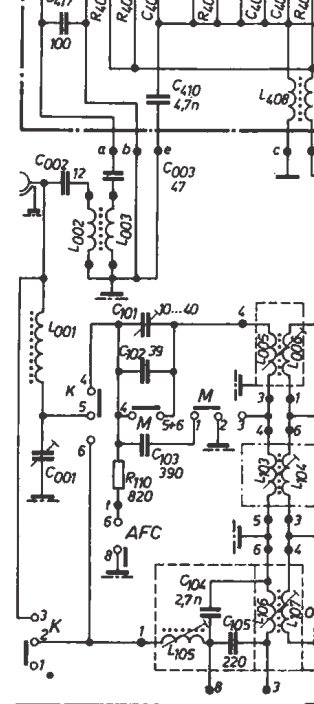
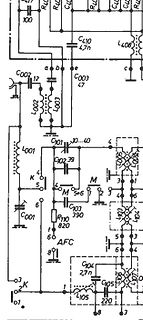
Ausschnitt eines Schaltplans
R4, C4, R4, C4, C410, 4,7n, L408, c, a, b, e, C003, 47, L2002, L003, C101, 10...40, 4, C102, 39, M, 5+6, M, 1, 2, 3, 4, 6, C103, 390, R110, 820, 5, 6, AFC, 1, 60, 8, C104, 2,7n, C105, 220, L105, 1, 3, 8, 03, 02, K, 01
-
 Bild
Bild
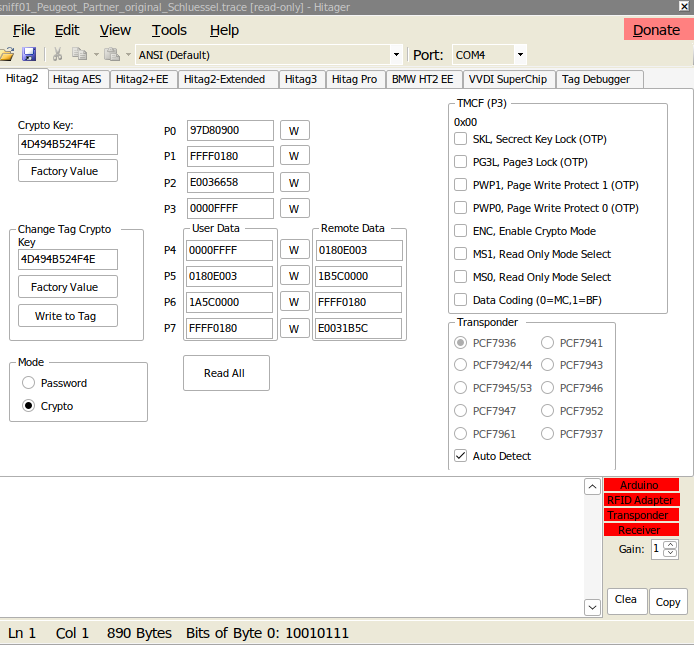
Software zur Programmierung von RFID-Transpondern
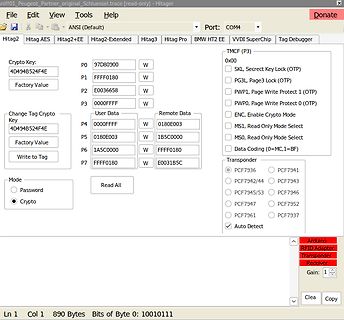
Peugeot_Partner_original_Schluessel.trace [read-only] - Hitag File Edit View Tools Help Donate ANSI (Default) Port: COM4 Hitag2 Hitag AES Hitag2+EE Hitag2-Extended Hitag3 Hitag Pro BMW HT2 EE VVDI SuperChip Tag Debugger Crypto Key: 0x00 P0 97D80900 W SKL, Secret Key Lock (OTP) P1 FFF0180 W PG3L, Page3 Lock (OTP) P2 E0036658 W PWP1, Page
-
 Bild
Bild
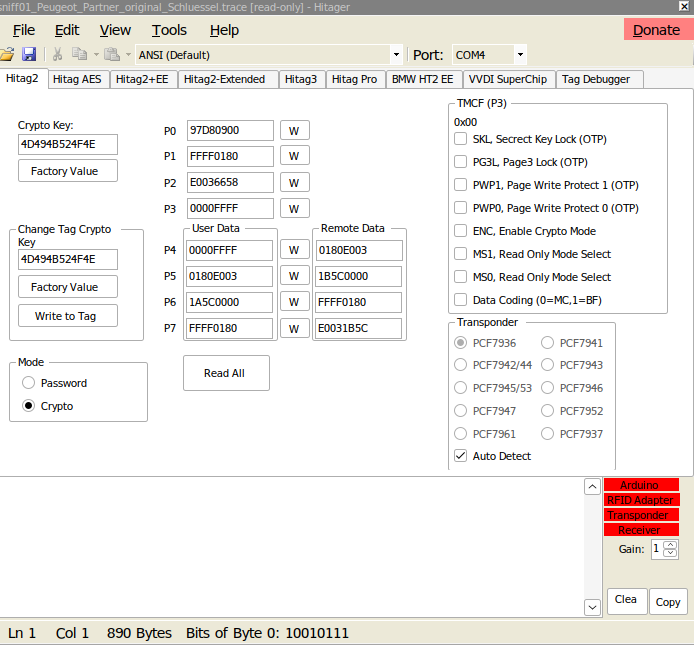
Softwareoberfläche zur Konfiguration von RFID-Transpondern
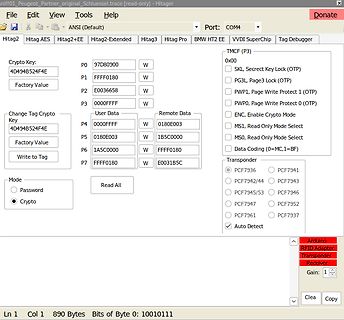
Peugeot_Partner_original_Schluesseltace [read-only] - Hitag File Edit View Tools Help Donate Port: COM4 Hitag2 Hitag AES Hitag2+EE Hitag2-Extended Hitag3 Hitag Pro BMW HT2 EE VVDI SuperChip Tag Debugger Crypto Key: 0x00 P0 97D80900 W SKL, Secret Key Lock (OTP) P1 FFF0180 W PG3L, Page3 Lock (OTP) P2 E0036658 W PWP1, Page
-
Thread
LCD-Modul MC1001AW-TGR
Sub Lampe13 ' Dim T1 As Byte 'Taster1 Dim T2 As Byte 'Taster2 Dim T3 As Byte 'Taster3 Dim L4 As Byte 'lampe4 Dim I As Word Dim L1 As Word 'lampe1 Dim L2 As Word
-
Thread
BASCOM: Zeichenumwandlung nach Vorgaben aus einer Tabelle
Hallo! Habe es noch nicht ausprobiert aber würde es in etwa so funktionierten: [c] dim text as string*10 dim char(10) as byte dim i as byte dim index(10) as byte text = "ABCDEFGHIJ" i = 1 Do 'Einzelne Chars aus String ziehen char(i) = mid(text , i , 1) 'Char in Tabelle data1
91 ' Dezimalwert bei dem die alten Zeichen enden Dim String_in As String * Strl Dim String_char(strl) As Byte At String_in Overlay Dim Char_ctr As Byte , Char_val As Byte Char_ctr = 0 Char_val = String_char(char_ctr) While Char_val > 0 If Char_val >= Orig_char_start
-
Thread
Mosfet parallel schalten mit Kaltleiter in der Sourceleitung?
sharing between cells. The very latest ones suffer from > > secondary breakdown limitations that are as bad as the most fragile > > of power BJTs. Because of this many of the newer MOSFETs now have > > extensive safe operating area curves on their data sheets. > > > > Generation III & IV MOSFETs
Newer: 200V _60mohm 25nC/10nC (total/Miller) _30V (max Vdc) > > > > The "newer" example is not even as bad as the very latest devices > > that are extremely optimized for switching use only. > > > > Regards -- analogspiceman > > analogspiceman, OK, that's what I thought (second breakdown like
-
Thread
Led Dimmen , flackern mit Pwm
$regfile = "m8def.dat" $crystal = 16000000 Dim A As Word Dim B As Word Config Timer1 = Pwm , Pwm = 8 , Compare A Pwm = Clear Up , Compare B Pwm = Clear Down , Prescale = 1 Config Portc.1 = Input Config Portb.1 = Output Do Toggle Portb.1 For
so ich habe es es läuft super. code: $regfile "m32def.dat" $crystal = 1100592 Dim R As Word Dim L As Word Dim Z As Word Config Timer1 = Pwm , Pwm = 10 , Prescale = 1 , Compare A Pwm = Clear Down , Compare B Pwm = Clear Down Config Adc = Free , Prescaler = Auto
-
Thread
Interrupt mit Bascom wird doppelt ausgeführt
Alias Porta Io_pins Alias Pina Config Io_port = Input Io_port = 255 ' Pull-Ups setzen Dim Iwr0 As Byte Dim Io_ct0 As Byte Dim Io_ct1 As Byte Dim Io_state As Byte Dim Io_press As Byte ' Init Eingänge Io_ct0 = 0 Io_ct1 = 0 Decr Io_ct0 Io_ct1 = Io_ct0 Io_state = 0 Io_press = 0 'Timer2
Verhalten ergibt sich zwangsläufig aus einer ganz einfachen, man könnte sagen Straight-Forward oder As-Simple-As-Possible Implementierung dieses Ablaufs. Das ist insofern keine "Absicht". Diese, wie auch die anderen oben in Klammern erwähnten Varianten sind sinnvoll nutzbar. Man muss aber doch wissen
-
Thread
Messchieber auslesen - unbekanntes Protokoll
provided that the B port of the first shift register is high what is ensured by the same gate signal as before - just as it should be. After 24 clock pulses the data is stored in the 3 shift registers (24 bit) and can now be read by the AVR using the AVR line mentioned above. For the following discussion
re-triggerable. Therefore the shift register will not accept new data (to suppress spurious clock/data peaks) as long as the 15+150ms hat functions are not elapsed. C1 and R2 are there to prevent that IC1C sees any gap between the two hat functions which may occur as Q1 falls before Q2 rises.. The two hat pulses
-
Thread
Fehlersuche.bekomms echt nicht hin
Timer1 = 55535 Enable Interrupts Config Int2 = Falling Enable Int2 On Int2 Check Dim Cnt As Integer , Cntalt As Integer Dim Umfang as Integer, Ms as Integer Umfang = 1850 Do Ms=Umfang/cntalt Lcdat 5,20,Ms wait 1 Loop End Check: Cntalt = Cnt Cnt = 0 Return Auswertung:
Rechenzeit fast egal (zur Not WAIT durch WAITMS ersetzen und dabei Wartezeit verkürzen). [pre] Dim Ms as Single Dim Umfang as Integer Umfang = 1850 ' ### Hauptprogramm ### Do Ms = Umfang Ms = Ms / Cntalt Lcdat 5, 20, Ms Wait 1 Loop End [/pre]
-
Thread
Frage wegen eines antiken Radios.
Wer ist im Besitz des Mini-UKW/MW-Empfängers "AMSONIC Solar-Radio AS339 oder das ältere Modell "AMSONIC Solar-Radio AS338" und hat noch die Beschreibung mit Schaltschema? http://www.staff.science.uu.nl/~tel00101/FotoAlbum/RadioCorner/Sets/SolAS339.htm Gruss
ich bin mitglied im radiomuseum. es gibt leider keine schaltpläne zu den geräten as338 bzw. as339
-
Thread
Rs485 reagiert nicht auf Daten
XMega128A1 wurde folgendermaßen initialisiert: USART_PORT_485.DIRSET = PIN3_bm; // Pin 3 (TXD0) as output. USART_PORT_485.DIRCLR = PIN2_bm; // Pin 2 (RXD0) as input. USART_PORT_485.DIRSET = PIN1_bm; // Pin 1 (CLK) as output USART_PORT_485.OUTSET = PIN1_bm; // 8 Data bits, No Parity
Und was soll das hier? >USART_PORT_485.DIRSET = PIN1_bm; // Pin 1 (CLK) as output
-
Thread
Gehalt/Gehaltsentwicklung Informatiker/Ingenieure
as
Stellen > auf. Ach, das schwankt immer: Mal werden Stellen aufgebaut, dann wieder abgebaut. Business as usual. Bewerbungen sind dort, wie bei allen Konzernen, im Wesentlichen Glücksache. Ich habe dort vor einigen Jahren das große Los gezogen.
-
Thread
PiPico PIO programmieren
PIO-Befehlen nicht. [pre]3.3.7. Pseudoinstructions Currently pioasm provides one pseudoinstruction, as a convenience: nop Assembles to mov y, y . "No operation", has no particular side effect, but a useful vehicle for a side-set operation or an extra delay.[/pre]
Datenblatt [code] 3.4.7.2. Operation A nonblocking PULL on an empty FIFO has the same effect as MOV OSR, X. The program can either preload scratch register X with a suitable default, or execute a MOV X, OSR after each PULL NOBLOCK, so that the last valid FIFO word will be recycled until new data
-
Thread
AVR ASM Timer-Interrupt
noch schreiben^^ Hatte ich ganz vergessen^^ Ich kann keine Registernamen nutzen weil ich mit avr-as compiliere
Geht net. Bei avr-as geht das net!
-
Thread
Linux: kann man DTR auf ttyUSBx abschalten?
setup as dfl Save the parameters as the default for the next time the program is started. Instead of dfl, any other parameter name may appear, depending on which one was used when the program was started. Save setup as.. Save the parameters under a special name. Whenever Minicom is started with this name as an argument, it will use these parameters. This option is of course privileged
-
Thread
ATTiny44: Timer-Frequenz ändert in Abhänigkeit des Main-Programms
//Toggle OC1A on compare Timer1 OCR1A = 0xFFFF; DDRA |= (1<<DDA6); //Set PA6/OC1A as output DDRA |= (1<<DDA5); //Set PA5/OC1B as output for (;;) { if (PINA & (1<<PINA2)) { PORTA |= (1<<PORTA2); } else { PORTA &= ~(1<<PORTA2
//Toggle OC1A on compare Timer1 OCR1A = 0xFFFF; DDRA |= (1<<DDA6); //Set PA6/OC1A as output DDRA |= (1<<DDA5); //Set PA5/OC1B as output for (;;) { if (PINB & (1<<PINB2)) { PORTB |= (1<<PORTB2); } else { PORTB &= ~(1<<PORTB2
-
Thread
portpin PD.3 liefert kein signal
$regfile = "m8def.dat" $crystal = 3686400 $hwstack = 40 $swstack = 16 $framesize = 32 Dim I As Byte , Sw As Byte , Zw As Byte Ddrb = &B1111_1111 'Ausgänge Ddrd = &B1111_1111 'Ausgänge Do For I = 0 To
$regfile = "m8def.dat" $crystal = 3686400 $hwstack = 40 $swstack = 16 $framesize = 32 Dim I As Byte , Sw As Byte , Zw As Byte Ddrb = &B1111_1111 'Ausgänge Ddrd = &B1111_1111 'Ausgänge Do For I = 0 To
-
Thread
Warum bei Avionik immer weiße Kabel?
fast ausschließlich Tefzel-Kabel des Typs AS22759/16 und AS22759/18 im Avionik-Bereich. Grund für die Wahl dieses Isolationsmaterials ist vor allem die chemische Beständigkeit, das Alterungsverhalten, die Temperaturfestigkeit und nicht zuletzt
kann vielleicht > einiges > klarstellen. > > Für die am häufigsten verwendeten "Litzen" (Norm AS22759) stehen viele > verschiedene Isolierungen zur Verfügung, unter anderem FEP, PTFE und > ETFE. Auch mehrschichtige Isolierungen (extrudiert oder gewickelt) > stehen zur Verfügung. > Hast du mal
-
Thread
Atmega via Ethernet flashen
jetzt! Folgende Änderungen: etherflash.c in der initializeHardware(): DDRB = 8; //EA set PB3 as output to deselect CS on MMC card DDRC = 0; DDRD = 0; PORTB = 8; //EA set PB3 high --> MMC card not selected PORTC = 0; PORTD = 0; spi.c in der SPI_init(): // set mosi, sck as output
sind wie folgt gesetzt: [c] avrdude: Device signature = 0x1e9502 avrdude: safemode: lfuse reads as FF avrdude: safemode: hfuse reads as 99 [/c] Das Pollin AVR-NET-IO arbeitet mit 16 MHz. Im Verzeichnis device_001 habe ich in der config.h nur das Debuging eingeschaltet, sonst ist das File unverändert
-
Thread
httpS Authentication für Webapp, später nur http, sicher?
eigentliche Verschlüsselung sollte fast keine CPU zeit verbrauchen. Alternative über https einfach eine AES Schlüssel austauschen, und dann die Daten mit http und verschlüsselt mit AES übertragen.
langsamere Clients über 99% ihrer CPU an die Entschlüsselung. > Alternative über https einfach eine AES Schlüssel austauschen, und dann > die Daten mit http und verschlüsselt mit AES übertragen. Bringt überhaupt nichts, da der Aufwand für die Entschlüsselung derselbe ist.
-
Thread
S/PDIF-Interface als HDL
wirst Du wahrscheinlich ohnehin schon haben, aber falls nicht, hier kannst Du Dir den passenden AES-Standard runterladen (AES3-2003): http://www.aes.org/publications/standards/ Ist quasi (fast) dasselbe wie S/PDIF. Interessant hierzu auch folgendes Dokument ("Interfacing AES3 and S/PDIF"): www.rane.com
Hallo Xenu, bei der AES bin ich Mitglied :-) aber die Altere-Note hatte ich noch nicht erspäht. Danke. Werde mich mal dranmachen, sobald ich Zeit dafür finde, ob dann AES oder SPDIf, ist am Ende nur eine Frage der Analogkomponente
-
Thread
AP7000 und ICnova ADB1000: Bisschen wenig?
sehr viel besser: [code] usb 1-1.1: configuration #1 chosen from 1 choice input: USB Keyboard as /class/input/input1 generic-usb 0003:1241:1503.0001: input: USB HID v1.10 Keyboard [ USB Keyboard] on usb-isp176x.0-1.1/input0 input: USB Keyboard as /class/input/input2 generic-usb 0003:1241:1503.0002
using isp176x and address 3 usb 1-1.1: configuration #1 chosen from 1 choice input: USB Keyboard as /class/input/input1 generic-usb 0003:1241:1503.0001: input: USB HID v1.10 Keyboard [ USB Keyboard] on usb-isp176x.0-1.1/input0 input: USB Keyboard as /class/input/input2 generic-usb 0003:1241:1503.0002
-
Thread
OCR für Monospace-Schrift
of vertically aligned text. 6 Assume a single uniform block of text. 7 Treat the image as a single text line. 8 Treat the image as a single word. 9 Treat the image as a single word in a circle. 10 Treat the image as a single character. 11 Sparse text. Find as much text as possible in no particular order. 12 Sparse text with OSD. <---- interessant!! 13 Raw line. Treat the image as a single text line, bypassing hacks that are Tesseract-specific. [/
-
Thread
Atmel ICE und AVR Stuido 4?
Möglichkeit den Atmel-ICE im AS 4 zu integrieren... Wer hat da eine Idee oder Empfehlung? Danke und Gruss Peter
Peter S. schrieb im Beitrag #6085164: > Oder vielleicht gibt es eine Möglichkeit den Atmel-ICE im AS 4 zu > integrieren... Nein gibt es nicht. Diese Kombination hatte ich mir auch vor langer Zeit gewünscht. Peter S. schrieb im Beitrag #6085164: > Und ich möchte wenn immer möglich kein AS
-
Thread
µC sendet Mist
Au weia. Das tut weh: Processor Expert Beans are referred to as Standard Beans, Complex Beans and Software Beans. Standard Beans (or simple beans) refer to the basic on-chip modules such as parallel ports, timers, A/D converters, and simple serial interfaces as well as simple functions using them. Software beans are implementation of functions such as math functions, filtering functions, motor control functions and flow control fucntions. Da
-
Thread
ATmega328PB: UART(MC) empfängt falsche Daten
Philipp K. schrieb im Beitrag #6302765: > Ich habe beim Device Programming in AS7 nochmal nachgeguckt wegen den > Fusebits: CKDIV8 ist aktiv Wie kann das sein, du kannst die Fuses doch gar nicht auslesen! > Daher wollte ich die F_CPU auf 8MHz erhöhen wo die Fehlerquote >
Gerade habe ich einen neues Programm für ein LED-Blinken daraufgeladen. Auf die Fuses kann ich über AS7->Device Programming->Fuse->LOW.CKDIV8->Programm zugreifen. Ich habe offenbar nichts verstellt, weil von vorein ich keine Device Signature erhalten habe.
-
Thread
OceanGate Titanic U-Boot
. Cracks had developed in the fuselages of the ill-fated Comets, around doors and window apertures as the aircraft were subject to repeated pressurisation cycles - where the fuselage is pressurised for passenger comfort at the start of each flight and depressurised when the engines shut down - and as
nun nachweislich implodiert Mit Sicherheit. "The debris that has been located and confirmed as belonging to the Titan submersible consists of the nose cone (not part of the pressure vessel) as well as the forward and aft end bell (part of the pressure vessel)." Die haben die Nasenkonus gefunden
-
Thread
VB 2008 Bei Programmstart prüfen ob COM frei ansonsten ERROR ausgeben
die Fehlerbehandung. In deinem Fall würde es so aussehen [pre] private function Open_COM_Port() as boolean Try SerialPort1.Open() Catch ex As Exception MsgBox(ex.Message) return False End Try Return True End Function [/pre]
private function Open_COM_Port() as boolean Try SerialPort1.Open() Catch ex As Exception MsgBox(ex.Message) return False End Try Return True End Function SO ganz worked das noch nicht aber ich werde den Denkanstoß
-
Thread
Frage zu einem kleinen PIC-ASS-Programm
mal die include-Anweisung fuer den PIC :#include <xc.h> und #include <pic16f15313.inc> Den Pic-As schaue ich mir vorlaeufig nicht an....kein Bedarf im Moment
Schon seit längerem haben offenbar auch andere Probleme mit Pic as. https://www.microchip.com/forums/m1150682.aspx
-
Thread
Einfachen Tongenerator.
> dass man nichts im Netz darüber findet Oops, ist schon wieder Freitag ? oder: Troll as troll can ? Google ist dein Freund und findet Tongeneratoren in jeglicher Form.
das passende mit google (Suchbegriff Morsepieper): https://www.aatis.de/content/baus%C3%A4tze/tipps/AS001-PH26 https://www.aatis.de/content/baus%C3%A4tze/tipps/as001-1
-
Thread
LL-MOSFET an AVR Pin: max. PWM Freq?
nicht dem weh, der zieht, sondern Dir... Es war im OP von 10mA Umladestrom die Rede. 20nC = 20nAs; 20nAs/10mA = 20nAs / 0.01A = 2000ns = 2µs. Könnte diese Zeit IRGENDWIE für im FET umgesetzte Leistung relevant sein?
der zieht, >sondern Dir... Hehe ;-) >Es war im OP von 10mA Umladestrom die Rede. 20nC = 20nAs; >20nAs/10mA = 20nAs / 0.01A = 2000ns = 2µs. Nö, das war eine Vermutung des OPs. Die Realität sieht GANZ anders aus.
-
Thread
HW-Stack wird in Subroutine voll bis Prog. abstürzt
###### 'START Variablen---------------------------------------------------------------- Dim C1 As Word Dim C2 As Word Dim C4 As Word Dim C5 As Word Dim C3 As Word Dim Tastenfeld As Word Dim Tastenfeld_zaehler As Byte Dim Tastenwert_ug As Word Dim Tastenwert_og As Word Dim Ubatterie As Long Dim Ubatterie_formatiert As Long Dim Ubatterie_str2 As String * 5 Dim Ubatterie_aktueller_wert As Word Dim Idc1 As Long Dim X As Word Dim Watt As Long Dim L As Word Dim Var1
-
Thread
ATMega328P - Fuses falsch gesetzt?
rumschreibt??: Programm: [code]$regfile = "m328pdef.dat" $crystal = 16000000 $baud = 115200 Dim s as byte Dim t as byte print "start" t = 1 s = 1 print "t=" ; t if t = 0 then print "t0" else print "t1" print "s=" ; s if s = 0 then print "s0" else print "s1" end [/code] Ausgabe: [code
Programm: > [code]$regfile = "m328pdef.dat" > $crystal = 16000000 > $baud = 115200 > > Dim s as byte > Dim t as byte > > print "start" > t = 1 > s = 1 > print "t=" ; t > if t = 0 then print "t0" else print "t1" > print "s=" ; s > if s = 0 then print "s0" else print "s1" > > end >
-
Thread
Grasshopper Inbetriebnahme
avr32-linux-uclibc-addr2line avr32-linux-ar avr32-linux-uclibc-ar avr32-linux-as avr32-linux-uclibc-as avr32-linux-cc avr32-linux-uclibc-cc avr32-linux-c++filt avr32-linux-uclibc-c++filt avr32-linux-cpp
<not found> (Need version 4.2 or newer) avr32-gcc: <not found> (Need version 4.2 or newer) avr32-as: <not found> (Need version 2.17 or newer) avr32-nm: <not found> (Need version 2.17 or newer) You are using the Linux version of the AVR32 Utilities and AVR32/GNU Toolchain. There are multiple
-
Thread
AVR - Bascom - externes EEPROM
to work with a 24LC256 I2c EEPROM '24lc256 Const E_ctlw = &HA0 Const E_ctlr = &HA1 Dim E_ah As Byte Dim E_al As Byte Dim E_addr As Word Dim E_dat As Byte Dim Dat As Byte Declare Sub E_write(byval E_addr As Word , Dat As Byte) Declare Sub E_read(byval E_addr As Word , E_dat As Byte) Declare
' Routine to read the 24LC256 ' Sub E_read(byval E_addr As Word , E_dat As Byte) E_ah = High(e_addr) E_al = Low(e_addr) I2cstart I2cwbyte E_ctlw I2cwbyte E_ah I2cwbyte E_al I2cstart I2cwbyte E_ctlr I2crbyte E_dat