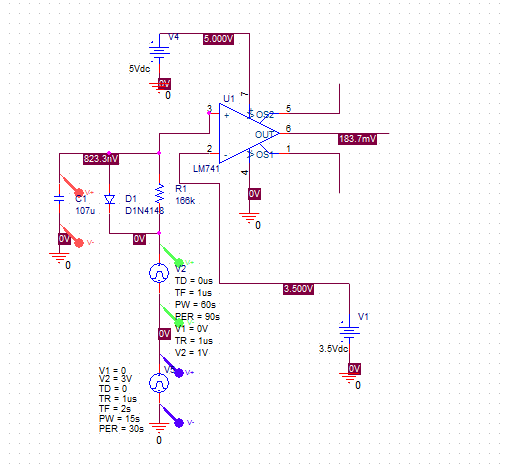
# V1 is the value when the pulse is not "on." So for a square wave, the
value when the wave is 'low'. This can be zero or negative as required.
For a pulsed current source, the units would be "amps" instead of
"volts."
# V2 is the value when the pulse is fully turned 'on'. This can also be
zero or negative. (Obviously, V1 and V2 should not be equal.) Again, the
units would be "amps" if this were a current pulse.
# TD is the time delay. The default units are seconds. The time delay
may be zero, but not negative.
# TR is the rise time of the pulse. PSpice allows this value to be zero,
but zero rise time may cause convergence problems in some transient
analysis simulations. The default units are seconds.
# TF is the fall time in seconds of the pulse.
# TW is the pulse width. This is the time in seconds that the pulse is
fully on.
# PER is the period and is the total time in seconds of the pulse.

Also
V1 auf 3.4 V
V2 auf 3.6 V
TD auf 0
TR = TF = 1us oder sowas
und nun:
TW = 1
PER = 16 (15+1)

So müsste es gehen, kanns grad leider nicht testen.

Schönen Abend,
Benni

 Unbenannt.png
(14 KB)
Unbenannt.png
(14 KB)