
https://datasheets.maximintegrated.com/en/ds/MAX6955.pdf

Wird einer von euch schlau daraus, wie man Register lesen kann? Ich
finde nirgendwo ein Beispiel (ausser bei AVRFreaks, da hatte auch einer
Probleme, wurde aber auch nicht gelöst.
Letzten Endes will ich die Tasten lesen, aber es funktioniert überhaupt
keine Leseoperation.

unsigned char readMAX6955 (unsigned char adr)
{unsigned char data;
i2c_start();
i2c_write (MAX6955);    //0xC0
i2c_write (adr);
i2c_start();            //rep. start
i2c_write (MAX6955 | 1);   //read
data=i2c_read (NO_ACK);
i2c_stop();
return data;
}
Gast
#5159352
So lese ich Register mit der I2C Bibliothek von  Peter Fleury
Bausteinen:
1 | |
2 | |
3 | |
4 | |
5 | |
6 | |
7 | |
8 | |
9 | |
10 | |
11 | |
12 | |
13 | |
14 | |
Das ist mehr oder weniger das gleiche, oder? Und so funktionierts mit
allen mir bekannten I2C-Bausteinen.
Beim MAX6955 funktionierts aber nicht, liefert 0xFF. Blöderweise steht
im Datenblatt nichts zur Lesefunktion :-( . Wieder mal ein eigenes
Süppchen gekocht (die SPI von Maxim ist ja manchmal auch was
eigenartig)?
Habe die jetzt mal angeschrieben.

Schreiben funktioniert, auf der gleichen Platine ist auch ein EEPROM, da
funktionierts, Hardwarefehler sind also eher auszuschliessen. Auch keine
Adresskonflikte.

Komischerweise findet sich im ganzen Netz nicht ein Stückchen
Beispielcode, immer nur die reinen Schreibfunktionen. Scheint keiner die
Tasten benutzt zu haben.
unsigned char readMAX6955 (unsigned char adr)
{unsigned char data;
i2c_start();
i2c_write (MAX6955);    //0xC0
i2c_write (adr);

i2c_stop();          //<- das will er haben, zumindest funktioniert es
jetzt

i2c_start();            //rep. start
i2c_write (MAX6955 | 1);   //read
data=i2c_read (NO_ACK);
i2c_stop();
return data;
}
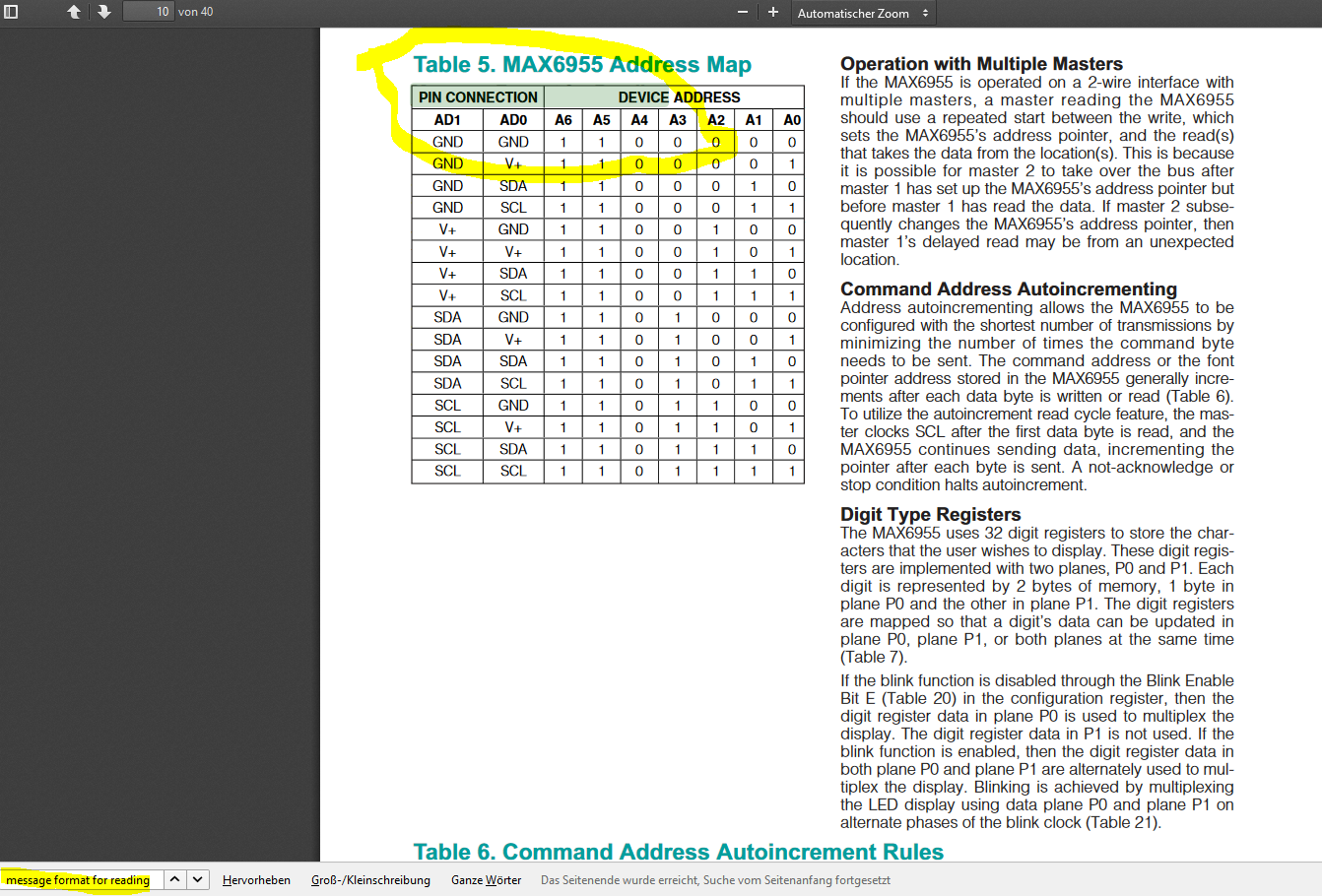
Da ist wohl im Datenblatt was verrutscht. Wenn man nach "message for
reading" sucht, landet man sozusagen unter Table5.
Angehängte Dateien:
-
 MAX6955.PNG
(330 KB)
MAX6955.PNG
(330 KB)
Gast
#5159976
Was soll verrutscht sein?
Gast
#5159992
Der Abschnitt zum Auslesen von Registern befindet sich hinter der
Tabelle. Die Tabelle ist zu weit oben
Gast
#5160588
Der verlorene Abschnitt


Message Format for Reading
*********************************
The MAX6955 is read using the MAX6955’s internally
stored command byte as address pointer, the same
way the stored command byte is used as address
pointer for a write. The pointer generally autoincrements
after each data byte is read using the same rules as for
a write (Table 6). Thus, a read is initiated by first configuring
the MAX6955’s command byte by performing a
write (Figure 7). The master can now read n consecutive
bytes from the MAX6955, with the first data byte
being read from the register addressed by the initialized
command byte (Figure 9). When performing readafter-write
verification, reset the command byte’s
address because the stored byte address generally is
autoincremented after the write (Table 6).

************************************************************************
*
https://web.archive.org/web/20121224060106/https://datasheets.maximintegrated.com/en/ds/MAX6955.pdf
Das war die Antwort von Maxim:
"The read procedure for the MAX6955 registers follows the I2C standard:

1. The master communicates a Start Condition.

2. The master sends the slave address byte with a write bit. Slave
acknowledges.

3. The master sends a command byte (in the case of the MAX6955, this
byte is the address of the register that is to be read). Slave
acknowledges.

4. The master communicates a Repeated Start Condition.

5. The master sends the slave address byte with a read bit. Slave
acknowledges.

6. The slave sends the data byte from the desired register to be read.
Master communicates a Not-Acknowledge.

7. The master communicates a Stop condition.

Let me know if you have any additional questions."

Also das übliche procedere, aber genau das klappt beim MAX6955 eben
nicht. Stellt sich die Frage, was eigentlich Standard ist? Ist die Sache
mit dem rep. start eine mögliche Verkürzung, die man unterstützen kann
oder auch nicht?
Gast
#5160727
Hardware, Pull-ups?
Gast
#5160737
Guten Morgen,

wie hoch ist der I2C Clock beim MAX6955?

https://datasheets.maximintegrated.com/en/ds/MAX6955.pdf

Im Datenblatt finde ich Serial Clock Frequency fSCL max. 400 kHz.
Somit solltem man erst einmal mit fSCL = 100 kHz und den passenden I2C
Pullups starten.
100kHz, 3,3V, 3k3 pullup.
Antwort schreiben
Bitte melde dich an, um einen Beitrag zu schreiben.