CORE COMPARATOR ADC 8-BIT DATA BUS PORT A PORT B PA[7:0] PB[3:0] ATtiny441/841 [DATASHEET] 4 8495H–AVR–05/2014 The AVR core combines a rich instruction set with 32 general purpose working registers. All 32 registers are directly connected to the Arithmetic Logic Unit (ALU), allowing two independent registers
CORE COMPARATOR ADC 8-BIT DATA BUS PORT A PORT B PA[7:0] PB[3:0] ATtiny441/841 [DATASHEET] 4 8495H–AVR–05/2014 The AVR core combines a rich instruction set with 32 general purpose working registers. All 32 registers are directly connected to the Arithmetic Logic Unit (ALU), allowing two independent registers
unabhängig. DerAdresszeiger wird beiAusgabe eines Zeichens ins DD Ram automatisch erhöht. Das Display verhält sich so, als ob eine Zeile immer aus 32 logischen Zeichen besteht, von der, je nach konkretem Displaytyp (16 Zeichen, 20 Zeichen) immer nur ein Teil sichtbar
32. 35 8272C–AVR–06/11 ATmega164A/PA/324A/PA/644A/PA/1284/P To find suitable load capacitance for a 32.768kHz crysal, please consult the crystal datasheet. When this oscillator is selected, start-up times
auch, meine ich jedenfalls, auf der ST Seite eine Empfehlung zu C++ gelesen), würde ich mir das STM32F4 DISCOVERY STM32F407VGT6 STM32 ARM Cortex-M4 Development Board kaufen und damit anfangen. Da brauchst du zunächst keine Widerstände und auch nichts anderes kaufen. Die F0 und F1 Boards sind noch günstiger
-b.examiner.com/sites/default/files/styles/image_content_width/hash/e8/30/Williams_5a.jpg?itok=pI8cDdUW :-D Grüße Andreas
like is provided only for your convenience The Microchip name and logo, the Microchip logo,AnyRate,AVR, and may be superseded by updates. It is your responsibility to AVR logo, AVR Freaks, BitCloud, chipKIT, chipKIT logo, ensure that your application meets with your specifications. CryptoMemory, CryptoRF
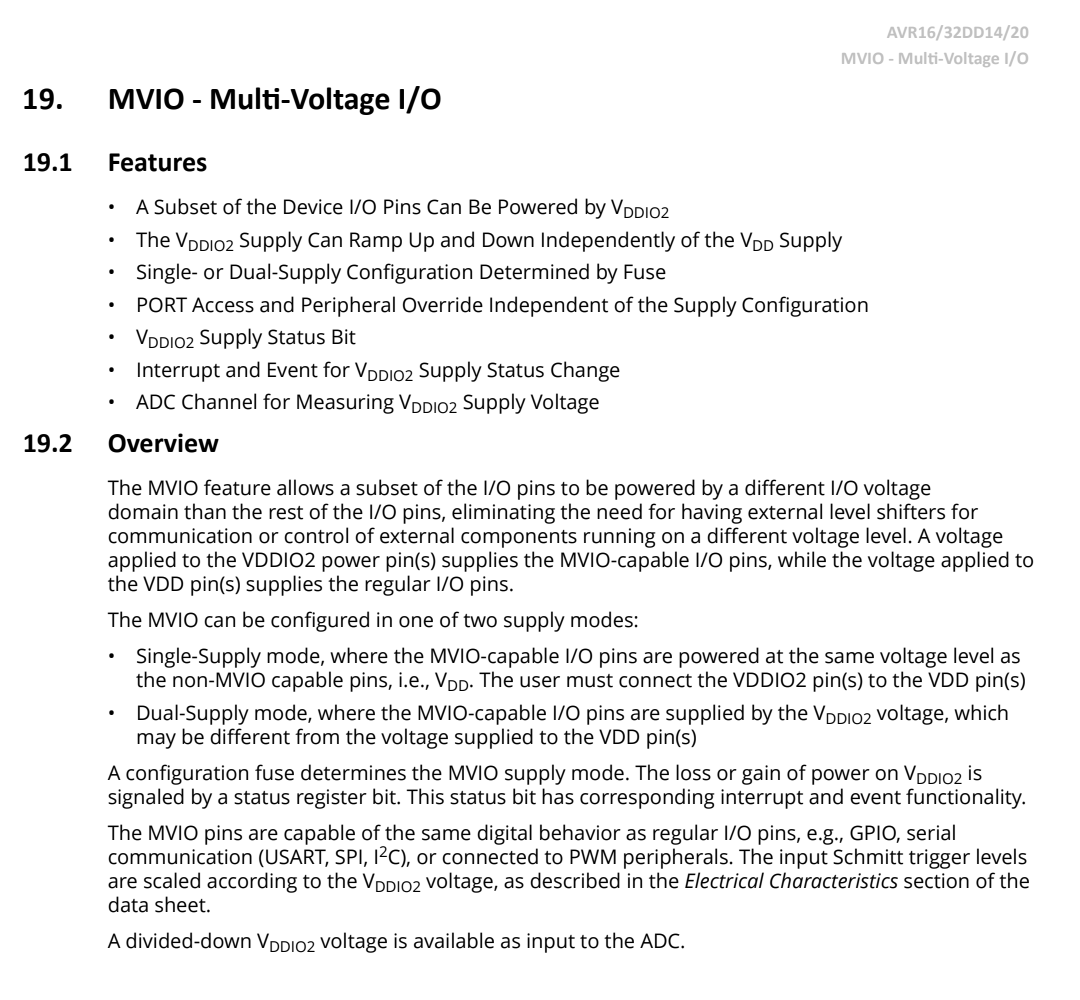
AVR16/32DD14/20
MVIO - Multi-Voltage I/O
19. MVIO - Multi-Voltage I/O
19.1 Features
• A Subset of the Device I/O Pins Can Be Powered by VDDIO2
• The VDDIO2 Supply Can Ramp Up and Down Independently of the
B-Maschine: https://www.youtube.com/channel/UCNIBcY401FsiPh_4y8IeKTQ/videos?view=0&shelf_id=0&sort=dd ...um zu verstehen was man mit AutoHotKey machen kann. Macht das nicht Lust auf ein Sammeleinkauf von z.B. 10 Maschinen? ;) Tomy
15x32cm Tray mit 15mm Abstand zwischen Lanes, Dima Standard. Entweder 10 horizontal oder 20 Vertikal Dies bei 8 oder 12mm, Bei 16 oder 24mm halbiert sich die Anzahl, ... 8mm kann auch alle cm gemacht
library (lcd_io.c) Author: Chris efstathiou hendrix@otenet.gr Date: 2/2/2003 6:35:06 ìì Software: AVR-GCC with AVR-AS Target: any AVR device Comments: This software is FREE. DESCRIPTION Basic routines for interfacing a HD44780U-based text lcd display Based on Volker Oth's lcd library (http://members.xoom.com
library (lcd_io.c) Author: Chris efstathiou hendrix@otenet.gr Date: 2/2/2003 6:35:06 ìì Software: AVR-GCC with AVR-AS Target: any AVR device Comments: This software is FREE. DESCRIPTION Basic routines for interfacing a HD44780U-based text lcd display Based on Volker Oth's lcd library (http://members.xoom.com
nicht unter 2000 ??? Einzige Chance die ich im Moment sehe ist einen PS2 Konzentrator mit einem AVR zu basteln. Also quasi parallel schalten der Tastatur für die Ausgabe und bei Abfragen wird nur die Erste angesprochen.
DRIVERS PORTD DRIVERS PORTG DRIVERS PORTE DRIVERS PE0 - PE7 PB0 - PB7 PD0 - PD7 PG0 - PG4 3 2467R–AVR–06/08 The AVR core combines a rich instruction set with 32 general purpose working registers. All the 32 registers are directly connected to the Arithmetic Logic Unit (ALU), allowing two independent
and regular. 5.2 In-System Reprogrammable Flash Program Memory The ATmega164P/324P/644P contains 16K/32K/64K bytes On-chip In-System Reprogramma- ble Flash memory for program storage. Since all AVR instructions are 16 bits or 32 bits wide, the Flash is organized as 32/64 x 16. For software security, the
2B/3B 4317I–AVR–01/08 AT90PWM2/3/2B/3B Table 3-1. Pin out description (Continued) S024 Pin SO32 Pin QFN32 Pin Number Number Number Mnemonic Type Name, Function & Alternate Function 6 8 4 VCC power Power Supply: Analog
2B/3B 4317I–AVR–01/08 AT90PWM2/3/2B/3B Table 3-1. Pin out description (Continued) S024 Pin SO32 Pin QFN32 Pin Number Number Number Mnemonic Type Name, Function & Alternate Function 6 8 4 VCC power Power Supply: Analog
and regular. 7.2 In-System Reprogrammable Flash Program Memory The ATmega164P/324P/644P contains 16/32/64K bytes On-chip In-System Reprogrammable Flash memory for program storage. Since all AVR instructions are 16 or 32 bits wide, the Flash is organized as 32/64 x 16. For software security, the Flash
syncron Eva_AVM >AVM decompress Kernel: ......................................executeProgram on 0x94103DD0 Linux version 2.6.32.41 (gcc version 4.6.3 (Buildroot 2011.11) ) #2 Mon Jan 14 13:09:57 CET 2013 . . . . Kernel panic - not syncing: [piglet]panic: Can't load dect-fw! Rebooting in 3 seconds
Gibt's auch aus Deutschland und sogar als Bausatz. Funktionsweise, Genauigkeit etc. sind in der "AVR / Arduino-Literatur" lang und breit beschrieben (http://www.mikrocontroller.net/articles/AVR_Transistortester). Mir genügt es meist, wenn der ESR-Wert in der Nähe der Herstellerangaben oder im zweistelligen
Empangsroutine rumliegen, die ich mal in die ArduinoIDE getragen hatte: Die RFM12.c [code] #include <avr/io.h> #include <avr/interrupt.h> #include <avr/pgmspace.h> #include "global.h" #include "RFM12.h" void RFM12_send_cmd(unsigned int command) { unsigned char i; RFM12_PORT &= ~(1<<RFM12
waren bis 5V, die neueren B-Typen nur noch 3,6V max. Bei den alten brauchte man garnichts zum 5V AVR. Gruß aus Berlin Michael
(L) The AVR core combines a rich instruction set with 32 general purpose working registers. All the 32 registers are directly connected to the Arithmetic Logic Unit (ALU), allowing two independent registers to
(L) The AVR core combines a rich instruction set with 32 general purpose working registers. All the 32 registers are directly connected to the Arithmetic Logic Unit (ALU), allowing two independent registers to
habe ich noch Do:Loop Until SPSR.SPIF=1 eingefügt. zudem hab ich die SPI-Funktion mittels 2 AVR auf Funktion überprüft, dass es nun an der SPI-Funktion liegt kann ich aussließen, glaube eher das es an den einzustellenden Hexzahlen liegt oder an der Reihenfolge.
Int0 Data_tx = &H00AA Call Tx_data(data_tx) Data_tx = &HAAAA Call Tx_data(data_tx) Data_tx = &H2DD4 Call Tx_data(data_tx) For I = 5 To 1 Step -1 Data_tx = Tx_telegram(i) Call Tx_data(data_tx) Next I Data_tx = &HAA 'Frame-Ende Call Tx_data(data_tx
Tiefpass-Weg. Das gilt auch für double amping, wenn der Woofer seinen eigenen Verstärker hat. Wenn der AVR einen Woofer-Ausgang hat, der nur Tiefton abgibt, braucht man gar keine Weiche oder Tiefpass vor dem Woofer.
Vorstellung von den Daten meiner "Mittel-Hochtöner".;) https://www.visaton.de/sites/default/files/dd_product/FRS%205.pdf Die "Boxen" sind etwa faustgroß. ;) Komm her und hör's dir an!
the ADC, T/C4, and T/C5 only available in the 100-pin version. PD7..0 PB7..0 PH7..0 PL7..0 5 2549L–AVR–08/07 The AVR core combines a rich instruction set with 32 general purpose working registers. All the 32 registers are directly connected to the Arithmetic Logic Unit (ALU), allowing two independent
Features • Utilizes the AVR RISC Architecture AVR – High-performance and Low-power RISC Architecture – 118 Powerful Instructions – Most Single Clock Cycle Execution – 32 x 8 General Purpose Working Registers – Up to 10 MIPS Throughput
Features • Utilizes the AVR RISC Architecture AVR – High-performance and Low-power RISC Architecture – 118 Powerful Instructions – Most Single Clock Cycle Execution – 32 x 8 General Purpose Working Registers – Up to 10 MIPS Throughput
the ADC, T/C4, and T/C5 only available in the 100-pin version. PD7..0 PB7..0 PH7..0 PL7..0 5 2549I–AVR–07/06 The AVR core combines a rich instruction set with 32 general purpose working registers. All the 32 registers are directly connected to the Arithmetic Logic Unit (ALU), allowing two independent
TWI PORT D (8) PORT B (8) PORT C (7) RESET XTAL[1..2] PD[0..7] PB[0..7] PC[0..6] ADC[6..7] 3 2545B–AVR–01/04 The AVR core combines a rich instruction set with 32 general purpose working registers. All the 32 registers are directly connected to the Arithmetic Logic Unit (ALU), allowing two independent

 Bild
Bild