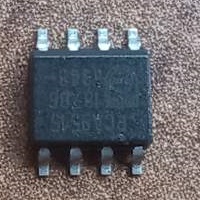
Wenn du größere Kabellängen brauchst kannst du auch i2c-Treiber einsetzen. z.B. P82B96, P82B715 oder PCA9515, damit sind bis zu 3000pF möglich bzw. etwa 50m Leitungslänge. grüsse leo9
Geht, siehe Datenblatt (nicht User Manual) Seite 9 (Pin description). Ansonsten gibt es den PCA9515, ein I2C Bus Repeater der 5V Tolerant ist. - Michael
einfach. Wie weit geht der I2C Bus? Habe schon gesucht. Mit entsprechenden Treibern und Empfängern z.B. PCA9515 und P82B96 und P82B715 geht das. Ist im Hausbus oder auf NXP alles beschrieben. Leider haben diese den Nachteil, das ich immer 2 verwenden muss. Was kann ich aber nehmen, nur 1 IC, um längen von
Hallo, habe jetzt bei Reichelt folgenden Chip gefunden. PCA 9515 D :: Philips I²C-Bus Microcontroller & Peripherie Komisch das Phillips nicht auf die Idee mit dem draufklemmen gekommen ist. Haben die deshalb eine Lösung gesucht mit einen Chip, damit die
Bislang kam ich immer mit i2c au, dies kann das BTM222 nicht. Auch finde ich es langsam nervig ständig PCA9515 als i2c levelshifter einzusetzen. Werden teuer auf dauer, habe ich gerade nicht da und kriege ich bis zum Wochenende nicht. Gleiches gilt für UART levelshifter. Daher kam mir diese idee. Freue mich
beim I²C-Bus eigentl. nur mit entsprechenden Treibern realisieren, z.B.: P82B715 I²C-Bus Extender PCA9515 I²C-Bus Repeater Mit dem SHT11 habe ich (durch die Verringerung des Pull-Ups an SDA auf 1k) aber auch schon Messwerte über ca. 2m Flachbandkabel übertragen.
Ja der AVR läuft mit 5V, dazwischen habe ich aber einen PCA9515 der zwischen 5V und 3V shiftet. Alle geposteten Messungen habe ich selbstverständlich auf der 3V Seite vorgenommen!
sehr sauber aus. der AVR läuft mit 5V/12 MHz, das Display mit 3.3V, dazwischen hängt sogar ein PCA9515 als Pegelwandler. Pullups sind 4k7 (jeweils am AVR und am Display) und 10k am Pegelwandler. ich bin mir nun nicht sicher, was mir das Display damit sagen will. Für "ich hab grad keine zeit" wäre
Geschwindigkeit s.o. Beispiel: I2C-Bus: gemeinsam 3.3V und 5V. MSP430 an 3,3V/5V: slaa148.pdf Philips PCA9515: I2C Puffer mit Pegelwandlung. Der PCA9515 ist ein I2C-Bus Repeater, welcher I2C Busse mit verschiedenen Spannungen isoliert. Verfügbar bei Reichelt und DigiKey. AN97055 von Philips, "Bi-directional
without exceeding the 400 pF specs. A total of 400 pF would be allowed on each side of the interface. PCA9515 can also be used to link (just) two standard 400pF busses like this. It IS allowed to interconnect, say, 10 of these interfaces together on the ‘new’ bus formed by the linked TxD/RxD pins and thus
without exceeding the 400 pF specs. A total of 400 pF would be allowed on each side of the interface. PCA9515 can also be used to link (just) two standard 400pF busses like this. It IS allowed to interconnect, say, 10 of these interfaces together on the ‘new’ bus formed by the linked TxD/RxD pins and thus
SDA und SCL haben keine zusätzliche Beschaltung. Der Raspberry besitzt aber einen I2C Repeater (PCA9515) ohne Pullups. Allerdings gehe ich nicht davon aus, dass diese Platine speziell für Rolladenmotoren ist. PE und N hätte man sich dafür sparen können. Auch die ungerade Zahl von 11 Relais spricht
conversion of I C SDA or SCL signals to multi-drop differential bus hardware, e.g., via compatible PCA82C250. voltage level. If this special “buffered low” is applied to the Sx/Sy of another P82B96 that second P82B96 will not recognize it as a Interfaces with Opto-couplers to provide Opto isolation between
conversion of I C SDA or SCL signals to multi-drop differential bus hardware, e.g., via compatible PCA82C250. voltage level. If this special “buffered low” is applied to the Sx/Sy of another P82B96 that second P82B96 will not recognize it as a Interfaces with Opto-couplers to provide Opto isolation between
conversion of I C SDA or SCL signals to multi-drop differential bus hardware, e.g., via compatible PCA82C250. voltage level. If this special “buffered low” is applied to the Sx/Sy of another P82B96 that second P82B96 will not recognize it as a Interfaces with Opto-couplers to provide Opto isolation between
conversion of I C SDA or SCL signals to multi-drop differential bus hardware, e.g., via compatible PCA82C250. voltage level. If this special “buffered low” is applied to the Sx/Sy of another P82B96 that second P82B96 will not recognize it as a Interfaces with Opto-couplers to provide Opto isolation between
conversion of I C SDA or SCL signals to multi-drop differential bus hardware, e.g., via compatible PCA82C250. voltage level. If this special “buffered low” is applied to the Sx/Sy of another P82B96 that second P82B96 will not recognize it as a Interfaces with Opto-couplers to provide Opto isolation between
and fast mode plus I C-bus devices in additional to SMBus. The TCA9406 is not a bus buffer like the PCA9515A and PCA9517. It provides both level translation and physically isolates the capacitance to either side of the bus when both sides are connected. The I offfeature can be utilized to isolate the
of I C-bus SDA or SCL signals to multi-drop differential bus hardware, for example, via compatible PCA82C250 n Interfaces with opto-couplers to provide opto-isolation between I C-bus nodes up to 400 kHz. 4. Ordering information Table 1. Ordering information Type number Package Name Description Version
the PCA9517 bus buffer or the PCA9546A switch. • Switched pull-up circuit (Section 7.2.4): A switched pull-up circuit can be used to accelerate rising edges by switching a low value pull-up alternately in and
the PCA9517 bus buffer or the PCA9546A switch. • Switched pull-up circuit (Section 7.2.4): A switched pull-up circuit can be used to accelerate rising edges by switching a low value pull-up alternately in and
the PCA9517 bus buffer or the PCA9546A switch. • Switched pull-up circuit (Section 7.2.4): A switched pull-up circuit can be used to accelerate rising edges by switching a low value pull-up alternately in and
the PCA9517 bus buffer or the PCA9546A switch. • Switched pull-up circuit (Section 7.2.4): A switched pull-up circuit can be used to accelerate rising edges by switching a low value pull-up alternately in and
the PCA9517 bus buffer or the PCA9546A switch. • Switched pull-up circuit (Section 7.2.4): A switched pull-up circuit can be used to accelerate rising edges by switching a low value pull-up alternately in and
the PCA9517 bus buffer or the PCA9546A switch. • Switched pull-up circuit (Section 7.2.4): A switched pull-up circuit can be used to accelerate rising edges by switching a low value pull-up alternately in and
C318 - - A A B B A A U Freon MF - B U U B - B B U Glykokoll (Aminoessigsäure, U U A A A U B B U Freon PCA - A A U B - A A U Leimsüß) Freon TA - A A A U - A A A Glykolsäure (Hydroxyessigsäure)U U B A B A A A A Freon TC - A A B A - A A U Grubengas (Methan) A U B B A A A A A Freon TF - A A U A U A A U Freon
which have the same CTN (Commercial Type 6 = play 16 : 9 format, 12 = play 4 : 3 Number; e.g. 28PW9515/12) but which have a different B.O.M. format number. AARA Automatic Aspect Ratio Adaptation: By looking at the third digit of the serial number, one can algorithm that adapts aspect ratio to identify

 Bild
Bild