. Habe hier zB zwei funktionierende 7447 von 1972, habe ich stilgerecht auf ein Breakout mit zwei 3015F gesetzt :) Eher sollte man dem Vernehmen nach bei altem MOS-Zeug ESD sehr ernstnehmen. Es gibt wohl Herstellungsfehler/Materialwissenschaftliche Fallstricke geben die zum "Verrotten" bestimmter
in einer Stunde mit Hausmitteln brauchbare Platinen zu fertigen. In meinem Fall sogar mit einem HP3015 Laserdrucker. Und da das ja ein Hobby ist zählt das dann als sinnvoll-produktiv verbrachte Freizeit, das warten auf den Postboten zählt für mich als vertane Zeit.
boards 1 6 COMPLIES WITH THE FOLLOWING STAN- DARDS: 2 5 IEC61000-4-2 : level 4 MIL STD 883C-Method 3015-6 : class3 3 4 (human body model) March 2000 Ed: 5D 1/7 ESDAxxSC5 / ESDAxxSC6 ABSOLUTE MAXIMUM RATINGS (T amb= 25°C) Symbol Test conditions Value Unit VPP ESD discharge - MIL STD 883C - Method 3015-
verkaufe wie oben beschrieben den AAT1230ITP von Analogic Tech. incl. Inductor (2,2µH) NR3015T2R2 von Taiyo Yuden. Ich habe den für die Erzeugung der OLED-Spannung von 13V/10V benutzt. Das OLED war ein DD160128FC-1A. Sind noch einige über, da ich bei Mouser etwas mehr bestellt hatte. Der
brauchte ich 5,7 Volt, das konnte ich mit OKI-78sr nicht machen, dann kam TS3552CS in Einsatz. Auch AOZ3015AI ist nicht schlecht: mit P-MOSFET, deshalb 1 Kondensator weniger. Beide sind synchron, d.h. brauchen keine Diode und haben keine Verluste von Diode. Es gibt viele Varianten... Buck-Wandler haben
Ich benutze nach einem kurzem Zwischenspiel mit einem Tintendrucker jetzt wieder einen HP Laser (3015) und bin damit sehr zufrieden: Kein Eintrocknen und der Toner hält Tausende Seiten.
5706/document1.tif Projekt 2. Kühlkörper. CNC Programm : http://img21.imageshack.us/img21/3015/document2.tif Die Projekte wurden an einer Maho 600C Maschine abgearbeitet. Ich stehe dafür gerade das das meine Programmierung war ( falls einer meint das kann nicht von mir sein oder so )
gerne nicht nur MOSFETs von A&O, die hat auch gute Wandler in Programm. Ich habe gerade 50 St. AOZ3015AL bekommen. Die gilt zwar als "nicht für neue Entwicklungen", aber für mich ist IC sehr, sehr gut. Mit Iout bis 3A immer noch SOP-8 ohne Pad unten. D.h. auch ohne Ofen gut zu löten.
Resolutionbandbreite von 8MHz? > > Kaum zu glauben. Nuja, dann legst Du nochmal was drauf. Für einen RSA3015N möchte Batronix aktuell 2497,81€ (inkl. MwSt). Dafür gibt es 10 MHz RBW. Selbst, wenn man weniger hat, dann setzt man sich auf die Kanalkante und kann trotzdem den Pegel des OFDM-Signals ermitteln
STANDARDS: IEC61000-4-2, level 4 ±15 kV (air discharge) ±8 kV (contact discharge) MIL STD 883E, Method 3015-7 Class 3 C = 100 pF R = 1500 3positivestrikesand3negativestrikes(F=1Hz) ABSOLUTE RATINGS (T amb = 25°C) Symbol Parameter Value Unit V PP ESD discharge IEC 61000-4-2, air discharge ±16 kV ESD discharge IEC 61000-4-2, contact discharge ±9 kV ESD discharge - MIL STD 883E - Method 3015-7 ±25 kV T j Maximum junction temperature 150 °C T Storage temperature range - 55 to +150 °C stg TL Lead solder temperature (10 second duration) 260 °C T op Operating temperature range 0 to 70 °C P
equipment against electrostatic A discharges according to IEC 61000-4-2, and MIL STD 883, method 3015, and electrical over stress according to IEC 61000-4-4 and 5. These K K devices are more generally used against surges below 600 W (10/1000 μs). Planar technology makes these devices suitable Unidirectional
0xfd031000 (irq = 122) is a stasc stasc.1: ttyAS1 at MMIO 0xfd032000 (irq = 121) is a stasc Marvell 88E3015: Registered new driver GMAC - user ID: 0x10, Synopsys ID: 0x33 No valid MAC address yet; it will be set from the console later. eth0 - (dev. name: stmmaceth - id: 0, IRQ #134 IO base addr:
0xfd031000 (irq = 122) is a stasc stasc.1: ttyAS1 at MMIO 0xfd032000 (irq = 121) is a stasc Marvell 88E3015: Registered new driver GMAC - user ID: 0x10, Synopsys ID: 0x33 No valid MAC address yet; it will be set from the console later. eth0 - (dev. name: stmmaceth - id: 0, IRQ #134 IO base addr:
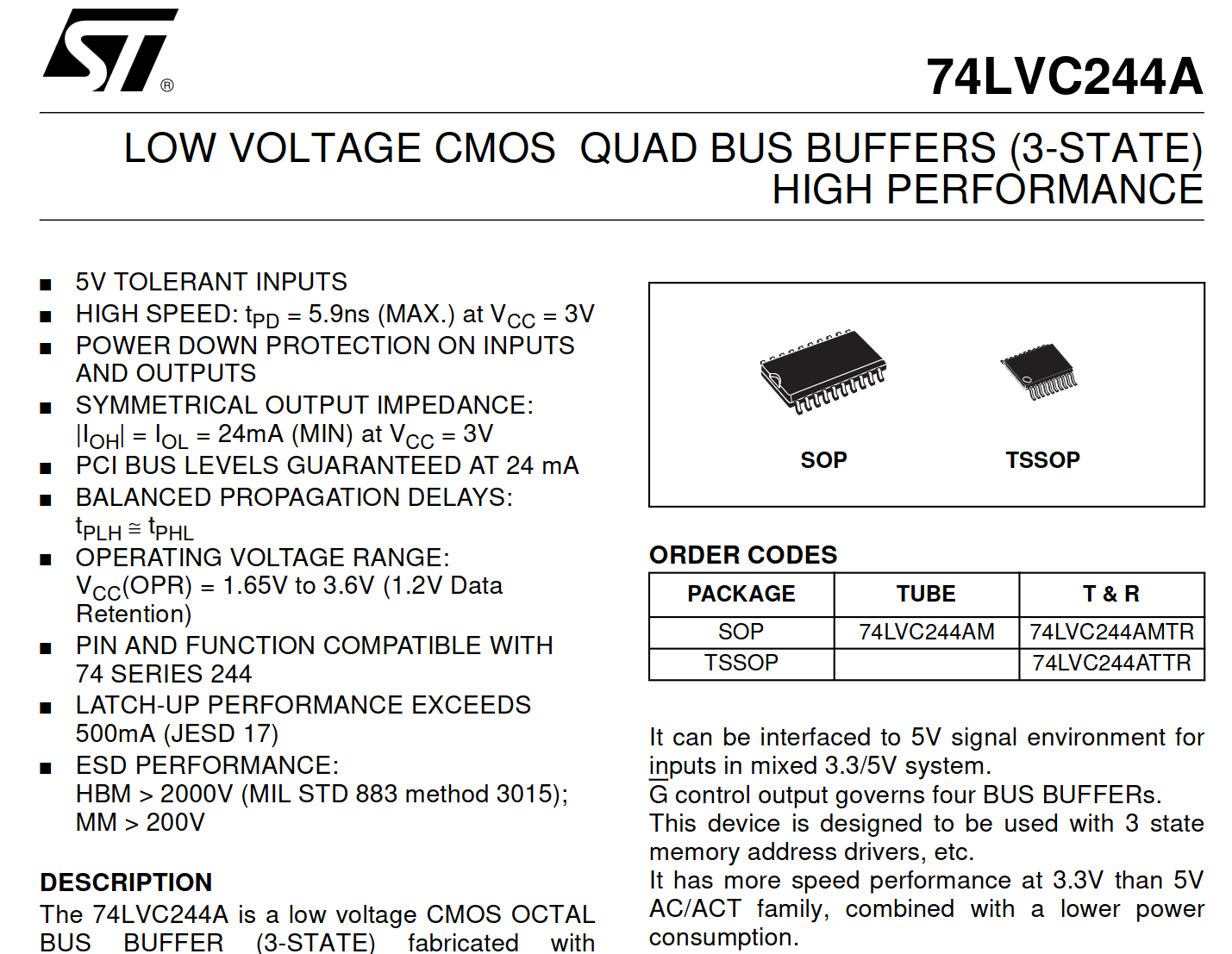
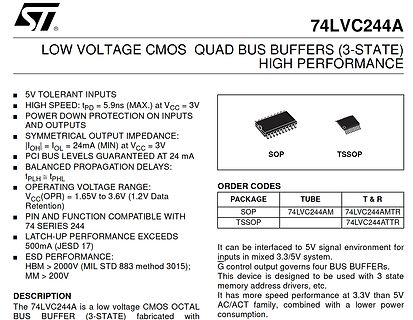
244 LATCH-UP PERFORMANCE EXCEEDS 500mA (JESD 17) ESD PERFORMANCE: HBM > 2000V (MIL STD 883 method 3015); MM > 200V ORDER CODES PACKAGE TUBE T & R SOP 74LVC244AM 74LVC244AMTR TSSOP 74LVC244ATTR DESCRIPTION The 74LVC244A is a low voltage CMOS OCTAL BUS BUFFER (3-STATE) fabricated with
-2 level 4 discharges according to IEC 61000-4-2, and – 15 kV (air discharge) MIL STD 883, method 3015, and electrical over – 8 kV (contact discharge) stress according to IEC 61000-4-4 and 5. These devices are generally used against surges below ■ IEC 61000-4-5 (see Table 3 for surge level) 400 W (10/1000 μs). ■ MIL STD 883G, method 3015-7 Class 3B Planar technology makes these devices suitable – 25 kV HBM (human body model) for high-end equipment and SMPS where low ■ Resin meets UL 94, V0 leakage current and high junction temperature
2 level 4: discharges according to IEC 61000-4-2, and – 15 kV (air discharge) MIL STD 883, method 3015, and electrical over – 8 kV (contact discharge) stress according to IEC 61000-4-4 and 5. These devices are more generally used against surges ■ IEC 61000-4-5 below 600 W (10/1000 μs). ■ MIL STD 883G, method 3015-7 Class 3B: Planar technology makes these devices suitable – 25 kV HBM (human body model) for high-end equipment and SMPS where low ■ Resin meets UL 94, V0 leakage current and high junction temperature
low power consumption (1.65mW), and an ESD tolerance of 2000V (<5nA at +85°C) G minimum per Method 3015.7. The new design offers ♦ Withstand Electrostatic Discharge (2000V min) per Method 3015.7 4 lower off-leakage current over temperature (less than 5nA at +85°C). 4 Existing Features The DG441/DG442
PISS10114 PA6 PISS20114 PB10 PISS3014 PIUC1094 BOOT0 PE4 P I U C 1 0 3 NLPE5 PISS10115 PISS20115 PISS3015 PE5 P I U C 1 0 4 NLPE6 PC1 PISS10116 PA7 PISS20116 PB11 PISS3016 PE6 P I U C 1 0 5 PE6 C PO NRSTT NRSTS PIUC1014 NRST PE7 PIUC1038 PE7E7 SS11 SS2 2 SS33 C GND PIUC1020 VREF- PE8 PIUC1039 PE8E8 PB12
Thema: Gleicher Fall mit einem 22nF/630-FolienC: Yamaha-RX-Amplifier und der berühmte C254 - C405 - C3015: http://www.mikrocontroller.net/topic/285487#new der geht trotz Reihenwiderstand R412 = 2,2k kaputt (Kapazitätsverlust durch ständige Selbstheilung)
consumption, and an ESD Improved Charge Injection (10pC max) tolerance of 2000V minimum per Method 3015.7. The Improved Off-Leakage Current Over Temperature G (<5nA at +85°C) 4 new design offers low off-leakage current over temper- ature (less than 5nA at +85°C). Withstand Electrostatic Discharge (2000V min) 1 The DG417/DG418 are single-pole/single-throw (SPST) per Method 3015.7 8 switches. The DG417 is normally closed, and the / DG418 is normally open. The DG419 is single- __________________Existing Features D pole/double-throw (SPDT) with one normally closed Low R DS(ON
0,8 Ms 0,8 Ms 0,8 g/1000 450 480 440 440 420 600 640 700 710 Artikel Nr. 61-1889-11 61-1889-14 67-3015-11 61-1536-11 61-2410-11 61-3025-11 61-3025-14 61-1990-11 61-1991-11 b 1 l1 6,3 x 18 6,3 x 20 6,3 x 24 6,3 x 24 6,3 x 37 6,3 x 40,7 6,3 x 67,6 13 x 16 13 x 16 b 2 l2 1,4 x 4 1,3 x 4 1,4 x 5 1,4 x 5
Measured at 100Vdc) ENVIRONMENTAL & MECHANICAL SPECIFICATIONS ESD Susceptibility MIL-STD-883, Method 3015, Class 1, HBM: 1500V Fine Leak Test MIL-STD-883, Method 1014, Condition A Flammability UL94-V0 Gross Leak Test MIL-STD-883, Method 1014, Condition C Lead Integrity MIL-STD-883, Method 2004 Mechanical
von der ich zufällig ein Foto habe. Gezeichnet noch mit Eagle 7 und gedruckt auf einem HP Laserjet 3015. Belichtet mit oben genannten Gesichtsbräuner und geätzt mit Salzsäure aus dem Baumarkt. Investitionskosten: ca. 50€ (ohne Drucker, sowieso vorhanden) Herstelldauer ab Foliendruck: 1h.
R Flatness over Specified Signal 2 consumption and ESD tolerance greater than 2000V per ON Method 3015.7 are guaranteed. Range (2Ω max) M The MAX312/MAX313/MAX314 are quad, single- ♦ Guaranteed ESD Protection > 2000V per Method A pole/single-throw (SPST) analog switches. The MAX312 3015.7 is normally
Trafonetzteil mit 5-Ampere-Regler davor, den Strom hat noch Papa bezahlt. Die Anzeigen waren Minitron-3015 und fehlerhafte Anzeigen kamen relativ häufig vor.

 Bild
Bild
 Bild
Bild
 Bild
Bild
 Bild
Bild
 Bild
Bild
 Bild
Bild
 Bild
Bild
 Bild
Bild