Hello,
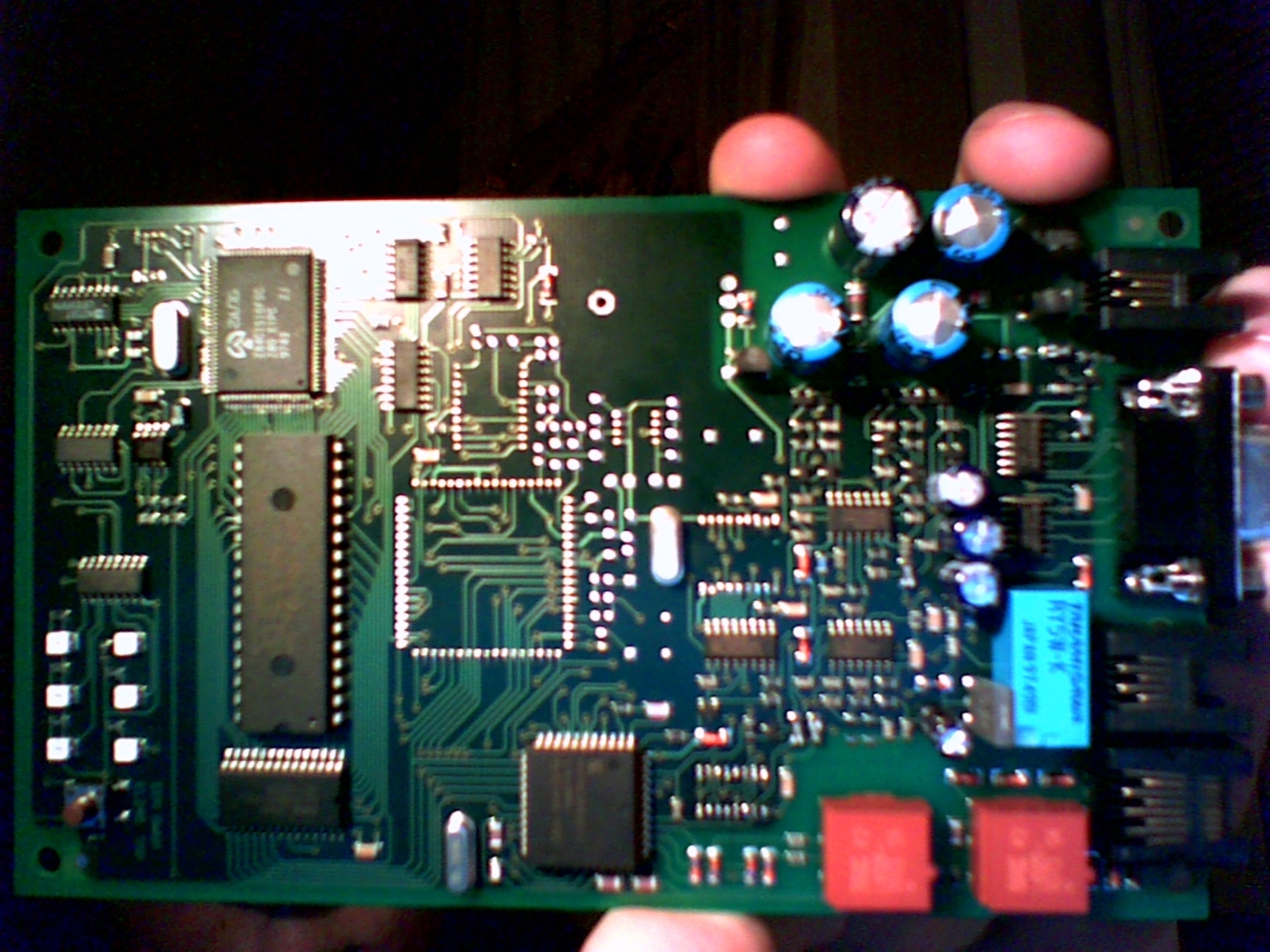
The product you show on the photo is a ISDN - RS232 device.
It was on the market around 1996-1998.
In it's full version (i'll come to that) it's a "serial modem like"
product, intended to connect to the serial RS-232/v24 port, as well as
an "a/b" adapter, to connect a analog phone to the ISDN.
The "modem" part could be controlled as a AT command device that was
common with analog modems in those days. So called "AT-compatible"
modems.
It had both an analog as digital function: it could work as an analog
modem i.e. as fax modem and/or V34 modem, and also to connect to the
Internet through a dial-up connection.
It could connect to the internet both on a analog as digital basis. On a
digital basis, it is a ISDN R or TE2 device, fully digital, and can best
be described as a bitrate adapter. In those days, dail-up connections
had a speed of multiple of 300 bits/sec, so: 300, 1.200, 2.400, 4.800,
9.600, 19.200, 38.400 etc. That where the RS-232 bitrate's found on
"IBM" compatible PC's.
On a analog basis, an Internet dail-up connection as a V34 modem.
So, with this one device -let's call it a "modem"- the user could both
send/receive faxes as well connect to the internet using a dail-up
connection, either analog with V34 or digital via ISDN. A so called "all
in one" product ;-).
Now the product you show: It lack's the following componentes:
The big chip is the V34 modem, RCV288DPi from Rockwell
The chip "above" it, is a mc14lc5480, an a/u law codec (motorola).
The chip to the "right" that fails is a 8870, a dtmf decoder (industry
standard).
It seems that the analog part has been removed at all, so that it
basicly now is a bitrate adapter, to adapt the speed of a RS-232 port to
the ISDN 64k bits/s (or perhaps 2 x 64k bits/sec.).
It can not be used as an analog fax modem, nor the analog phone
connector will work.
So it's not an eval board, but a real product that was on the market in
the transition days from analog telephone network towards ISDN.
Good luck.
Anton