Gast
#565360
Hallo zusammen,
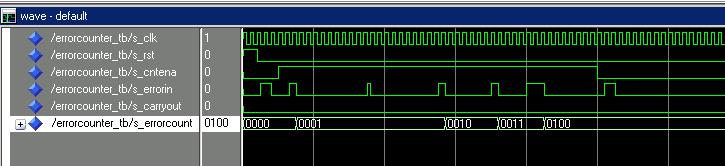
hab da ein kleines Problem mit einem Zähler. Der sollte hochzählen
sobald der Eingang ErrorIn bei rising_edge(clock) und CountEna = 1 high
ist. Das funktioniert bei einzelnen bits aber bei drei hintereinander
folgenden eins zählt er nur einmal hoch. Bin bis jetzt bei der
Fehlersuche nicht fündig geworden. Könnte mir jemand helfen ?
Danke im Voraus.

Hier die quellcode:

library ieee;
use ieee.std_logic_1164.all;
use ieee.std_logic_arith.all;

entity ErrorCounter is
    generic( n : natural := 4 );
       port( clock :  in std_logic;
             reset :  in std_logic;
          CountEna :  in std_logic;  -- is 1 when synchronity is given
           ErrorIn :  in std_logic;  -- Error detected
          CarryOut : out std_logic;  -- Triggers incrementation of Cnt
No2
        ErrorCount : out std_logic_vector(n-1 downto 0) );
end entity ;

architecture ErrorCounter_arch of ErrorCounter is

type state_type is (s0,s1,s2,s3,s4,s5,s6,s7,s8,s9);

signal curr_state,next_state : state_type;
signal s_counter : std_logic_vector(n-1 downto 0);

constant tdelay      : time := 50 ns;
constant tperiod     : time := 15000 ns;

begin
Sync_proc : process(clock,reset,CountEna)
     begin
         if reset = '1' then
            curr_state <= s0;
         else
            if  rising_edge(clock) and CountEna = '1' then
                curr_state <= next_state;
            end if;
         end if;
end process;
state_proc: process(next_state,ErrorIn)
    begin
        CarryOut <='0';
        case curr_state is
            when s0 =>
                ErrorCount <= "0000";
                if (ErrorIn = '1') then
                   next_state <= s1;
                else
                   next_state <= s0;
                end if;

            when s1 =>
                ErrorCount <= "0001";
                if (ErrorIn = '1') then
                   next_state <= s2;
                else
                   next_state <= s1;
                end if;

            when s2 =>
                ErrorCount <= "0010";
                if (ErrorIn = '1') then
                   next_state <= s3;
                else
                   next_state <= s2;
                end if;

            when s3 =>
                ErrorCount <= "0011";
                if (ErrorIn = '1') then
                   next_state <= s4;
                else
                   next_state <= s3;
                end if;

            when s4 =>
                ErrorCount <= "0100";
                if (ErrorIn = '1') then
                   next_state <= s5;
                else
                   next_state <= s4;
                end if;

            when s5 =>
                ErrorCount <= "0101";
                if (ErrorIn = '1') then
                   next_state <= s6;
                else
                   next_state <= s5;
                end if;

            when s6 =>
                ErrorCount <= "0110";
                if (ErrorIn = '1') then
                   next_state <= s7;
                else
                   next_state <= s6;
                end if;

            when s7 =>
                ErrorCount <= "0111";
                if (ErrorIn = '1') then
                   next_state <= s8;
                else
                   next_state <= s7;
                end if;

            when s8 =>
                ErrorCount <= "1000";
                if (ErrorIn = '1') then
                   next_state <= s9;
                else
                   next_state <= s8;
                end if;

            when s9 =>
                ErrorCount <= "1001";
                if (ErrorIn = '1') then
                   next_state <= s0;
                   CarryOut <= '1';
                else
                   next_state <= s9;
                end if;
        end case;
end process;
end architecture ;
Angehängte Dateien:
-
 wave.jpg
(28 KB)
wave.jpg
(28 KB)