TI DRV8833 Muss man den PWM Pin wechseln?

OP #3764197
Lesenswert?

Guten Tag,

ich habe folgendes Problem:

Ich möchte zwei DC Motoren mit oben genanntem Chip,
TI DRV8833 betriben (Datenblatt habe ich beigefügt).

Das ganze soll über einen Mikrocontroller angesteuer werden und die 
Geschwindigkeit der Motoren soll per PWM gesteuert werden. Pro Motor ein 
PWM Signal.

Mein Problem ist nun folgendes:

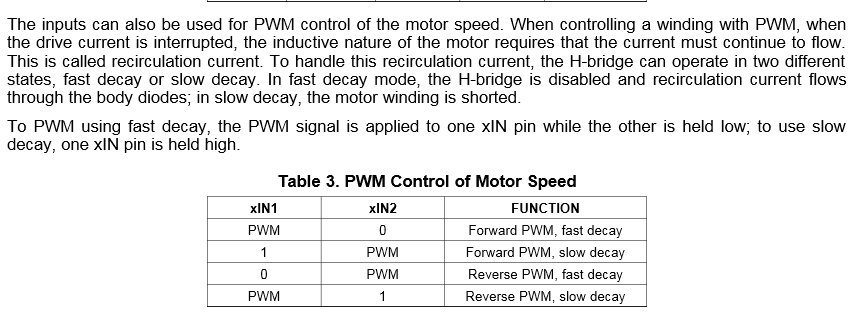
In Tabelle 8 Seite 3 Datenblatt steht die Pinbelegung für die versch. 
Auslaufmöglichkeiten. (Siehe Screenshot)

Ich möchte den Motor vorwärts und rücwärts auf dieselbe Weise bremsen. 
Laut dieser Tabelle müsste ich aber nun den PWM immer auf den anderen 
Anschluss legen?

Gibt es hier eine andere Möglichkeit? Es kann doch nicht sein, dass ich 
den PWM Pin wechseln muss, bzw. 4 Pins für PWM verwenden muss.

Vielen Dank.
Angehängte Dateien:
Gast #3764386
Lesenswert?

Warum muss es dieser Chip sein?
Evtl. gibt es ja einen, der nur einen PWM- Input benötigt und Du für die 
Umschaltung sorgen kannst?

Wenn es aber dieser sein muss, dann kannst Du doch die Logik ziemlich 
einfach mit standard TTL - Technik aufbauen!

Gruß T.
Gast #3769144
Lesenswert?

seems to be so: both input-pins should be able to output a PWM-signal
http://ebldc.com/?p=264:

EBLDC: That definitely sounds easy! So I can control direction of 
rotation by selecting output polarity. But what if I want to control the 
speed? This is a must when driving a DC motor, right?

DRV8833: But of course! This can be easily done as well since my inputs 
can be PWM’d. Just apply a PWM signal to the driving input and my 
outputs will follow. For example, if you make AIN1 HI and AIN2 is being 
PWM’sd, then current will flow from AOUT1 to AOUT2 when the PWM signal 
is in the OFF state and I will enter slow decay mode when the PWM signal 
is at the ON state. You can do it backwards to. Make AIN1 LO and then I 
will conduct when AIN2 is HI and enter slow decay when AIN2 is LO.

EBLDC: Intriguing… So it seems we can only do slow decay then?

DRV8833: Ehh… That is not true actually! You can do fast decay if 
instead of a single PWM you have two of them. If both AIN1 and AIN2 are 
being PWM’d in such a fashion that they are always opposing each other, 
then I will be entering fast decay at all times.
Gast #3770082
Lesenswert?

Stefan B. schrieb:
> Thanks a lot.
>
> I thought i would be wrong but it seems that i will ned two pwm outputs
> to controll this chip.

Lies das Datenblatt und VERSTEHE auch was drin steht. Wenn dir der IC zu 
komplex ist, dann nimm einen einfacheren.
Ansonsten wenn du es nicht besser weißt: es gibt auch Logikbausteine 
(AND) mit denen kann man da was machen ("pwm and logic") dann spart man 
sich einen pwm Pin ...

Antwort schreiben

Bitte melde dich an, um einen Beitrag zu schreiben.

oder

Mit Google-Account einloggen

Die Registrierung ist kostenlos und dauert nur eine Minute.

Jetzt registrieren