USB OTG mit Ladefunktion

Gast #4156047
Lesenswert?

Hallo,

da ich zurzeit mit einem Windows Tablet arbeite und Tastatur und Maus 
angeschlossen habe, kann ich es nicht während dem arbeiten laden. Hat 
nur einen Micro USB Port.
Da es anscheinend keine OTG Kabel gibt, die ein Laden zulassen (warum 
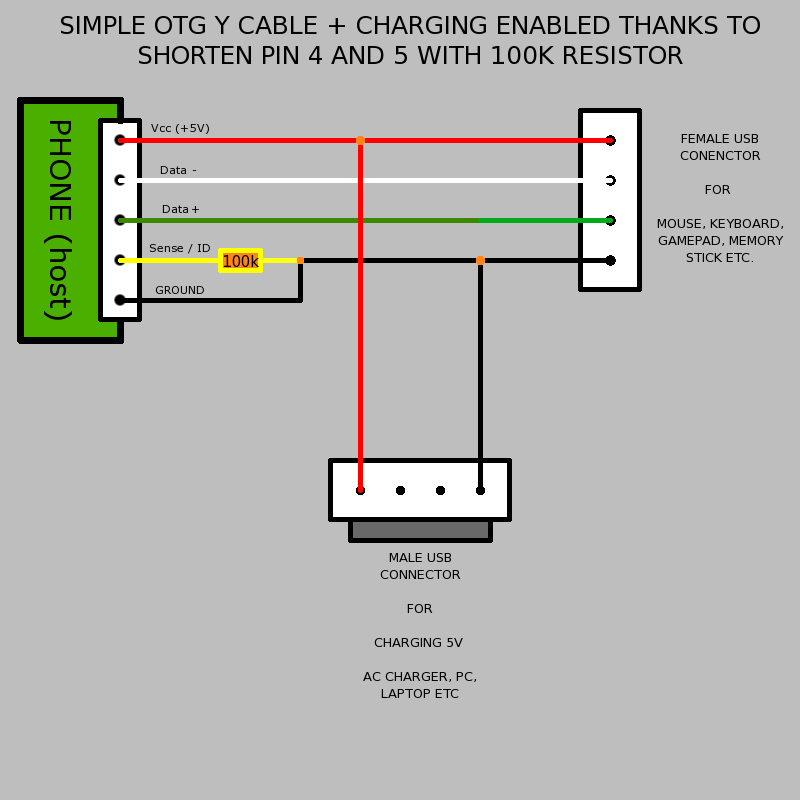
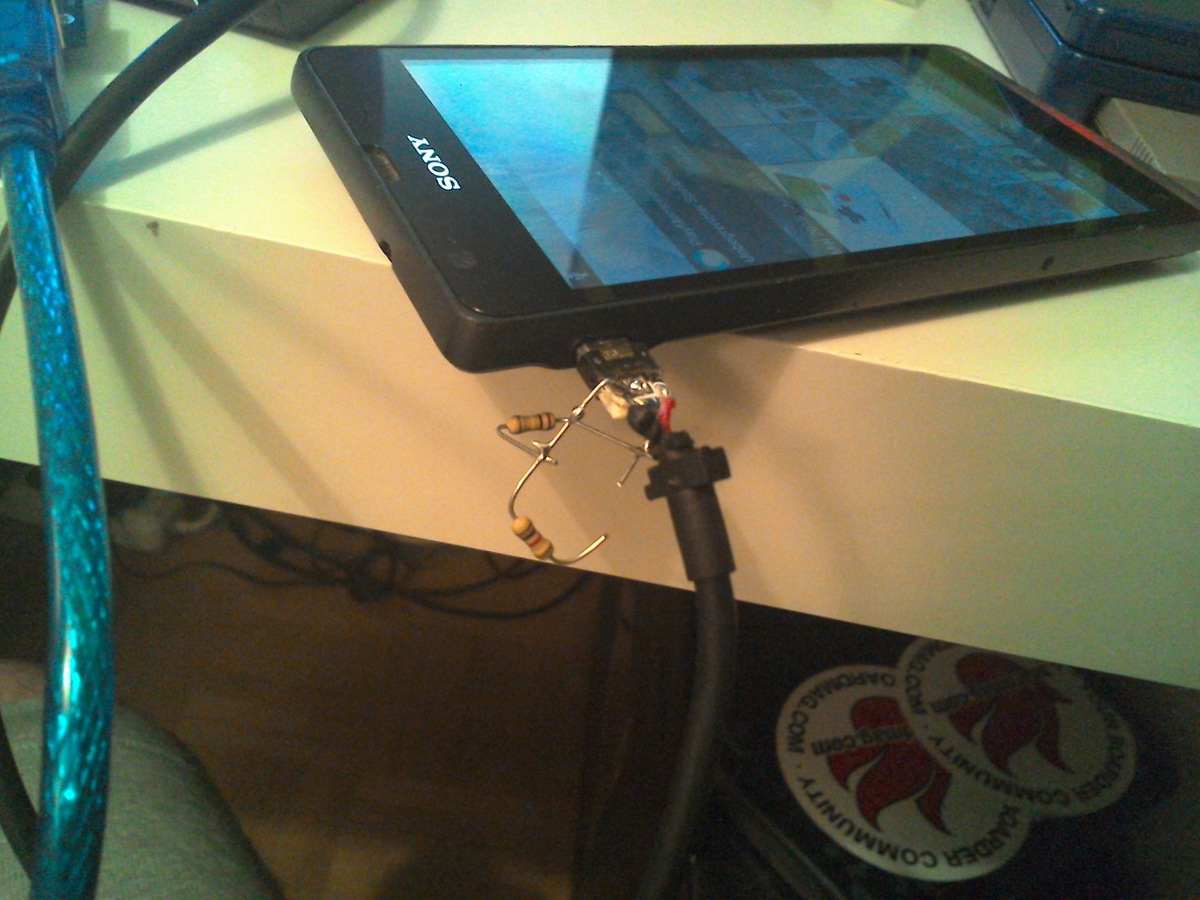
eigentlich nicht?) ,aber es im Internet Workarounds wie diese[1] gibt, 
kann man das ja selber machen.
Allerdings, ist der 100K Widerstand von Bedeutung ?

[1]Anhang
Angehängte Dateien:
Gast #4512672
Lesenswert?

habe jetzt mal bisschen gesucht..

das englische wikipedia gibt für USB On-The-Go folgendes an:

grounded: A-device, acts as the default host
floating: B-device, acts as the default peripheral

Three additional ID pin states are defined at the nominal resistance 
values of 124 kΩ, 68 kΩ, and 36.5 kΩ, with respect to the ground pin.

- A charger and either no device or an A-device that is not asserting 
VBUS (not providing power) are attached. The OTG device is allowed to 
charge and initiate SRP but not connect
- A charger and an A-device that is asserting VBUS (is providing power) 
are attached. The OTG device is allowed to charge and connect but not 
initiate SRP
- A charger and a B-device are attached. The OTG device is allowed to 
charge and enter host mode

als Referenz wird sich allerdings auf folgendes bezogen:

Battery Charging Specification (Rev 1.1)

- 124 kΩ / ACA ID pull-down, OTG device as A-device
- 68 kΩ / ACA ID pull-down, OTG device as B-device, can't connect
- 36.5 kΩ / ACA ID pull-down, OTG device as B-device, can connect

funktioniert jedoch bei mir alles nicht :(
Gast #5197008
Lesenswert?

Du brauchst einen kompatiblen Kernel-Treiber, der ein USB-Proxy Device 
(Hardware) erkennt. Das zu entwickelnde (Hardware-)Gerät arbeitet auf 
der einen Seite als USB-Host (zum OTG-Hub hin) und auf der (weiteren) 
anderen Seite ebenfalls als USB-Host (zum Smartphone hin). Der Treiber 
muss dann das Smartphone / Tablet in den Slave-Modus schalten (als wäre 
ein PC oder ist ein (das) Netzteil angeschlossen) und im Linux-Kernel 
einen virtuellen USB-Host bereitstellen, der ganz "nicht virtuell" als 
USB-(Host-)Gerät vom System erkannt wird.
Beitrag #6920616 wurde von einem Moderator gelöscht.

Antwort schreiben

Bitte melde dich an, um einen Beitrag zu schreiben.

oder

Mit Google-Account einloggen

Die Registrierung ist kostenlos und dauert nur eine Minute.

Jetzt registrieren