1 | #include <stm32f30x.h>
|
2 | #include <stm32f30x_gpio.h>
|
3 | #include <stm32f30x_rcc.h>
|
4 | #include <stm32f30x_usart.h>
|
5 | #include <stm32f30x_misc.h> //for NVIC
|
6 | #include <core_cm4.h>
|
7 | #include <stm32f30x_dma.h>
|
8 | #include <stm32f30x_debug.h>
|
9 |
|
10 |
|
11 | #define TXnumber 8 USART gesendet werden sollen
|
12 | #define RXnumber 16 // Anzahl der 8bit Werte die über USART empfangen werden sollen
|
13 |
|
14 |
|
15 | //###### global variables ########
|
16 |
|
17 | uint8_t send_buffer[TXnumber] = {0x55, 0x0, 0x55, 0x0, 0x55, 0x0, 0x55, 0x0};
|
18 |
|
19 |
|
20 | // prototypes
|
21 | void RCC_Configuration(void);
|
22 | void USART3_Configuration();
|
23 | void DMA_UART3_transmit_Configuration();
|
24 | void send_with_DMA_UART3(uint8_t buffer[], uint8_t size);
|
25 |
|
26 |
|
27 | void RCC_Configuration(void)
|
28 | {
|
29 | RCC_AHBPeriphClockCmd(RCC_AHBPeriph_GPIOB, ENABLE); // Enable peripheral clock for GPIOB for USART3
|
30 | RCC_APB1PeriphClockCmd(RCC_APB1Periph_USART3, ENABLE); // Enable peripheral clock for USART3
|
31 | RCC_AHBPeriphClockCmd(RCC_AHBPeriph_DMA1, ENABLE); // Enable peripheral clock for DMA1
|
32 | }
|
33 |
|
34 |
|
35 |
|
36 | void USART3_Configuration()
|
37 | {
|
38 | gpioConfig.GPIO_Mode = GPIO_Mode_AF; // Alternate function mode page: 237
|
39 | gpioConfig.GPIO_OType = GPIO_OType_PP; // Output Push-Pull page: 237
|
40 | gpioConfig.GPIO_Speed = GPIO_Speed_10MHz; // Medium speed page: 238
|
41 | gpioConfig.GPIO_PuPd = GPIO_PuPd_NOPULL; // No pull-up, pull down page: 239
|
42 | gpioConfig.GPIO_Pin = (uint32_t)(GPIO_Pin_10 | GPIO_Pin_11);
|
43 | GPIO_Init(GPIOB, &gpioConfig); // pin initialization
|
44 | GPIO_PinAFConfig(GPIOB, GPIO_PinSource10, GPIO_AF_7);
|
45 | GPIO_PinAFConfig(GPIOB, GPIO_PinSource11, GPIO_AF_7);
|
46 |
|
47 | USART_InitTypeDef usartConfig;
|
48 |
|
49 | RCC->CFGR3 |= RCC_CFGR3_USART3SW_0; // UART3 clock nun SYSCLK (72MHz)
|
50 |
|
51 | usartConfig.USART_BaudRate = 57600;
|
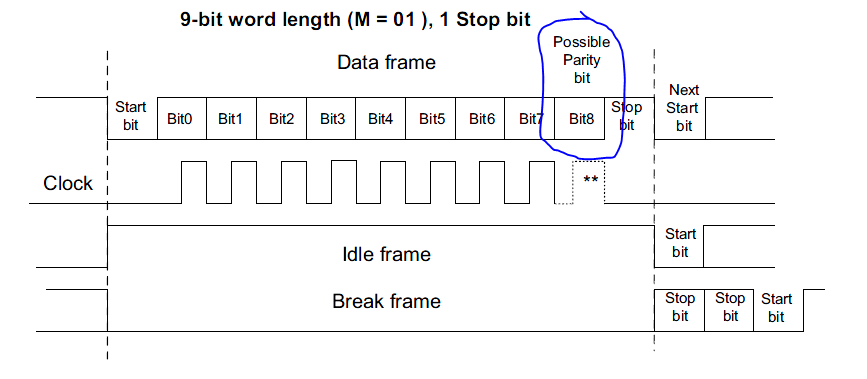
52 | usartConfig.USART_WordLength = USART_WordLength_9b; // 9th bit = parity bit
|
53 | usartConfig.USART_StopBits = USART_StopBits_2;
|
54 | usartConfig.USART_Parity = USART_Parity_Even;
|
55 | usartConfig.USART_Mode = USART_Mode_Rx | USART_Mode_Tx;
|
56 | usartConfig.USART_HardwareFlowControl = USART_HardwareFlowControl_None;
|
57 | USART_Init(USART3, &usartConfig);
|
58 |
|
59 | USART_ClearITPendingBit(USART3, USART_IT_RXNE); // Clear interrupt flag
|
60 | USART_ClearITPendingBit(USART3, USART_IT_TXE);
|
61 |
|
62 | USART_ITConfig(USART3, USART_IT_TXE, DISABLE); // disable Transmit Data Register empty interrupt
|
63 | USART_ITConfig(USART3, USART_IT_RXNE, ENABLE); // Enable the USART RX Interrupt (without enabling it, no interrupt will occur when receiving)
|
64 |
|
65 | NVIC_EnableIRQ(USART3_IRQn); // Enable USART3 global interrupt
|
66 | USART_Cmd(USART3, ENABLE); // UART3 enable
|
67 | }
|
68 |
|
69 |
|
70 |
|
71 |
|
72 | void DMA_UART3_transmit_Configuration()
|
73 | {
|
74 |
|
75 | // DMA1 Channel 2 - UART3 TX
|
76 | DMA_Cmd(DMA1_Channel2, DISABLE);
|
77 |
|
78 | DMA_InitTypeDef DMA_InitStruct;
|
79 | //DMA_StructInit(&DMA_InitStruct);
|
80 | //DMA_InitStruct.DMA_Channel = DMA1_Channel2;
|
81 | DMA_InitStruct.DMA_PeripheralBaseAddr = (uint32_t)&(USART3->TDR);
|
82 | DMA_InitStruct.DMA_MemoryBaseAddr = (uint32_t)&send_buffer[0]; // 32-Bit Basis Adresse im Speicher (Adresse der Speicherzelle, wo das erste Byte vorhanden ist).
|
83 | DMA_InitStruct.DMA_DIR = DMA_DIR_PeripheralDST;
|
84 | DMA_InitStruct.DMA_M2M = DMA_M2M_Disable;
|
85 | DMA_InitStruct.DMA_MemoryDataSize = DMA_MemoryDataSize_Byte;
|
86 | DMA_InitStruct.DMA_MemoryInc = DMA_MemoryInc_Enable;
|
87 | DMA_InitStruct.DMA_Mode = DMA_Mode_Normal;
|
88 | DMA_InitStruct.DMA_PeripheralInc = DMA_PeripheralInc_Disable;
|
89 | DMA_InitStruct.DMA_Priority = DMA_Priority_Low;
|
90 | DMA_InitStruct.DMA_BufferSize = 0;
|
91 | DMA_Init(DMA1_Channel2, &DMA_InitStruct);
|
92 | DMA_ClearFlag(DMA1_FLAG_TE2);
|
93 | DMA_ClearFlag(DMA1_FLAG_TC2);
|
94 | DMA_ClearFlag(DMA1_FLAG_HT2);
|
95 | //DMA_ITConfig(DMA1_Channel2, DMA_IT_TC, ENABLE); // Interrupt will occur when Transmission complete (TC)
|
96 | //NVIC_EnableIRQ(DMA1_Channel2_IRQn); // Enable DMA1 Chan2 global interrupt
|
97 |
|
98 |
|
99 | USART_DMACmd(USART3, USART_DMAReq_Tx, ENABLE); // Enable USARTy DMA TX request
|
100 |
|
101 | DMA_Cmd(DMA1_Channel2, ENABLE);
|
102 | }
|
103 |
|
104 |
|
105 |
|
106 |
|
107 | void send_with_DMA_UART3(uint8_t buffer[], uint8_t size)
|
108 | {
|
109 | // buffer = Array, das gesendet werden soll (ein Element hat 16bit)
|
110 | // size = Anzahl der Elemente, die gesendet werden (Größe des Arrays)
|
111 |
|
112 | DMA_Cmd(DMA1_Channel2, DISABLE);
|
113 | DMA_SetCurrDataCounter(DMA1_Channel2, size); // Anzahl der Bytes die gesendet werden sollen
|
114 | DMA1_Channel2->CMAR = (uint32_t)&(send_buffer[0]); // Pointer zeigt auf Adresse des ersten Bytes, das gesendet werden soll
|
115 | DMA_Cmd(DMA1_Channel2, ENABLE);
|
116 | } // void send_with_DMA
|
117 |
|
118 |
|
119 |
|
120 |
|
121 |
|
122 | int main ()
|
123 | {
|
124 | RCC_Configuration();
|
125 | USART3_Configuration();
|
126 | DMA_UART3_transmit_Configuration();
|
127 |
|
128 | RXcounter = 2;
|
129 |
|
130 | while(1)
|
131 | {
|
132 | send_with_DMA_UART3(send_buffer,8); // 1st parameter: array which should be sent; 2nd parameter: number of the arrays that should be sent
|
133 | } //while(1)
|
134 | } //main
|