STM32F413 externer Oszi ---> HSE Clock Problem

Gast #5566099
Lesenswert?

Hallo zusammen,

ich versuche seit geraumer Zeit den internen 16 MHz RC Oszi durch ein 
externes 8 MHz Quarz zu ersetzen.

Leider kommt das Programm nicht aus der While Schleife und geht in den 
HAL_TIMEOUT.

•
1
    /* Enable the main PLL. */
2
        __HAL_RCC_PLL_ENABLE();
3

4
        /* Get Start Tick*/
5
        tickstart = HAL_GetTick();
6
        
7
        /* Wait till PLL is ready */  
8
        
9
        while(__HAL_RCC_GET_FLAG(RCC_FLAG_PLLRDY) == RESET)
10
        {
11
          if((HAL_GetTick() - tickstart ) > PLL_TIMEOUT_VALUE)
12
          {
13
            return HAL_TIMEOUT;
14
          } 
15
        }

Meine Config sieht so aus.
Der Quarz wurde durchgemessen und ist o.k. Vielleicht habe ich vergessen 
wieder irgendetwas zu aktivieren? Vielleicht hat ja jmd eine Idee ?
Hier meine zugehörige Config. Über etwas Hilfe würde ich mich sehr 
freuen.

•
1
static void SystemClock_Config(void)
2
{
3
  RCC_ClkInitTypeDef RCC_ClkInitStruct;
4
  RCC_OscInitTypeDef RCC_OscInitStruct;
5

6

7
  __PWR_CLK_ENABLE();
8
  
9
  __HAL_PWR_VOLTAGESCALING_CONFIG(PWR_REGULATOR_VOLTAGE_SCALE1);
10
  
11
  RCC_OscInitStruct.OscillatorType = RCC_OSCILLATORTYPE_HSE;
12
  RCC_OscInitStruct.HSEState = RCC_HSE_ON;
13
  RCC_OscInitStruct.PLL.PLLState = RCC_PLL_ON;
14
  RCC_OscInitStruct.PLL.PLLSource = RCC_PLLSOURCE_HSE;
15
  RCC_OscInitStruct.PLL.PLLM = 8;
16
  RCC_OscInitStruct.PLL.PLLN = 200;
17
  RCC_OscInitStruct.PLL.PLLP = RCC_PLLP_DIV2;
18
  RCC_OscInitStruct.PLL.PLLQ = 2;
19
  if(HAL_RCC_OscConfig(&RCC_OscInitStruct) != HAL_OK)
20
  {
21
    Error_Handler();
22
  }
23

24
  RCC_ClkInitStruct.ClockType = (RCC_CLOCKTYPE_SYSCLK | RCC_CLOCKTYPE_HCLK | RCC_CLOCKTYPE_PCLK1 | RCC_CLOCKTYPE_PCLK2);
25
  RCC_ClkInitStruct.SYSCLKSource = RCC_SYSCLKSOURCE_PLLCLK;
26
  RCC_ClkInitStruct.AHBCLKDivider = RCC_SYSCLK_DIV1;
27
  RCC_ClkInitStruct.APB1CLKDivider = RCC_HCLK_DIV4;  
28
  RCC_ClkInitStruct.APB2CLKDivider = RCC_HCLK_DIV2;  
29
  if(HAL_RCC_ClockConfig(&RCC_ClkInitStruct, FLASH_LATENCY_5) != HAL_OK)
30
  {
31
    Error_Handler();
32
  }
33
}
Gast #5566310
Lesenswert?

Du benutzt den HAL-Mist, daher kann ich zu Deinem Problem nichts 
schreiben.
Aber ich empfehle dringend, das Reference Manual mal zumindest zu 
überfliegen - auch wenn das heutzutage nicht mehr en vogue ist.
Da stehen nämlich überaschenderweise nützliche Dinge drin.
Z.B.:
PLLM[5:0] -> Caution:
The software has to set these bits correctly to ensure that the VCO 
input frequency ranges from 1 to 2 MHz. It is recommended to select a 
frequency of 2 MHz to limit PLL jitter.

Pass also besser Deine Teilungsfaktoren entsprechend an.
Gast #5566794
Lesenswert?

Ich habe mir deinen original Quelltext angesehen und in CubeMx 
nachgestellt.

Er weist mich darauf hin, dass PLLQ <= 75MHz sein muss.
Bei dir sind es 200/2 = 100MHz.

RCC_OscInitStruct.PLL.PLLQ = 3;

ergibt 66,666 MHz und würde passen.
#5566816
Lesenswert?

STCubeMX ist eine gute Empfehlung, um wenigstens mal die ganzen Uhren 
richtig einzustellen. Das ist schon recht kompliziert, mit dem 
unübersichtlichen Bild der Referenz-Doku sowieso.

Hier mal meine Konfiguration, ebenfalls 8 MHz HSE und intern 100 MHz 
SysClk, und Peripherie 100 MHz, abgesehen von APB1 Peripherie (50 MHz):
1
//RCC_CR
2
#define SYS_CLK_PLLI2SON  0u  //!< PLLI2S enable
3
#define SYS_CLK_PLLON    1u  //!< main PLL enable
4
#define SYS_CLK_CSSON    1u  //!< clock security system enable
5
#define SYS_CLK_HSEBYP    1u  //!< HSE clock bypass
6
#define SYS_CLK_HSEON     1u  //!< HSE clock enable
7
#define SYS_CLK_HSION     0u  //!< HSI clock enable
8

9
//PLL config
10
#define SYS_CLK_PLLQ    4u  //!< PLL division factor for USB OTG FS, and SDIO clocks (PLLQ)
11
#define SYS_CLK_PLLSRC    1u  //!< PLL source (PLLSRC)
12
#define SYS_CLK_PLLP    0u  //!< PLL multiplication factor for main system clock (PLLP)
13
#define SYS_CLK_PLLN    100u  //!< PLL multiplication factor for VCO (PLLN)
14
#define SYS_CLK_PLLM    4u  //!< division factor for the main PLL (PLLM)
15

16
//PLLI2S config
17
#define SYS_CLK_PLLI2SR    2u  //!< PLLI2S division factor for I2S clocks (PLLI2SR)
18
#define SYS_CLK_PLLI2SN    192u  //!< PLLI2S multiplication factor for VCO (PLLI2SN)
19
#define SYS_CLK_PLLI2SM     16u  //!< PLL prescaler for audio (PLLI2S) clock (PLLI2SM)
20

21
//RCC_CFGR
22
#define SYS_CLK_MCO2PRE     6u  //!< MCO2 prescaler (MCO2PRE)
23
#define SYS_CLK_MCO1PRE     6u  //!< MCO1 prescaler (MCO1PRE)
24
#define SYS_CLK_MCO1     3u  //!< MCO1 source (MCO1)
25
#define SYS_CLK_RTCPRE     8u  //!< RTC prescaler (RTCPRE)
26
#define SYS_CLK_APB2     0u  //!< APB high speed prescaler (APB2)
27
#define SYS_CLK_APB1     4u  //!< APB low speed prescaler (APB1)
28
#define SYS_CLK_HPRE     0u  //!< AHB prescaler (HPRE)
29
#define SYS_CLK_SW     2u  //!< system clock switch (SW)

Sind alles die Registerwerte, den HAL benutze ich nicht.
Gast #5566868
Lesenswert?

pegel schrieb:
> Ich habe mir deinen original Quelltext angesehen und in CubeMx
> nachgestellt.
>
> Er weist mich darauf hin, dass PLLQ <= 75MHz sein muss.
> Bei dir sind es 200/2 = 100MHz.
>
> RCC_OscInitStruct.PLL.PLLQ = 3;
>
> ergibt 66,666 MHz und würde passen.


Ach, und wie passt das mit dem Reference Manual zusammen?

Caution:
The USB OTG FS requires a 48 MHz clock to work correctly. The SDIO and 
the random number generator need a frequency lower than or equal to 48 
MHz to work correctly.

Wie oben schon angemerkt wurde: RM lesen!
Gast #5573267
Lesenswert?

Besten Dank für eure Antworten.

Ich habe die HAL rausgeworfen, kriege das aber dennoch nicht zum laufen.
Vorher habe ich übrigens noch Port H aktiviert, da der Oszilator dort ja 
angeschlossen ist.
AHB1_GPIOH |= 0x00000080U;


•
1
static void SystemClock_Config(void)
2
{
3
  RCC_PLLCFGR |= 0x22403208;
4
  //RCC_PLLCFGR |= 0010 0010 0100 0000 0011 0010 0000 1000; 
5
  //Bit 31     0          Reserved
6
  //Bit 30:28  010        PLLR Division Factor = 2
7
  //Bit 27:24  0010       PLLQ Division Factor = 2
8
  //Bit 23     0          Reserved 
9
  //Bit 22     1          HSE oscillator clock selected as PLL and PLLI2S clock entry
10
  //Bit 21:18  0000       Reserved
11
  //Bit 17:16  00         PLLP Division Factor = 2
12
  //Bit 15     0          Reserved
13
  //Bit 14:6   011001000  PLL PLLN Multiplication Faktor = 200
14
  //Bit 5:0    001000     PLL PLLM Division Factor = 8
15

16
  RCC_CFGR |= 0x36481012;
17
  //RCC_CFGR    |=  0011 0110 0100 1000 0001 0000 0001 0010;   
18
  //Bit 31:30   00      MCO2 System Clock selected
19
  //Bit 29:27   110     MCO2 Prescaler = 4
20
  //Bit 26:24   110     MCO1 Prescaler = 4 
21
  //Bit 23      0       Reserved
22
  //Bit 22:21   10      MCO1 HSE Oszilator Clock selcted
23
  //Bit 20:16   01000   HSE division for RTC Clock = 8
24
  //Bit 15:13   000     APB2 Prescaler = 1
25
  //Bit 12:10   100     APB1 Prescaler = 2
26
  //Bit 9:8     00      Reserved
27
  //Bit 7:4     0001    AHB Prescaler = 1
28
  //Bit 3:2     00      System clock switch status (set an cleared by hardware)
29
  //Bit 1:0     10      PLL selected as system clock   
30

31
  RCC_PLLI2SCFGR |= 0x22003010;
32
  //RCC_PLLI2SCFGR |= 0010 0010 0000 0000 0011 0000 0001 0000;
33
  //Bit 0:5     010000      PLLI2SM Division factor for the main PLL input clock = 16 
34
  //Bit 14:6    011000000  PLLI2SN Multiplication factor = 192
35
  //Bit 21:15   0000000    Reserved
36
  //Bit 22      0          PLLI2S entry clock source HSE or HSI (depending on PLLSRC of PLLCFGR)
37
  //Bit 23      0          Reserved
38
  //Bit 27:24   0010       PLLI2SQ = 2
39
  //Bit 30:28   010        PLLI2SR = 2
40
  //Bit 31      0          Reserved  
41
  
42
  RCC_CR |= 0x05090000; 
43
  //RCC_CR      |= 0000 0101 0000 1001 0000 0000 0000 0000;
44
  //Bit 31:28  0000       Reserved
45
  //Bit 26     01         PLLI2SON = 1 enable
46
  //Bit 25     0          PLLReady (set by hardware)
47
  //Bit 24     1          PLLON Main PLL enable = 1
48
  //Bit 23:20  0000       Reserved
49
  //Bit 19     1          CSSON clock security system = 1 (enable)
50
  //Bit 18     0          HSEBYP HSE clock Bypas = 0 (HSE oscillator not bypassed)
51
  //Bit 17     0          HSERDY HSE clock ready flag. Set by hardware to indicate that the HSE oscillator ist stable
52
  //Bit 16     1          HSEON HSE clock enable = 1 (HSE oscillator on)
53
  //Bit 15:8   00000000   Internal high speed clock calibration
54
  //Bit 7:3    00000      Internal high speed clock trimming
55
  //Bit 2      0          Reserved
56
  //Bit 1      0          HSIRDY set by hardware (0=HSI not ready ; 1=HSI Ready)
57
  //Bit 0      0          HSION Set by hardware in case of failure of HSE oscilator etc....}
Gast #5573273
Lesenswert?

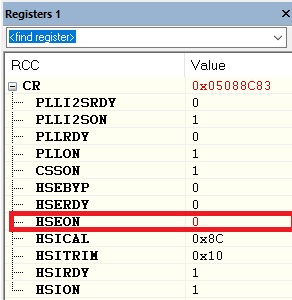
Das HSE Bit wird zwar gesetzt, aber im nächsten Schritt wieder gelöscht. 
Dann fliegt das Programm in den NMI_Handler.

Sofern das Quarz nicht stabil läuft, sollte nicht einfach der HSI 
verwendet werden. Ich verstehe nicht, warum der NMI_Handler aufgerufen 
wird.
Angehängte Dateien:
Gast #5573280
Lesenswert?

Gastino G. schrieb:
> //PLL config
> #define SYS_CLK_PLLQ    4u  //!< PLL division factor for USB OTG FS, and
> SDIO clocks (PLLQ)
> #define SYS_CLK_PLLSRC    1u  //!< PLL source (PLLSRC)
> #define SYS_CLK_PLLP    0u  //!< PLL multiplication factor for main
> system clock (PLLP)
> #define SYS_CLK_PLLN    100u  //!< PLL multiplication factor for VCO
> (PLLN)
> #define SYS_CLK_PLLM    4u  //!< division factor for the main PLL (PLLM)

Mal vom obigen Problem abgesehen, kann das nicht ganz stimmen:

Wenn HSE = 8MHz, dann ist SYSCLK = 8 MHz / PLLM * PLLN / PLLP  =
                          SYCLK  = 8 MHz / 4    * 100  / 1     = 200 MHz

Müssen beim Schreiben in die Register irgendwelche delay-Zeiten o.ä 
eingehalten werden?
#5573728
Lesenswert?

Heint schrieb:
> Ich verstehe nicht, warum der NMI_Handler aufgerufen
> wird.

Wenn du keine Fault-Handler implementiert hast, dann landest du eben im 
Default-Handler und das sieht dann so aus als wärest du im NMI gelandet, 
weil der NMI eben auch durch den Default-Handler ersetzt wird.


Heint schrieb:
> RCC_PLLCFGR |= 0x22403208;

Bitte keine magic numbers und lass mal den kompletten Code sehen

Antwort schreiben

Bitte melde dich an, um einen Beitrag zu schreiben.

oder

Mit Google-Account einloggen

Die Registrierung ist kostenlos und dauert nur eine Minute.

Jetzt registrieren