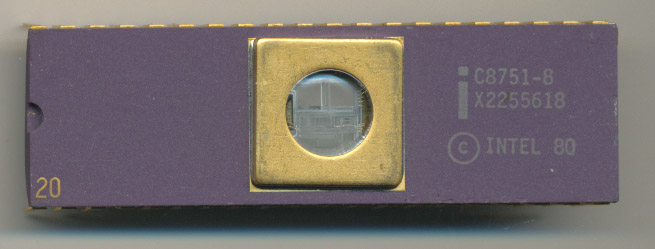
1 | Programming the Intel 8751H and 8751BH/87C51:
|
2 |
|
3 | I have the Intel databooks, and all of them say the same thing about
|
4 | powering and clocking the chip with a typical crystal. Also they want
|
5 | several pins pulled HI or LO, and then it programs just as an EPROM does
|
6 | but the pinout is scattered around a bit differently, is all. I would
|
7 | suppose you can grab the .pdf file from Intel that has all that for the
|
8 | 8751 and others, like the 8748/9 and the 87C52 as well. They all use the
|
9 | same scheme, and it is quite simple. I have several of these laying about,
|
10 | and they have always been easy. I show for the 8751:
|
11 |
|
12 | 1) apply Vcc and Gnd to pins 40, 20
|
13 | 2) xtal (4-6 MHz for programming only) to pins 19, 18 with caps to ground, 30pF
|
14 | 3) address to Port1 pins and high byte to port 2.0-2.3
|
15 | 4) data to port 0
|
16 | 5) other pins per table below:
|
17 |
|
18 | *For the 8751BH and 87C51 :
|
19 | This is the Quick-Pulse Algorithm, pulse is repeated 25 times/byte
|
20 | address and then verified or failed by readback.
|
21 | ALE/-PROG LO is the programming pulse, only 100us long
|
22 | Vpp is 12.75V +/- 0.25V
|
23 |
|
24 | *For the 8751H :
|
25 | The ALE/-PROG LO is the programming pulse, 50ms long,
|
26 | Vpp is 21V +/- 0.25V
|
27 | Verify chip after all programmed.
|
28 |
|
29 | RST -PSEN ALE/-PROG -EA/Vpp P2.7 P2.6 P3.6 P3.7
|
30 | Pin 9 Pin 29 Pin 30 Pin 31 Pin 28 Pin 27 Pin 16 Pin 17
|
31 | ------------------------------------------------------------------------
|
32 | Program 1 0 0* Vpp 1 0 1 1
|
33 | ------------------------------------------------------------------------
|
34 | Verify 1 0 1 1 0 0 1 1
|
35 | ------------------------------------------------------------------------
|
36 | Program 1 0 0* Vpp 1 0 0 1
|
37 | Encryption Tbl using addresses 0-1FHex
|
38 | ------------------------------------------------------------------------
|
39 | Program
|
40 | Lock bits
|
41 | x=1 1 0 0* Vpp 1 1 1 1
|
42 | x=2 1 0 0* Vpp 1 1 0 0
|
43 | ------------------------------------------------------------------------
|
44 | Read 1 0 1 1 0 0 0 0
|
45 | Signature
|
46 | ------------------------------------------------------------------------
|
47 |
|
48 | Pinout:
|
49 |
|
50 | A0 P1.0 -1 40- Vcc
|
51 | A1 P1.1 -2 39- P0.0 D0
|
52 | A2 P1.2 -3 38- P0.1 D1
|
53 | A3 P1.3 -4 37- P0.2 D2
|
54 | A4 P1.4 -5 36- P0.3 D3
|
55 | A5 P1.5 -6 35- P0.4 D4
|
56 | A6 P1.6 -7 34- P0.5 D5
|
57 | A7 P1.7 -8 33- P0.6 D6
|
58 | RST -9 32- P0.7 D7
|
59 | RXD P3.0 -10 31- -EA/Vpp
|
60 | TXD P3.1 -11 30- ALE/-PROG
|
61 | -INT0 P3.2 -12 29- -PSEN
|
62 | -INT1 P3.3 -13 28- P2.7 A15* * not used for programming EPROM
|
63 | T0 P3.4 -14 27- P2.6 A14* onboard, which is just 4K
|
64 | T1 P3.5 -15 26- P2.5 A13*
|
65 | -WR P3.6 -16 25- P2.4 A12*
|
66 | -RD P3.7 -17 24- P2.3 A11
|
67 | XTAL2-18 23- P2.2 A10
|
68 | XTAL1-19 22- P2.1 A9
|
69 | Vss -20 21- P2.0 A8
|
70 |
|
71 | And after an erasure, all but program and verify are optional, of course.
|
72 | You should get the docs and read about the lock bits and the encryption
|
73 | table, if you were producing a product, but for home use, it's not needed.
|
74 | Have fun!
|
75 | -Steve
|
76 | --
|
77 | -Steve Walz rstevew@armory.com ftp://ftp.armory.com:/pub/user/rstevew
|
78 | -Electronics Site!! 1000 Files/50 Dirs!! http://www.armory.com/~rstevew
|
79 | Europe:(Italy) http://ftp.cised.unina.it/pub/electronics/ftp.armory.com
|