design, the innovative dual-accelerometer device ensures high accuracy for activity tracking up to 16g and impact detection up to 320g. . . . The 2.5mm x 3mm LSM6DSV320X integrates three micro-electromechanical systems (MEMS) sensors, comprising the ±16g and ±320g accelerometers and a MEMS gyroscope
ebenfalls besprochen - finden sich unter der URL https://community.nxp.com/t5/i-MX-Processors-Knowledge-Base/SCALABLE-EDGE-COMPUTING-FOR-IOT-DEVICE-MANAGEMENT-amp-REAL-TIME/ta-p/2053228.
size using @ref Sn_RXBUF_SIZE. The total sum of @ref Sn_RXBUF_SIZE can not be exceed 16Kbytes. * When exceeded, the data reception error is occurred. */ #define Sn_RXBUF_SIZE(N) (_W5500_IO_BASE_ + (0x001E << 8) + (WIZCHIP_SREG_BLOCK(N) << 3)) /* @ingroup Socket_register_group * @brief Transmit
Hallo, die 16 Kanal Saleae Nachbauten auf ebay in Zigarettenschachtelgröße machen ihren Job. Bis zu 2 Kanäle sind mit bis zu 100MHz Abtastung möglich. Mit USB 3.0 Anbindung gibt es keine Probleme. Die Daten landen
notwendig. Ich denke der Saleae ist einfacher zu handhaben. https://community.infineon.com/t5/Knowledge-Base-Articles/EZ-USB-FX3-Explorer-kit-as-16-channel-100-MHz-logic-analyzer-with-sigrok/ta-p/283993#.
system include an advanced-control timer, a general-purpose timer, two watchdog timers and system time base timer. Advanced-control timer The advanced-control timer is a 16-bit auto-loading up/down counter with a 16-bit programmable prescaler. In addition to the complete general-purpose timer function,
versions of its publications. For example, edition numbers 1.0, 1.1 and 1.2 refer, respectively, to the base publication, the base publication incorporating amendment 1 and the base publication incorporating amendments 1 and 2. Further information on IEC publications The technical content of IEC publications
X1.5 brücken. An X1.4 muß jetzt eine Spannung messbar sein, die sich aus dem Teilerverhältnis R13/R16 ergibt, als R16/(R13+R16)*Uref. Weicht die Spannung stark ab, mal C6 auslöten. Man könnte C6 auch gleich auslöten und so prüfen ob dieser die Ursache ist.
Ja, die V16 habe ich da reingequetscht, weil ich den Platz oben nicht "ankratzen" wollte. Aber Dir zuliebe mach ich das noch.
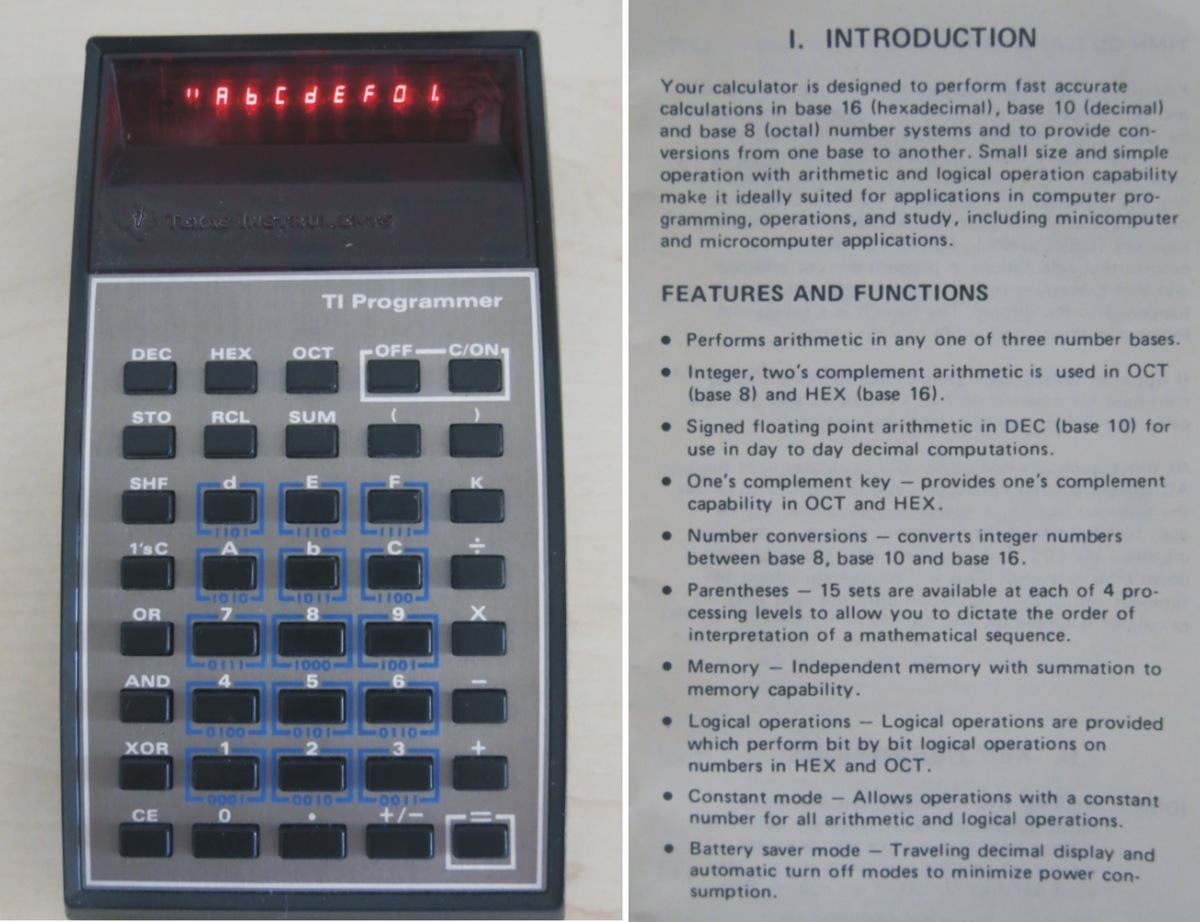
0011 CE 0 +/- I. INTRODUCTION Your calculator is designed to perform fast accurate calculations in base 16 (hexadecimal), base 10 (decimal) and base 8 (octal) number systems and to provide conversions from one base to another. FEATURES AND FUNCTIONS
instructions, the whole 1K address space is directly accessed. Most AVR instructions have a single 16-bit word format. Every program memory address contains a 16- or 32-bit instruction. During interrupts and subroutine calls, the return address Program Counter (PC) is stored on the Stack. The Stack is
Unter 16qmm gibt es KEINE Ausnahme der VDE 0100-540, Punkt. Nein, ich habe es nicht angeschlossen. Solange man nur den Stecker reinsteckt weiss man nichts von dem Mangel. Aber weiss man es erstmal sollte man
Base64 U. schrieb im Beitrag #7874293: > für fest angeschlossene > ortsunveränderliche Geräte keinen FI (in DE anscheinend schon). Nein, auch in Dschland brauchen fest angeschlossene, ortsunveränderliche
volatile unsigned int WKUPEPR; /* PWR wakeup enable and polarity register */ }; #define PWR_BASE 0x58024800 #define PWR ((struct stm32_pwr *) PWR_BASE) [/c] Zugreifen auf die einzelnen Register kannst du dann so: [c] PWR->CR1 = 0x1234ABCD
die Ausgabe vom RA8875 nicht stimmt. Die sind laut Datenblatt nur 8-Bit breit. ChatGPT behauptet 8/16Bit.
in <module> > raise f"Expected 'id', got {x[3][0]}" > TypeError: exceptions must derive from BaseException > [/code] Huch. Gut, wichtig ist ja erstmal, dass komplett neben der Spur liegende Dateien nicht versucht werden zu bearbeiten. [pre]raise Exception("f"Expected 'id', got {x[3][0]}")
durchaus interessieren. > Die eigentlichen Symbole gehen dann ab Index 4 los. Daher ja die Zeile 16 bei mir im Script, die genau ab da bearbeitet. Man könnte natürlich auch noch eine Ergänzung bei "generator" hinzufügen. ;-) Aber stellt sich die Frage, ob das überhaupt irgendwo abfragbar ist.
402: e2 e0 ldi r30, 0x02 ; 2 404: 0c 94 68 0d jmp 0x1ad0 ; 0x1ad0 <.Loc.16> [/avrasm] In `.Loc.16` ist eine sub-routine die den SREG rettet, interrupts stoppt, stack pointer runter schiebt, und dann den SREG wieder zurueck holt (gcc-15.1): [avrasm] 00001ad0 <.Loc.16>:
Die diesjährige GCC Release v16 ist raus: https://gcc.gnu.org/pipermail/gcc/2026-April/248065.html https://gcc.gnu.org/gcc-16/changes.html Im Gegensatz zur v15, wo es einige Verbesserungen und Erweiterungen für AVR gab, hat die
Die Version von ComputerBase scheint's zu tun, auch wenn sie behauptet, meine GeForce GraKa könnte keine 3D-Beschleunigung... Die von verschiedenen Stellen angebotenen Versionen unterscheiden sich in der Größe gerne mal um
nur aufpassen, daß das Blech nicht zu viele Kerne/Sockel hat, das derzeitige Limit liegt afaik bei 16. Für mehr will MS zusätzlichen Geldeinwurf. Aber wer mit Windows Server arbeitet, hat davon ja genug ... Allerdings hat Hyper-V auch einen fetten Nachteil, sowohl auf dem Server als auch auf dem Desktop
Hardware aktivieren können, bis es vom RP2040 explizit deaktiviert wird. Vielleicht wäre ja ein FM16W08 praktischer, der wäre sofort startklar. Zum Beschreiben wird dann natürlich Reset aktiviert, so daß der Bus frei ist. Die Puffer könnten entfallen. Also ein FM16W08 statt der drei Puffer-Chips. (Hat aber nur 16 Kbit nicht 32 KByte. Für einen 2716 reicht's. Dann eben ein FM18W08-SG für 32 KByte...)
port %x\n",val); //Serial.print("write port ");Serial.println(val); } void write6502(uint16_t address, uint8_t value) { if (address < RAM_SIZE) RAM[address] = value; if (address == 0xF001) { //EhBASIC simulated ASIC output serout(value); } if (address == 0xF002) { // microcontroller
Steampunk Archäologie - Blindflug mit Epson HX-20 Das Thema hat mich animiert, fib.bas von Yalu auf einem 44 Jahre alten Epson HX-20 laufen lassen. Der HX-20 hat einen Hitachi 6301 mit 614kHz. Darauf läuft ein "Microsoft & Epson" Basic von 1982. fib.bas lief abgesehen von RIGHT$ und
Mounting accessories Mounting Code Bolt / pin Compressor Parts Type of packaging number dimension base hole list Bolt joint 118-1917 M6 metric 16 mm I Single pack for one compressor Bolt joint 118-1918 M6 metric 16 mm I Industrial pack in any quantity Snap-on 118-1947 Ø 7.3 mm 16 mm II Single pack for
eine Multiplikation bzw. Division und die dürften hier recht häufig genutzt werden. - "RV32E" Base integer instruction set (embedded), 32-bit, 16 registers - "C" Standard extension for compressed instructions - "M" = Standard extension for integer multiplication and division - https://en.wikipedia.org
n\r"); benchmark_int8(array8); printf("int_8 done: %d\n\r", array8[0]); printf("\n\rint_16 Benchmark\n\r"); benchmark_int16(array16); printf("int_16 done: %k\n\r", array16[0]);[/c] Gibt es da mehrere Versionen? Und wenn ja, auf welche beziehen sich die Werte? Dann noch: Bei Optimierung
Ausgabe ins Logfile ohne Esc-Sequenzen bool ScrOn; // true : Ausgabe am Bildschirm int16_t WarteSec; // >-1: Wartezeit in sec für ErrChkPrint() und ErrPrint() // // -1: Wartezeit unendlich } tErr; // ----------------------------------------------------------
for(size_t i=0; i<count; i++){ size_t len = v[i].iov_len; memcpy(it, v[i].iov_base, len); it += len; } } *p_total_size = total_size; return mem; } [/c] Wer sieht ihn? ## Auflösung memcpy mit src=0 ist ub, selbst wenn len=0. struct iovec hingegen hat
Compare Match per Compare Channel • Two 8-Bit Timer/Counters in Split Mode 20.2 Overview The flexible 16-bit PWM Timer/Counter type A (TCA) provides accurate program execution timing, frequency and waveform generation, and command execution. A TCA consists of a base counter and a set of compare channels
>> The ESP32-P4 is powered by a dual-core RISC-V CPU featuring AI >> instruction extension 16 8Bit Multiplikationen oder 8 16Bit Multiplikationen. https://developer.espressif.com/blog/2024/12/pie-introduction/ Ich denke, prinzipiell ist der Speicherdurchsatz bei den kleinen Systemen ein Problem. Die NPU des STM32N6 kann mit je 16GB/s lesend und schreibend (parallel) auf die internen RAMs zugreifen. Das ist ein stolzer Wert für einen Mikrocontroller. Diesen Aufwand wollen die meisten halt nicht treiben.
Base64 U. schrieb im Beitrag #7859358: > Ich kenn jetzt die Vorschriften für Geräte (Elektrische Sicherheit?) > nicht, aber in AT und DE müssen die Leitungsschutzschalter z.B. > mindestens 6kA können
wollte. Das macht aber niemand so aufwendig. Der Grund ist der, dass in dem Falle auch noch die 16A Haussicherung auslösen wird und die kann 6kA Kurzschlussstrom trennen. Jedoch hat Sicherung bereits mit Halterung so viele mOhm, dass nur noch geringfügig über 3kA als maximaler Strom erreicht werden
shows a composite video When signals are displayed in the envelope signal with burst. The two time bases of the mode, the influence of jitter effects, amplitude HM1507-3 are operating in the mixed mode. changes and aberrations can be demonstrated Since the burst is asynchronous to other com- significantly
. Dazu noch ein bisschen Code: [c]int main (void) { ... /* USER CODE BEGIN 2 */ HAL_TIM_Base_Start (&htim2); HAL_TIM_IC_Start_IT (&htim2, TIM_CHANNEL_1); // main channel HAL_TIM_IC_Start (&htim2, TIM_CHANNEL_2); // indirect channel __enable_irq (); /* USER CODE END 2 *
ein Pico nur Mikrosekunden könne. (11:07) > Dafür reicht auch ein Arduino Nano Every mit seinen 16MHz -> 62,5ns. 15€ (also dreimal so teuer, dafür aber auch zwölfmal so ungenau) > TCB > hat den passenden Timermode dabei und liefert das Ergebnis auf dem > Silbertablett. Funktioniert natürlich
>IC56 128Mb x 6 METRO Wave ROM BENDER MAIN BOARD METRONOME JACK BOARD LEVEL UNIT Keyboard FDD SRX BASE BOARD PHOTO IN OUT TP/8SP (with aftertouch) MIDI FLASH ROM THRU X1 IC1 4Mb +5V 16.000MHz ADC POWER SUPPLY BOARD +12V 16bit IC16 AK5351VF FOOT -12V CPU IC1 IC2 LM7812 LM7912 H8 IC4 DAC HD6433060F 8bit
C 33 2,2nF/63V MKT B32529-C222-K EPCOS C 34 insert wire bridge C 35 insert wire bridge C 36 1000µF/16V B41822-A4108-M EPCOS C 37 1000µF/16V B41822-A4108-M EPCOS C 38 470µF/16V B41822-A4477-M EPCOS C 39 3,3nF 250V AC, Y1 B81123-C1332-M EPCOS C 41 * 220pF/50V CG B37979-G5221-J51 EPCOS C 40 not assembled
Noob A. schrieb im Beitrag #7858327: > sondern ein hexa-SPI. > > Also ein Bus mit 16 Datenleitungen ... "Hexa" steht übrigens für sechs, nicht für 16. Das "Dezimal" in "Hexadezimal" kommt nicht von ungefähr. Du solltes keine Fantasiebegriffe erfinden. Was für ein Gerät/Bauteil
microcontrollers-microprocessors/stm32n6-series.html und ja, hexadeca-SPI oder wäre richtiger 16xSPI ist aber recht eindeutig, gell?
PHONES BOARD IC11 32bit r 16bit 8bit 16bit 16bit 8bit P2027A IC6CPU f MAIN OUTPUT 64MHz Bus u VOLUME SH-3 7709S b 16bit 8bit 16bit 16bit X1 200MHz 16.000MHz aftertouch USB DIRECT buffer X5 3.3V<--->5V X2 12.000MHz USBC KeyScan 16.9344MHz
32bit to allow the 32bit instructions to work properly. When storing the result back, only the lower 8/16 bit are used. If 8/16bit overflow behavior is required (i.e. overflow at -128/127 for 8bit signed, 0/256 for 8bit unsigned, -32768/32767 for 16bit signed, 0/65536 for 16bit unsigned) for calculations
of both, respectively. To simulate 8/16bit overflow behaviour after a mathematical operation, use uxtb/uxth for unsigned 8/16 bit numbers, or sxtb/sxth for signed 8/16 bit numbers: The “uxth”/”uxtb” instructions copy the lower 16/8 bits of
applications from 350 nm to 970 nm - Adapted to human eye sensitivity (V ) λ - SMT package without base connection, suitable for IR reflow soldering - Only available on tape and reel - Smart-DIL package - Spectral range of sensitivity: (typ) 350 ... 970 nm 2 | Version 1.6 | 2024-12-06 SFH 3410 DATASHEET
BODY SIZE (NOM) • Personal Electronics TVSOP (20) 5.00 mm × 4.40 mm • Industrial Automation SOIC (16) 10.30 mm × 7.50 mm • Products with GPIO-Limited Processors PDIP (16) 19.30 mm × 6.35 mm PCF8574 TSSOP (20) 6.50 mm × 4.40 mm QFN (16) 3.00 mm × 3.00 mm VQFN (20) 4.50 mm × 3.50 mm (1) For all available
user manual LSB 0 0 0 0 0 0 0 0 A X X X X X X X B A (general call address) second byte mbc623 Fig 16. General call address format There are two cases to consider: • When the least significant bit B is a ‘zero’. • When the least significant bit B is a ‘one’. When bit B is a ‘zero’, the second byte has
the factory or the l.sted sales office (1) (2, 3) PART NO. [X] X /XX XXX Examples: a) 24LC256T-I/SN16KVAO: Tape and Reel, Device Tape and Reel Temperature Package Variant Automotive Grade 3, 2.5V, SOIC Package. Option Range b) 24LC256T-I/ST16KVAO: Tape and Reel, Automotive Grade 3, 2.5V, TSSOP Device
output stage by creating a pole that eliminates high frequency oscillations. f = 1/(2πR C ) c SN SN 16. L (1) Provides high impedance at high frequencies so that R may decouple a highly capacitive load and reduce the Q of the (1) series resonant circuit due to capacitive load. Also provides a low impedance
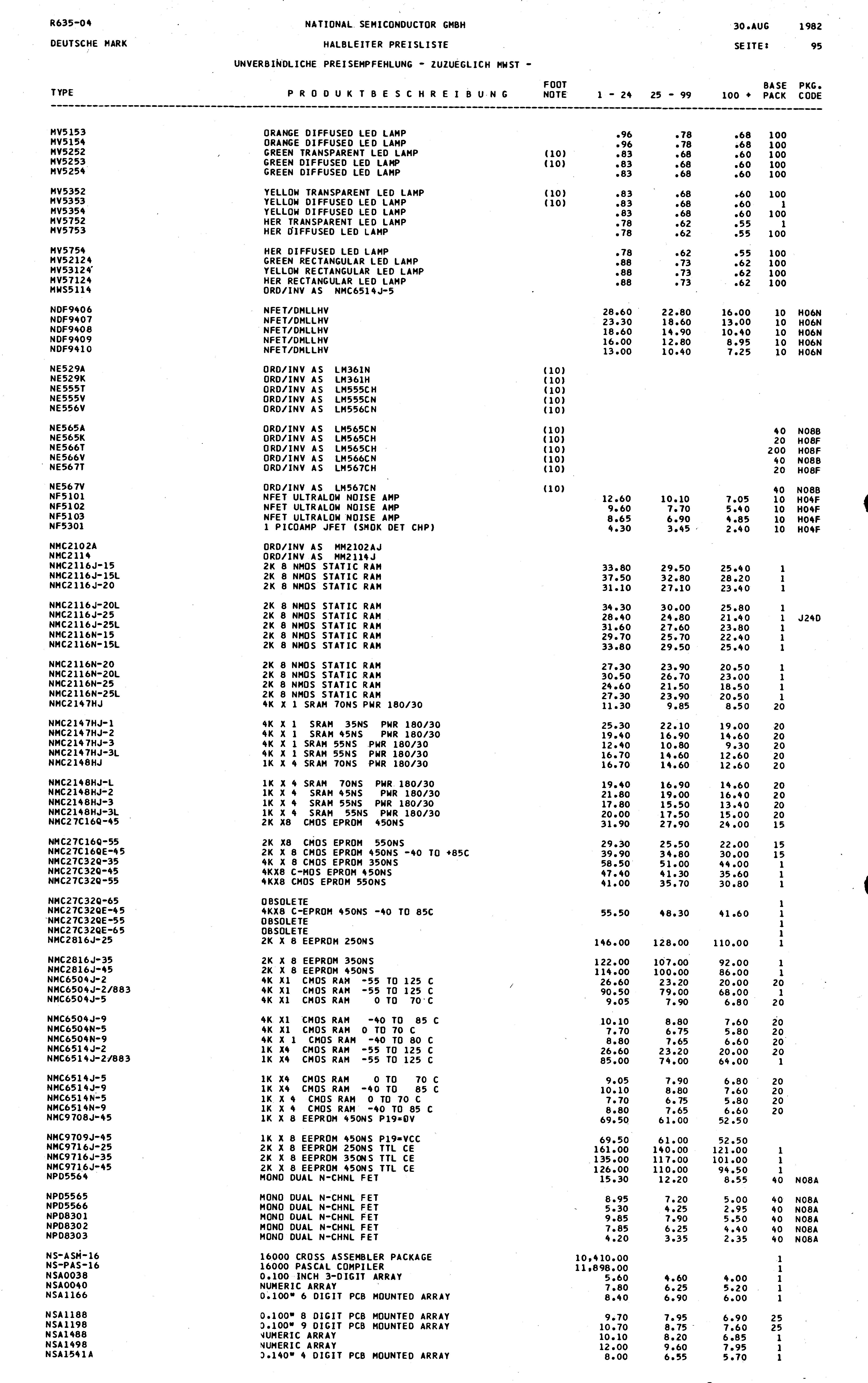
DEUTSCHE SEMICONDUCTOR GMBH SEITE| 95
TYPE FOOT NOTE BASE PKG
NV5153 ORANGE DIFFUSED LED LAMP .96 .78 100
NV5154 ORANGE DIFFUSED LED LAMP .96 .78 100
NV5255 GREEN DIFFUSED LED LAMP .83 .68 100
NV5256 GREEN DIFFUSED LED LAMP .83 .68 100
NV5754 YELLOW TRANSPARENT
VN5E016AH-E 16 mΩ high-side driver with analog current sense for automotive applications Features Max supply voltage V CC 41V Operating voltage range V 4.5 to 28V CC Max on-state resistance (per ch.)R ON 16 mΩ – Reverse

 Bild
Bild
 Bild
Bild