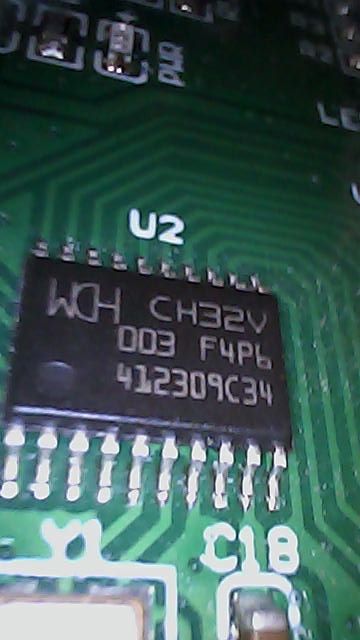
10x besser wie rumspielen mit der Aufhaengung. Eigentlich ein lustiges kleines Projekt fuer einen CH32V003... Vanye p.s: Mal schauen, hab aber noch ein anders Projekt in der Roehre...
störungsfreier Betrieb ist untypisch für den C3 als root cause - das IC bzw. dessen Prozess ist für VCC bis 18V einsetzbar, die 5V beziehen sich dann eher auf die max. mögliche Spannung an dem Pin, also 18V+5V= 23V; hier ist Vin aber 12V, also einige V mehr Reserve
k L k R be using in an amplifier with a loudspeaker 2 2 output, and at an anode voltage of only 27 V. 32Ω 32Ω We will also describe several miniature Russ- ian‘battery’valves, whichnot onlyworkwith 0.5mA 0.5mA lowanode voltages, but which also dissipate ECC81 L much less heater power. +0.5V +0.5V (030063
Mit dem Programmer konnte ich den Flash ohne zusätzliche 24V mit Jlink Flash über N32G455RE auslesen
Hi, Does anyone have the firmware for the Monster X BMS board CFYBMS48V-150A ver 1.4 with the CKS32F103C8T6 MPU (STM32F103FC8T6 clone). Does anyone have spare BMS board(s) they would like to sell? Just for reference here are the pinouts from the CFYBMS48V-150A board
V V BK32 EV E V EV V - EX 1 E X 1 V X X X 2 PEG_TX4 BL32 PEX_RX4 X X X _ G 6 R 6 R X S S S 2 PEG_TX#4 PEX_RX4 6 6 6 6 R _ G _ G 6S _ _ _ c _ _ _ S 2 R 2 R _ 6 6 6 2 PEG_RX5 C361 0.22u_10V_X5R_04 PEX_RX5
suchst, findest Du (Initialisierung SIO-Channel 2): [c] ld (0406bh),hl ld (04069h),hl ld hl,l003ch ld b,00bh ld c,003h otir [/c] und ein bischen weiter die initialisierung des 1.Kanals: [c] ld hl,l002fh ld b,00dh ld c,001h otir [/c] Mit dem Manual des SIO kannst Du dann
einem 10EUR-USB-LA einfach messen, was kommt. Ich wuerde sogar soweit gehen, dass ich bei Label l003ch (oder l002fh) mal gucken wuerde wie die SIO initialisiert wird. Dann waere z.B. klar, ob Handshake notwendig oder nicht. Das (wirklich schoene) SIO-Manual von Zilog (http://www.hartetechnologies.com
• V PP– First entry mode 1101 0100 0011 0100 1000 0101 0000' (more • V DD – First entry mode easily remembered as MCHP in ASCII). The device will enter Program/Verify mode only if the sequence is 4.1.1 V
sub-audio receiving and decoding (the input signal amplitude of MICIN needs to be controlled below 200mV), and also used as VCO. set as Down: WRITE(0x13,0x03FF); WRITE(0x35,0xF108); WRITE(0x3C,REG_3CH & 0xFFC0); WRITE(0x3D,0x0000); 36 | 75 FD6818 REV.1.0.0 Machine Translated by Google DISC baseband processing
(3Ch) The Fast Read Dual Output with 4-Byte Address instruction is similar to the Fast Read Dual Output instruction except that it requires 32-bit address instead of 24-bit address. No matter the device is
Jack V. schrieb im Beitrag #7483998: > Naja gut – da macht ’n durchschnittliches Telephon mindestens > gleichwertige, wenn nicht bessere Bilder ;) Das kostet aber mehr als 8 EUR und deutlich ungeegneiter
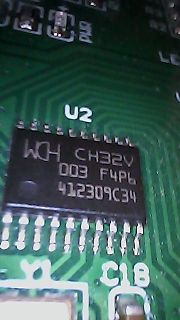
> 1692699557223.jpg [CH32V003] Oh, ein RISC-V in freier Wildbahn.
textures Bit-Blt Unit for transfers up to 4096x4096 areas Alpha Bit-Blt and ROP2 functions External 32-bit SDRAM interface for up to 64MB graphic memory Parallel host interface (FR,SH3,SH4,V850,SparcLite etc) Internal and external DMA support I2C Master interface Supply voltage 3.3V (I/O), 1.8V (Internal
integrierten Hardware-USB? Gibt ja genug. Von WCH gibt es sogar welche, die USB-PD unterstützen, den CH543 mit MCS-51-Kern https://www.wch-ic.com/products/CH543.html und den CH32X035 mit RISC-V-Kern https://www.wch-ic.com/products/CH32X035.html
www.mikrocontroller.net/topic/548353#new Die genannten 10 Cent sind beinahe korrekt, ein Gurtabschnitt mit 50 CH32V003J4M6 (im SO-8-Gehäuse) ist für etwa 5.70 EUR (allerdings zzgl. Versand) zu bekommen.
vorgestellt in https://www.mikrocontroller.net/topic/548353 https://www.mikrocontroller.net/topic/ch32v003-ressourcen-und-beschnupperung-der-hal und hat wirklich eine interessante modernere 32-Bit Hardware mit viel Performance zu bieten, so daß nicht nur der Preis sehr attraktiv ist. Unter Debian
} Delay_Ms(250); count++; } } [/code] Mit der aktuellen Bibliothek (#include "ch32v003_GPIO_branchless.h") sieht das erweiterte aktuelle Beispiel so aus: https://github.com/cnlohr/ch32v003fun/blob/master/examples/GPIO/GPIO.c Die Entwicklung ist noch stark im Fluß, ebenso wie
user-supplied external filtXrYcaZacitors (C , C , C ). 5Bandwidth with external capacitors = 1/(2 × π × 32 kΩX×YC). For C , C = 0.003 μF, bandwiZth = 1.6 kHz. For C = 0.01 μFX bYndZidth = 500 Hz. For C , C , C = 10 μF, bandwidth = 0.5 Hz. 6Self-test response changes cubicallS with V . 7Turn-on time is dependent
ein Widerstand ändert. Aber mit den 42 Volt komme ich nicht klar, weiß nicht wo man da mit dem ESP32 dazwischen kann. Für LOW am EN: Das mit den 571 mV ist gelöst. Ich muss mit dem ESP32 natürlich an T1 gehen, mit Pull-down und Dioden. Das sind nun schon wieder 10 Bauteile. Und der Ruhestrom von
Stromkreis. Am ESP32 konnte ich sogar 5 V messen, nur GPIO + GND, der hatte nicht mal VIN verbunden war also aus. Von den 42 V trennte ihn nur R2. Der GPIO war mit seiner Diode direkt an der Basis von T2, keine Ahnung wie
über den USB vom STM diesen an den PC anschließen. Im Geräte-Manager meldet sich der STM als „Mapple 003“ an [Bild 1] und nach kurzen automatischen Updates der Treiber wird dieser unter „libusb-win32 device“ als „Maple DFU“ angezeigt [Bild 2]. So weit so gut…. Leider fehlt hier jedoch die Zuweisung eines
Auch im 32-bit-Win10 ist die Lage jetzt stabil. Nach Ausführen von install_drivers.bat verschwand die Meldung "Maple 003" bei "andere Geräte" und es tauchte zunächst wie beim TO "Seine Majestät (erfindix)" in Bild
Dort kann man 10 Stück für ca. 23€ inkl. Versand erstehen. (Ich hatte dort vor einiger Zeit ein CH32V003/203-LinkE Kit gekauft. Die Ware kam ordentlich verpackt direkt vom Hersteller.)
LCSC hat sowohl die CH559T und CH559L: https://www.lcsc.com/search?q=ch559
low-cost-microcontrollers-mcus-based-on-arm-cortex-m0-plus-core:LPC80X Dann natürlch der sehr interessante RISC-V CH32V003 von WCH aus China: http://www.wch-ic.com/products/CH32V003.html Dann hätten wir den Puya PY32F002 als low cost CM0 mit <$0.10 https://www.puyasemi.com/cpzx3/info_271_aid_247_kid_246.html
auch mit 32 KB Flash und 8 KB RAM - allerdings dann im LQFP-32 Gehäuse: https://www.reichelt.de/arm-cortex-m0-mikrocontroller-32-bit-3v-32-kb-lqfp-32-stm32-f030k6t6-p351967.html Beide sind auch auf Lager - im
### Experiment GigaDevice. Nach Versuchen mit Achtbittern wollen wir nun auf den GigaDevice GD32VF103 setzen: Ein sehr leistungsfähiger RISCV-Kern, der (Unverdienterweise) noch nicht uneingeschränkt Reichweite hat. Abbildung fünf zeigt, wie Bard auf die Anfrage zur Erzeugung von Code reagiert.
unwissenschaftlichen) Versuch, „Code“ für den beispielsweise unter https://www.mikrocontroller.net/topic/ch32v003-ressourcen-und-beschnupperung-der-hal im Detail besprochene CH32 zu generieren. 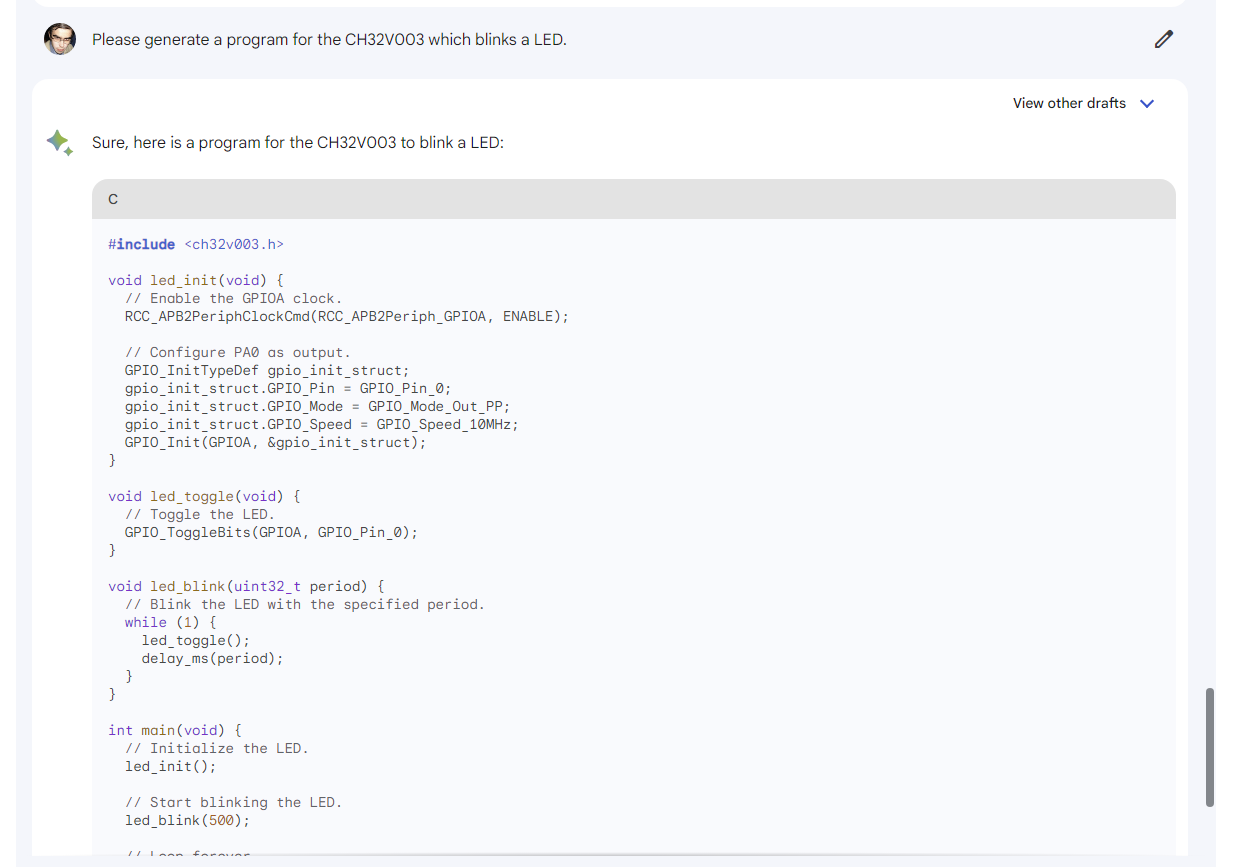 Bildquelle: Autor. ### Und jetzt mit Prozessrechnern. Nach den Experimenten
O a –1.0 G–0.5 –1.2 –0.6 –1.4 –0.7 –1.6 –40 –15 10 35 60 85 –40 –15 10 35 60 85 Temperature ( C) C003 Temperature ( C) C002 Figure 4. Coulomb Counter Gain Error Figure 5. Coulomb Counter Offset (from –0.2 V to 0.2 V) 0.01 0.01 ) r o 0.00 E n t–0.01 e e D–0.01 V O –0.02 –0.02 –40 –15 10 35 60 85 Temperature
aber auch noch STM32F7xx und STM32H7xx im Ärmel ;-)
natuerlich schon vor 25Jahren das an Peripherie hatte was man heute fuer normal haelt. > Aber RISC-V gibt es nun wirklich von jeder Bruchbude billiger. Jau, billiger geht immer. Hatte letztens hier einen CH32V003 (der in SOT8 ohne Resetleitung) der hat nur funktioniert wenn man das Programm ueber
The module is designed tor an operating volt quency. On the other hand. it is advisable tor age of 12V.but willoperatebetween approx.9 the connections from the transmit-receive V and 30 V.when uSing 20 to 30 V. the rest contact. at least, tobe fed via a feedthrough starsprovided in front 01thebaseconnecnons
supply voltage and operating free-air temperature (unless otherwise noted) PARAMETER TEST CONDITIONS V CC MIN TYP MAX UNIT 0.7 × VCC(start) See Figure 12 dV CC/dt ≤ 3 V/s V(B_IT--) V V(B_IT–) See Figure 12 through Figure 14 dV CC/dt ≤ 3 V/s 1.35 V Vhys(B_IT–) See Figure 12 dV CC/dt ≤ 3 V/s 140 mV d(BOR
operating eha racteristics DV 2805 DV 2810 DV 2880 c Absolute limit values at25 C Gate-source voltage 40V 40V 40V Drain-source Voltage 80V 80V 80V Drain-gate VOltage 80V 80V 80V Drain current 05A lA 8A Dissipanon power at 25 cC case lem p tOW 160W 20W Operating values at Uos = 28 V. f= 175 MHz Output powr
negative base drive but that current cannot be negative. capacitors with the same importance that of 0.1 V to 4.9 V would drop the emitter to Fig 2.32 presents the waveforms. The it is to transistors. A capacitor accumulates 4.3 V, which drops the output to -0.1 V. The negative going excursion is clipped
Flash memory 5V f(XIN)=16MHz 35.0 50.0 mA pins are VSS version Square wave, no division EPROM, One-time PROM, f(XCIN)=32kHz 90.0 µA mask ROM versions Square wave Flash memory 5V f(XCIN)=32kHz µA Icc Power supply current
weniger als) 20€ auf eBay und das Objektiv ist perfekt. Anodenspannung wird mit einem isolierten 24V DCDC erzeugt, wobei der positive Ausgang auf GND liegt, man hat also -24V. Die Segmente und Gates werden über BSS84 direkt von einem STM32 mit 3,3V angesteuert. Insgesamt also sowas 27,3V. Filament
Billiges Security-Alarm-System. Basierend auf CH32V003. Ein ESP8266 wird mit Tasmota-Firmware für die Kommunikation verwendet. Eine zusätzliche Funktion ist das Steuerungssignal auf eine IPCam oder WebCam, die eine DI-Schnittstelle hat. Ein Python-Plugin
Specification - Volume 2 Primary Communication - Issue 4.3.3. 2020 . OMS- Group [PP-0073] BSI-CC-PP-0073-2014, v1.3.1 Protection Profile for the Gateway of a Smart Metering System (Smart Meter Gateway PP. 2021 . Bundesamt für Sicherheit in der Informationstechnik [PP-0077] BSI-CC-PP-0077-2014, v1.3 Protection Profile
The module is designed tor an operating volt quency. On the other hand. it is advisable tor age of 12V.but willoperatebetween approx.9 the connections from the transmit-receive V and 30 V.when uSing 20 to 30 V. the rest contact. at least, tobe fed via a feedthrough starsprovided in front 01thebaseconnecnons
Auf einem ESP32 läuts ein wenig schneller: RiscV on Arduino time for 1000 steps [us]:472
olaf schrieb im Beitrag #7320101: > Gut vergleichen kann man das Teil > vermutlich mit einem STM32F030F4P6TR. Allerdings ist der CH32V003 offenbar als pinkompatibler Ersatz für den STM8S003 gedacht.
allgemeinen - „aufeinanderfolgend“ zu lesen sind. Beim Aufrufen der URLs https://github.com/openwch/ch32v003/blob/main/CH32V003DS0-EN.pdf und https://github.com/openwch/ch32v003/blob/main/CH32V003RM-EN.pdf gilt dabei, dass GitHub das Laden der Rich Text-Preview gerne verweigert - klicken Sie auf in der
Peripheriegeräte mitbringt. 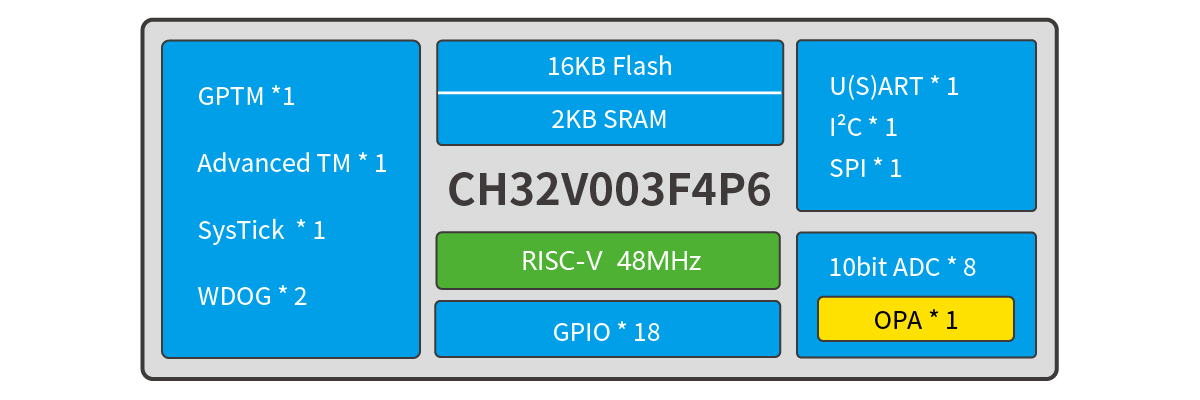 Bildquelle: http://www.wch-ic.com/products/CH32V003.html Ein interessantes Beispiel, das unter der URL https://github.com/openwch/ch32v003/blob/main/EVT/EXAM/ADC/Auto_Injection/User/main.c bereitsteht, demonstriert die Inbetriebnahme der ADC-Engine
CH32V003F4P6 devboard, den WCH-Link und 5 nackte uCs. Für ~17€ gibt es 50x CH32V003F4U6 als QFN20 für ein paar Mark weniger das ganze als SOP8. (Alles inkl. Versand und MwSt)
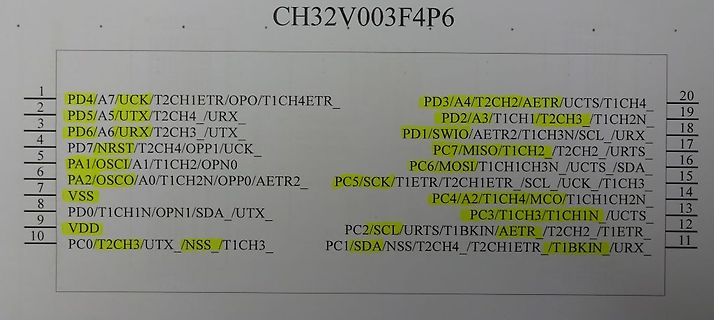
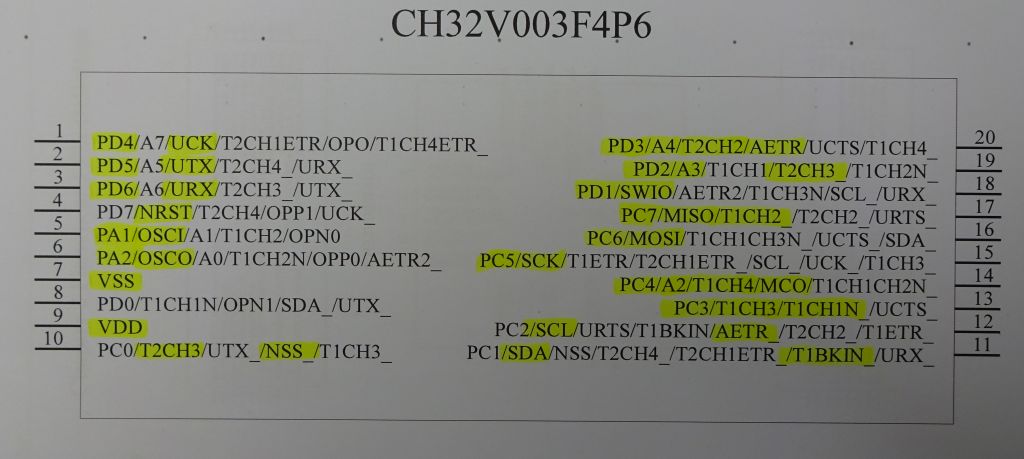
Ist schon jemandem aufgefallen, dass der CH32V003F4P6 nicht nur zufällig so ähnlich heisst wie der STM8S003F3P6? Das Pinout ist nahezu perfekt gleich, siehe Anhang. (Pinout des CH32V003F4P6 - gelb markiert sind die STM8S-Anschlüsse) Der CH32V003F4P6
Thread is schon älter, aber für alle, die sich hier her verirren: Selbst gebauter LED-Timer mit CH32V003J4M6. https://github.com/Linoprit/LED-Light-Chain-Timer/tree/main Have fun.
uint8 The unique identifier of the recently created time control entry. Remove Time Control Entry (0x003B) Name Require Format Additional Information ment Entry ID M uint8 The id of the entry to be removed. Nonce n K M uint8[32] The nonce received from the challenge. Security-PIN M uint16 The security pin. Request Time Control Entries (0x003C) Name Require Format Additional Information ment Nonce n K M uint8[32] The nonce received from the challenge. Nuki Home Solutions GmbH Münzgrabenstraße 92/4 • 8010 Graz • Austria • • F +43 316 22 84

 Bild
Bild
 Bild
Bild